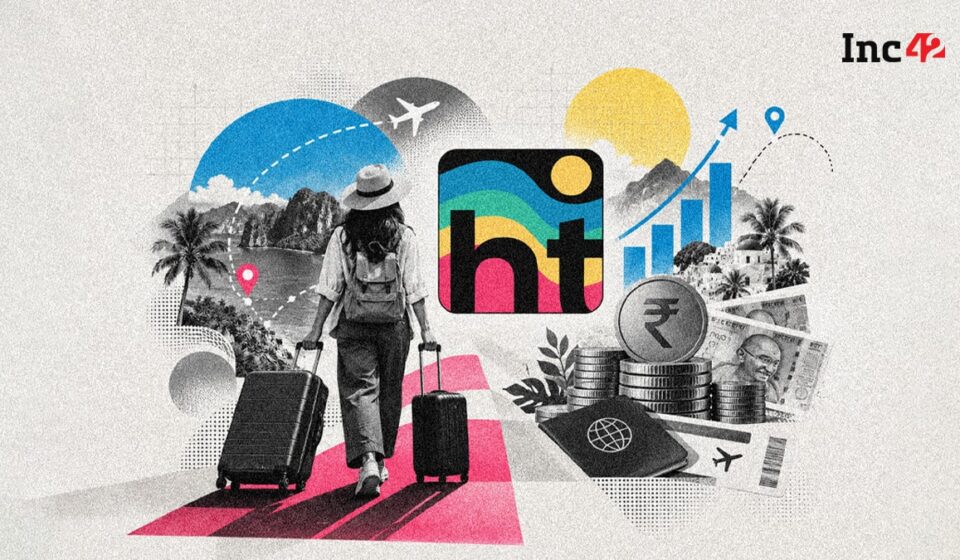
From Itineraries to Intelligence: Architecting the Custom Travel Stack

The Automation Paradox: When AI Meets the Human Touch in Travel Tech
We often obsess over the speed of AI deployment, but we rarely discuss the friction of integrating it into high-stakes service environments where human judgment remains irreplaceable. The travel industry is proving to be a fascinating laboratory for this tension.
The Signal
Traveltech startup Holiday Tribe is reportedly in discussions to raise approximately ₹50 Cr in a fresh funding round, with RPSG Capital Ventures as a prospective investor. This follows a broader pattern of capital flowing into customised holiday planning platforms-30 Sundays recently secured ₹61 Cr in Series A funding, and TravClan raised $5 Mn with Flipkart’s participation. The common thread? Every player is betting on AI-powered personalisation layered with human expertise.
The Architectural Tension
As someone who has spent years designing enterprise systems, I find this sector’s evolution instructive. We’re witnessing a fascinating architectural pattern emerge: the hybrid intelligence model.
Here’s the challenge that doesn’t make it into funding announcements. When you build a platform that promises “AI-powered planning with travel experts,” you’re not just integrating two capabilities-you’re wrestling with two fundamentally different data architectures, two distinct workflows, and most critically, two competing philosophies of customer interaction.
The pure-AI playbook says: automate everything, scale infinitely, reduce human overhead. The expert-augmented model counters: but travel isn’t a commodity transaction. It’s a high-anxiety, high-expectation purchase where a single misstep-a missed visa deadline, a hotel that looked different in photos-becomes a brand catastrophe.
What Holiday Tribe and its competitors are attempting is essentially a supervisor-worker architecture at scale. The AI handles lead qualification, itinerary generation, and follow-up automation. The human expert provides judgment, empathy, and accountability. This is not unlike how we architect modern enterprise systems: automation for throughput, human-in-the-loop for exceptions and high-value decisions.
The Scalability Question
But here’s where I become sceptical of the romanticism around “personalised travel.” The economics of human-augmented AI are brutal at scale. Every human expert you add to handle complex customisation requests reduces your margin. Every AI hallucination that requires human correction adds to your operational cost. The sweet spot-if it exists-requires the AI to handle perhaps 70-80% of interactions with minimal human touch, while the experts focus on genuine complexity.
I have often argued in technology forums that the most successful AI implementations are not those that replace humans, but those that make human expertise economically viable at scale. The travel tech startups raising capital today are essentially testing this hypothesis in one of the most consumer-facing, emotionally-charged segments possible.
The enterprise architecture lesson here extends beyond travel. Whether you’re building healthcare triage systems, legal document review platforms, or customer service bots, the question remains: Where do you draw the line between automation efficiency and human accountability?
The Northeast Parallel
This has direct resonance for how we think about digital enablement in Northeast India. I have seen firsthand how tourism operators in our region-often small, family-run establishments-struggle to compete with large platforms. The promise of AI-powered itinerary planning could democratise access to sophisticated booking capabilities. But only if the underlying systems are designed for frugal innovation and low-budget operations. An AI that assumes high-bandwidth, English-fluent, digital-first users will simply replicate existing inequalities.
The startups attracting venture capital today would do well to consider not just the metro consumer planning a Bali honeymoon, but the regional operator who needs AI assistance to compete for that same customer’s itinerary. The architectural decisions made now determine whether this technology consolidates power or distributes it.
Strategic Takeaways
For founders: The AI-human hybrid model is harder to scale than pure automation, but creates defensible moats through customer trust. Know your unit economics before you promise personalisation.
For architects: Design AI systems that handle exceptions gracefully. The human handoff should not feel like a failure mode but a premium feature.
For investors: Look beyond booking numbers. The real metric is repeat rate from satisfied customers who felt both the efficiency of AI and the judgment of experts.
Closing Thought
The future belongs not to platforms that automate everything, but to those that know precisely which decisions should never be automated.
About the Author: Sanjeev Sarma is the Founder Director and Chief Software Architect at Webx Technologies. With a core focus on Generative AI integration, Cloud-Native Scalability, and Enterprise Software Architecture, he has spent over two decades driving digital transformation across Northeast India and beyond. Beyond his corporate leadership, Sanjeev is deeply invested in shaping the future of the IT industry. He serves as an Industry Expert on the Board of Studies for Assam Don Bosco University’s School of Technology, advises state technology committees, and actively mentors emerging tech startups at STPI. He brings a unique, dual perspective of high-level enterprise execution and future-ready academic curriculum development.