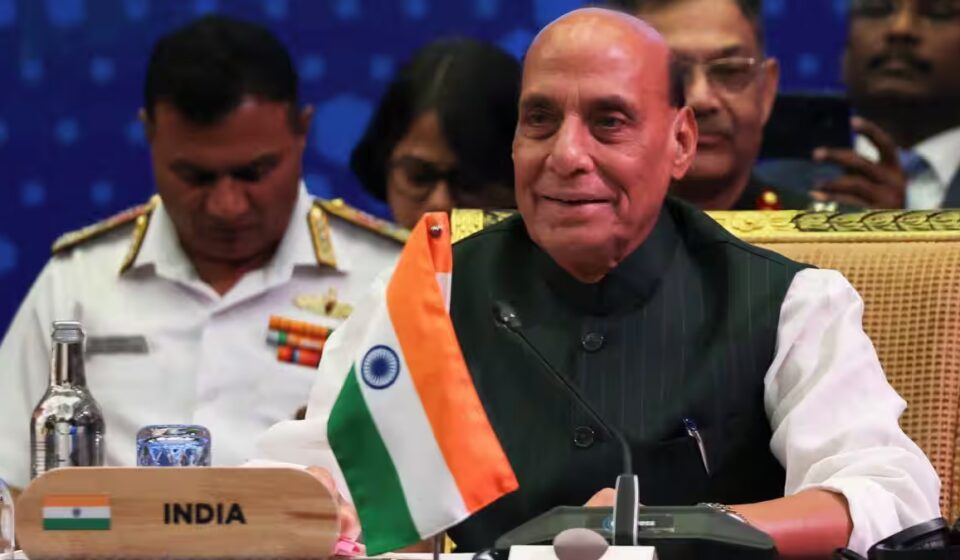

India’s Army has received its first new war doctrine in seven years, with Defence Minister Rajnath Singh releasing the Land Warfare Doctrine in New Delhi on Friday at the close of the Army Commanders’ Conference. The first such document since December 2018, and only the third since 2004, it will shape what the force buys, how it organises and what its officers are taught for the next decade. Officials point to drones, precision strike, electronic warfare and artificial intelligence as central themes. The doctrine arrives as the Army’s focus has shifted from a Pakistan-centric western strategy toward a two-front reality shaped by the 2020 Galwan clash and Operation Sindoor’s deep strikes into Pakistan in 2025, and as theatre commands near Cabinet approval that will place Army formations under joint commanders for the first time.
In step, the Defence Ministry has floated a tender for 500 scramjet engines for India’s hypersonic missile programme, a quantity suggesting plans for production of a scramjet-powered cruise missile rather than testing alone. Unlike rockets, scramjets breathe air and can sustain powered flight above Mach 5, making a missile harder to track and intercept. China fields the DF-17 and YJ-21, while Russia’s Zircon is among the few such weapons in service.
On the threat board, a battered Pakistan is scrambling for allies and leaning on nuclear bluster after Operation Sindoor exposed its thin defences. Islamabad signed the Mecca agreement with Saudi Arabia and Turkey in August and the Badr MoU with Turkey, Qatar and Indonesia in October, though neither brings much real combat power. Retired Lt Gen Khalid Kidwai’s warning that Pakistan may review nuclear deployments is aimed at rebuilding a deterrent India punctured in May. Pakistan-based networks also continue flying drones carrying drugs and weapons into Punjab and Jammu and Kashmir nightly.
On October 17, the Army shot dead two infiltrators in Kashmir’s Keran sector during the last window before snow closes the passes. The same day, Pakistani troops and Afghan Taliban fighters clashed for nearly four hours along the Kurram border, the latest in a string of firefights. Separately, China’s tungsten export curbs, covering about 80 percent of global supply, threaten India’s tank ammunition chain, with home mining years away.
In procurement, the Navy began ski-jump trials of the Rafale Marine at INS Hansa ahead of 26 deliveries from 2028, invited bids for four large amphibious ships, and is studying arming its P-8I patrol aircraft with kamikaze drones. The Army ordered BEL low-level radars capable of detecting dinner-plate-sized drones, while its GSAT-7B communications satellite slipped to mid-2028. The IAF briefed around 100 drone makers on its new Unmanned and Autonomous Systems Roadmap, India’s 1,500-km hypersonic anti-ship missile is slated for induction by 2029, and HAL’s first 12 Light Utility Helicopters are due in 2027-28.
Diplomatically, Polish Prime Minister Donald Tusk pitched drones and defence exports to PM Modi, Rajnath Singh warned against terrorism at the SCO summit in Dushanbe while meeting Tajik and Iranian leaders, India and Singapore began the 33rd SIMBEX focused on submarine hunting, and Indian and Australian troops launched the AUSTRAHIND exercise in Kerala, with New Zealand observing for the first time.
Original Source: https://www.firstpost.com/india/weekly-defence-dispatch-army-gets-new-war-doctrine-mod-seeks-500-scramjet-engines-as-pakistan-turns-to-nuclear-bluster-and-more-14054979.html
Category: India
Tags:
Publish Date: 2026-10-24 11:01:00