From Code Back Office to Story Engine: India’s AI Content Export Opportunity

India’s Next Great Export Won’t Be Code. It Will Be Pipelines.
We keep measuring AI video by how cheap it makes a single clip. The more consequential number is how many tools it deletes from the pipeline – and who ends up owning that pipeline.
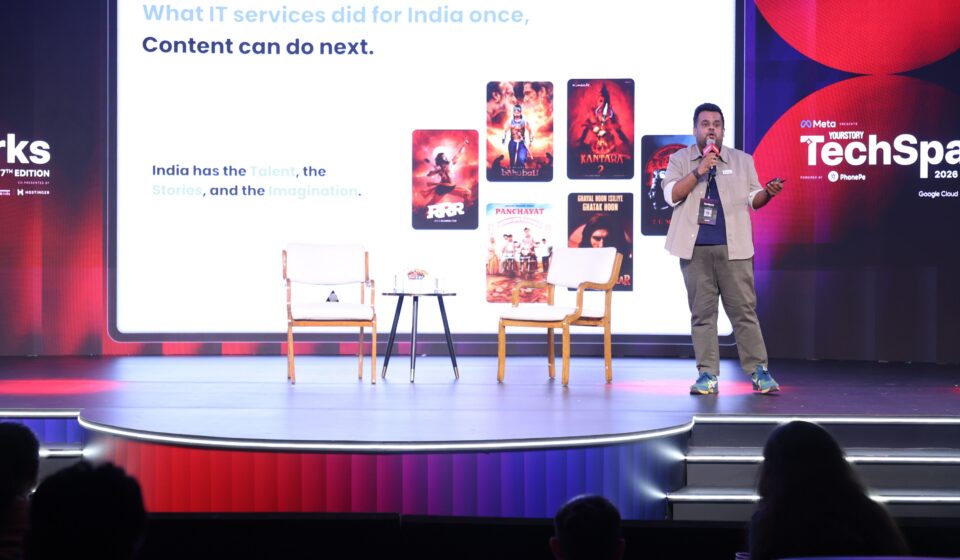
At TechSparks 2026, a founder made the case that India can repeat its software-export story in content, drawing the familiar comparison to Korean dramas, Japanese anime and Chinese micro-dramas. He demoed a suite that collapses roughly twenty fragmented AI tools into a single agentic chat, and noted that India’s micro-drama category has crossed a Rs 5,000-crore run rate in about eighteen months – while production still devours 50–60% of revenue.
The real innovation is orchestration, not generation
Generation is a commodity. Every model does it, and the gap between them narrows each quarter. The genuinely hard engineering problem – the one we wrestled with through SOA, then microservices, then workflow engines – is state. Continuity of context, persistence of characters, lineage of every asset through a hundred edits. The moment an agent holds that state and dispatches each sub-task to the right specialised model, you have moved from a craft tool to a pipeline abstraction.
The interoperability detail is the signal that matters to CTOs. Exposing the workflow layer to external models via protocol-level integration means creators compose capability instead of committing to a vendor. That is a portability argument, and it is the correct one. Enterprises designing agentic systems in any domain – claims processing, supply chain, citizen services – should read this media story as architecture: the value accrues to the orchestrator that owns the workflow, not to the component that emits the pixels.
The architectural debt to watch is non-determinism. Cheap generation at scale without provenance, cost controls and reproducibility is a liability, not an asset.
When supply cost collapses, the moat moves
If production drops from 60% of a revenue line to 15%, content stops being a scarcity business and becomes a rights-and-distribution business. The gatekeeper does not disappear; it relocates – to compute, to algorithmic reach, to who holds the IP registry. Founders building here should invest early in attribution, licensing discipline and audience data, because “AI slop” will flood the market faster than taste can filter it.
Why this matters in the Northeast
I have argued for years in state technology forums that our problem was never creativity – it was the absence of rails. This is where the content economy needs the DPI mindset: shared rendering compute, shared language corpora, shared compliance infrastructure. Language is data sovereignty. Assamese, Bodo, Khasi and Mizo storytelling data sits largely outside global model training today. Whoever curates it with consent and structure will own the nuance that no foreign model can fake. A three-person studio in Guwahati can now bid for work it would never have been invited to before – provided we fix connectivity, compute credits and payment rails. Cheap tools are not the same thing as a market.
Strategic takeaways
- Judge AI tooling by tools eliminated and state preserved, not by output quality alone.
- Treat orchestration and provenance as your core IP; treat models as swappable vendors.
- Localise at the cultural layer, not just the language layer – nuance is the differentiator.
- Build supply-side studios: small, fast, rights-clean. Platforms will consolidate; suppliers will not.
- Curate regional language data now. It is the most undervalued asset on the table.
Closing thought
India became the world’s back office because we learned to industrialise process, not because we learned to code. Stories are the same problem wearing different clothes – and this window will not stay open long.
About the Author: Sanjeev Sarma is the Founder Director and Chief Software Architect at Webx Technologies. With a core focus on Generative AI integration, Cloud-Native Scalability, and Enterprise Software Architecture, he has spent over two decades driving digital transformation across Northeast India and beyond. Beyond his corporate leadership, Sanjeev is deeply invested in shaping the future of the IT industry. He serves as an Industry Expert on the Board of Studies for Assam Don Bosco University’s School of Technology, advises state technology committees, and actively mentors emerging tech startups at STPI. He brings a unique, dual perspective of high-level enterprise execution and future-ready academic curriculum development.