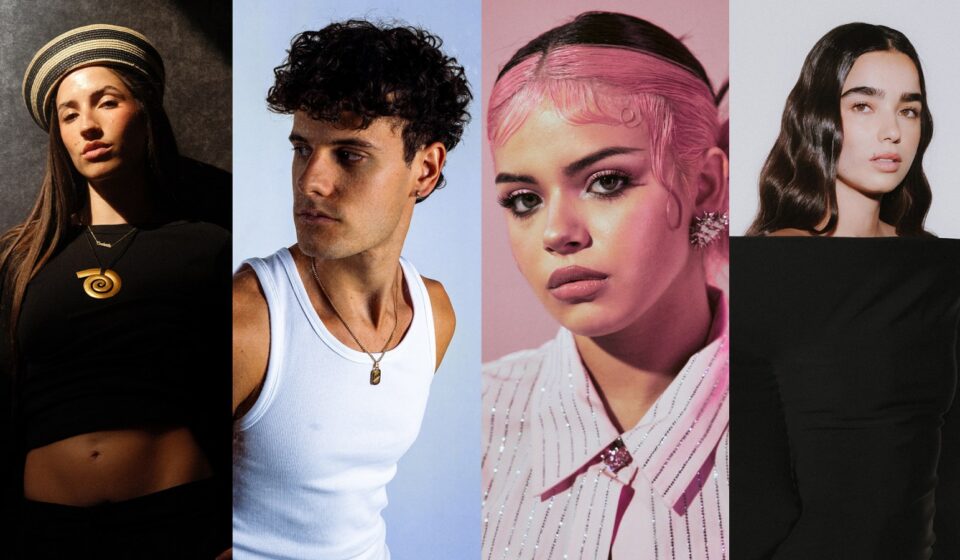

The Latin Grammy Newcomer Class of 2026: A Four-Way Race for the Crown
By Rupaliparda
The air in Las Vegas is about to get thick with ambition, drama, and the intoxicating scent of fresh talent. The 2026 Latin Grammys are upon us, and while the heavyweight categories will surely draw blood, all eyes are glued to the Best New Artist category. This isn’t just an award; it’s a coronation. It’s the industry’s way of anointing the next Karol G or Calle 13-a once-in-a-lifetime ticket to the big leagues.
This year, the Academy has upped the ante with eleven nominees instead of the usual ten, a sign of a vibrant, overflowing talent pool. I caught up with four of this year’s most promising upstarts, each a distinct flavor in this potent cocktail of talent.
First, let’s talk about Aria Vega. This Barranquilla native isn’t just riding a wave; she’s the tide. Her music is the Caribbean coast distilled-vibrant, rhythmic, and unapologetically real. For her, the nomination is an “invitation to bring my world to a bigger audience.” And what a world it is. She recently had a surreal run-in with Shakira in Madrid, a moment that could only be described as a passing of the torch between two Barranquilleras. Vega is ready to unleash her debut album, Costeñita Core, a project she describes as “playful, colorful, feminine, a little chaotic.” Consider us intrigued.
Then we have Delilah, a Mexican-American firecracker who is redefining the boundaries of música mexicana. She understands the weight of her nomination, not just as an artist but as a woman in a historically male-dominated genre. “I want to represent women in that space and show that I can be myself,” she told me. She’s already made history as the only woman to open for Natanael Cano at the iconic Estadio GNP Seguros, a testament to her fierce individuality. Her sound, a seamless blend of English and Spanish, is a reflection of her bilingual reality. She isn’t just breaking the mold; she’s shattering it.
Following in the footsteps of a famous parent is a classic industry tale, but Fabian is writing his own script. The son of Peruvian icon Gian Marco, Fabian is far from a nepo-baby. His nomination had his sister, Nicole, in tears, but his ambition is purely his own. Having moved from Lima to Los Angeles at nine, he’s on a mission to fuse Anglo-inspired sounds with Spanish lyrics. “I wanted to bring some of those sounds into Spanish-language music,” he shared, “without losing the way I naturally write.” His debut album, due next year, is a project five years in the making-a true labor of love in an era of singles.
Finally, we have Sofia Monroy, the Mexican-Swedish maverick. She is perhaps the most fascinating of the quartet. Her nomination for the deeply personal album Morena feels like a validation of a non-linear journey. “I’ve spent years figuring out who I am as an artist, experimenting, making mistakes,” she admitted. Monroy’s art is a beautiful contradiction, a fusion of two distinct cultures that she no longer tries to reconcile. Her music is an exploration of identity, grief, and belonging, proving that the most powerful art comes from embracing the chaos within.
The 2026 Best New Artist race is more than a competition; it’s a snapshot of Latin music’s future. Four artists, four distinct visions, one shared dream. Who will take the crown on November 12th? The drama is palpable, and I, for one, will be watching with bated breath.