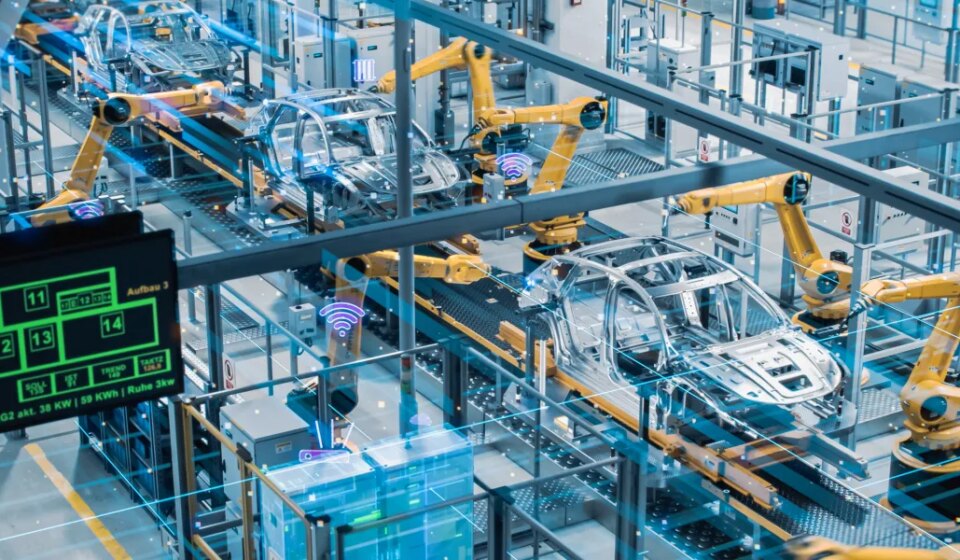
Beyond Smarter Machines: How Physical AI Amplifies Human Capability

Context Is the New Intelligence: Why Industrial AI’s Hardest Problem Is Trust
We obsess over how smart AI is becoming – benchmarks, parameters, reasoning scores. Yet in the physical world of manufacturing, I’d argue the deciding variable is far less glamorous: whether an organization has built the discipline to trust a machine enough to let it matter.
Two recent industrial deployments make the point. At Toyota Industries, connecting previously fragmented paint shop data cut defect analysis cycles from five days to under four hours, with a pilot reducing relevant paint defects by roughly 25%. And at Rockwell Automation’s Singapore plant, a maintenance copilot built on machine manuals and decades of veteran technicians’ know-how compressed new-worker troubleshooting competency from nine months to three. Different factories, same underlying story.
The breakthrough wasn’t a better model. It was context.
Notice what actually happened at Toyota. No miracle algorithm appeared. Teams were simply given the context to understand why defects occurred – before the outcome was locked in. In my two decades of architecting enterprise systems, this is the pattern I see repeated everywhere: data tells you what is happening; intelligence tells you what should happen, which constraints cannot be breached, and when a human must step in. Most organizations have the first and are starving for the second. That is not a model problem. It is an architecture problem – the unglamorous work of unifying operational technology with IT, building semantic layers, engineering context. The intelligence, as ever, lives in the connections.
Simulation: the right to be wrong cheaply.
The second lesson is about sequencing learning. Simulation lets manufacturers test proposed actions in a digital environment before touching physical equipment – the industrial equivalent of a staging environment, except the “production outage” is a scrapped batch or a safety incident. This doesn’t eliminate physical validation; it reorders it. For CTOs deploying agentic AI anywhere, the pattern generalizes: never let the production line – or the production database, or the production customer – be the first experiment.
Trust is an operating discipline, not a feeling.
Here is where I part ways with the breathless “autonomous factory” narrative. Responsible deployment begins with operational discipline: clear authority over what systems may change, reliable connections to equipment, defined safety boundaries, and a record of every decision and action. People must be able to recognize uncertainty, intervene, and bring equipment to a safe state. Think of it as Zero Trust applied to autonomy – least privilege for machines. Before asking “can the model do this?”, ask: what is the blast radius, who can override it, and where is the log? Trust rests on those practical arrangements, not on confidence in a model alone.
The asset that walks out the door.
The Rockwell case exposes something enterprise architects chronically underweight: tacit knowledge. When we modernize legacy systems, we treat the code as the asset. Often the real asset is the person who knows why the code is the way it is. Codifying veteran judgment before retirement is not an HR initiative – it is a knowledge architecture problem, and arguably the highest-ROI AI use case in industry today.
There is a lesson here closer to home, too. India’s older industrial estates – from Northeast India’s refineries to tea factory machinery floors – hold decades of operational expertise in heads that won’t be around forever; capturing that judgment is urgent, not optional. And for our MSMEs, the Toyota story is quietly liberating: you don’t need frontier models to move the needle. You need connected data, context, and discipline – the frugal path to industrial intelligence.
Takeaways for builders:
- Invest in context before capability. Unified OT-IT data is the real multiplier.
- Treat autonomy as a permissions problem: authority boundaries, safety envelopes, and audit trails come first.
- Simulate to learn cheaply; sequence validation deliberately.
- Architect for knowledge capture – veteran expertise is a deprecating asset.
The factories of the future will not be defined by how smart their machines are, but by how intelligently people and machines learn to trust each other.
About the Author: Sanjeev Sarma is the Founder Director and Chief Software Architect at Webx Technologies. With a core focus on Generative AI integration, Cloud-Native Scalability, and Enterprise Software Architecture, he has spent over two decades driving digital transformation across Northeast India and beyond. Beyond his corporate leadership, Sanjeev is deeply invested in shaping the future of the IT industry. He serves as an Industry Expert on the Board of Studies for Assam Don Bosco University’s School of Technology, advises state technology committees, and actively mentors emerging tech startups at STPI. He brings a unique, dual perspective of high-level enterprise execution and future-ready academic curriculum development.