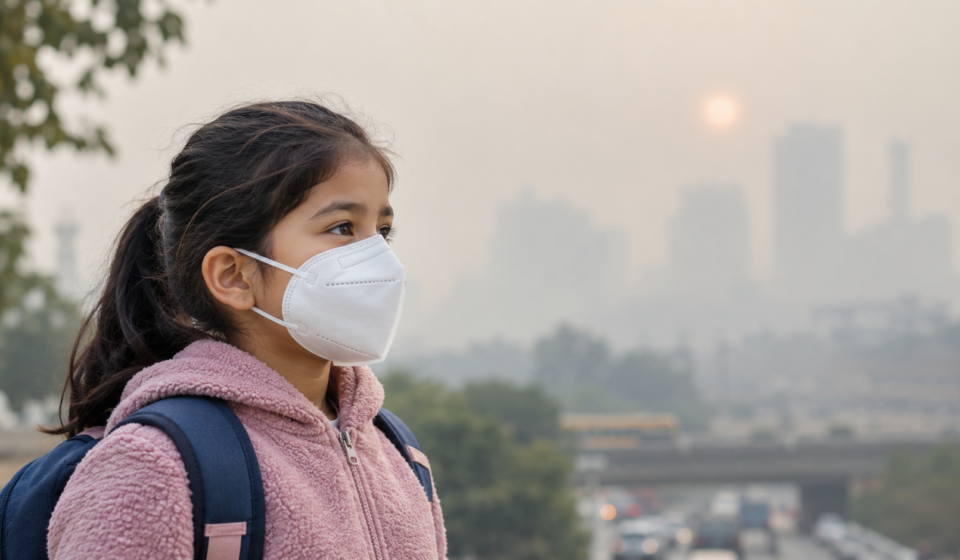

When the air outside turns hazy and hazardous, a cute cartoon mask may comfort parents but will do little to protect a child’s lungs. Paediatric experts say that only a properly fitted, certified respirator — an N95, KN95 or FFP2 — can meaningfully filter PM2.5, the fine pollution particle that harms children’s lungs, and even then a mask should be treated as a backup measure, not a licence for hours of outdoor play.
Dr Amit Gupta, Senior Consultant Paediatrician and Neonatologist at Motherhood Hospitals, Sector 48, Noida, recommends child-sized N95 or KN95 masks for children above five to six years, with a suitable filter, a soft inner layer and adjustable straps. “Design is not protection,” he cautions, urging parents not to be swayed by fancy masks sold without a filtration rating. Dr Ravi Malik, Founder and Director of Malik Radix Health Care, advises looking for a child-specific size, a certification mark printed on the mask, a soft adjustable nose clip and loops the child can tolerate — and avoiding valved masks, which do not filter exhaled air and fit poorly on small faces.
Fit matters as much as filtration. Dr Sumera Khan, MD Paediatrics at Crescent Hospital, explains that the mask should cover the nose, mouth and chin with no visible gaps at the cheeks or nose bridge; if air escapes near the eyes or glasses fog up, it does not fit. Parents should have their child talk and move their jaw to confirm the mask does not slip or block vision. Dr Indu Khosla, Senior Consultant in Paediatric Pulmonology at Narayana Health SRCC Children’s Hospital, Mumbai, notes that children’s faces make a tight seal difficult even with a good respirator, and warns against folding or knotting an adult-sized mask to make it work.
Age limits are strict. Children under two should never wear masks due to the risk of suffocation, while those aged two to five may use one only for short periods, under adult supervision, when going out in high pollution. No child should wear a mask while sleeping. Everyday cloth and surgical masks, the doctors add, were designed to block droplets rather than fine particles and fit loosely, so limiting outdoor time is a better option than trusting them to keep pollution out.
Masks should be replaced when they become wet, dirty, damaged or hard to breathe through, following the manufacturer’s instructions — disposable N95s must never be washed, and masks should never be shared between children. If a child feels breathless, faint or distressed, parents should stop the activity, move them to cleaner air and remove the mask, seeking urgent medical attention for wheezing, chest tightness or bluish lips. Children with asthma need their clinician’s guidance on respirator use, an up-to-date asthma action plan and inhalers kept close at hand.
Ultimately, experts stress that a mask is only a supplementary measure and “should not replace reducing exposure,” as Dr Khosla puts it. Parents should check the AQI daily, skip outdoor sports and assemblies on severely polluted days, keep windows closed when the air is bad, use a HEPA air purifier indoors and avoid indoor smoke from cigarettes, incense sticks and mosquito coils. Choose a mask for its filtration and fit, not its looks — but the best protection is reducing how much polluted air a child breathes in the first place, and always consult a health practitioner before starting any new routine.
Original Source: https://indianexpress.com/article/lifestyle/health/pollution-and-kids-4-doctors-explain-how-to-choose-the-right-mask-and-check-its-fit-10936510/
Category:
Tags:
Publish Date: 2026-10-25 22:06:00