Rethinking the Perimeter: Security in the Age of Autonomous Freight

The AI Perimeter Is Bigger Than the Data Center
AI governance is usually discussed through models, datasets, identities, and cloud environments. A recent cargo-theft case exposed a less fashionable-but increasingly important-boundary: the physical infrastructure on which every intelligent system depends.
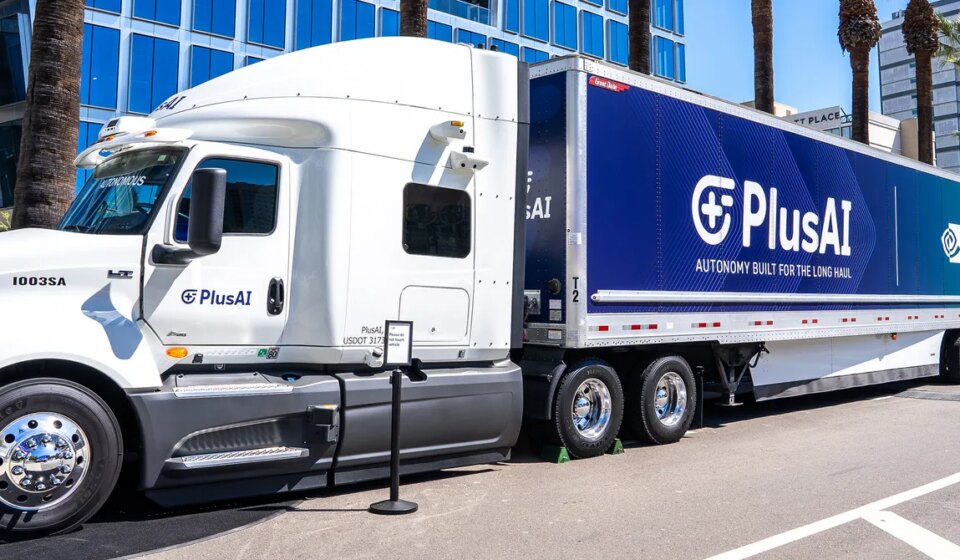
Two PlusAI-branded trailers were taken from near the company’s Fremont warehouse after thieves connected their own cabs and broke the hand locks. The technology-enabled cabs remained inside, while the trailers contained about 40,000 pounds of sand used as simulated loads for research and development. Police recovered the trailers the same day; no arrests had been reported.
This should not be dismissed as an isolated oddity. Theft is increasingly following high-value electronics and infrastructure across supply chains. Attackers may not understand the exact value in a particular trailer, but a visible logo, specialised equipment, or known testing relationship can create opportunity. Security models must account for opportunistic theft alongside sophisticated cyberattacks.
The Asset Was the Test Condition
Simulated payloads can look like poor security, but in autonomous mobility they are part of a controlled experiment. Weight, balance, axle loading, and vehicle behaviour may determine whether sensor and autonomy tests are valid.
The protected asset is therefore not merely a trailer or its cargo; it is the integrity of the experimental system. An apparently harmless payload can still be operationally significant.
That changes how I think about security architecture. A conventional Zero Trust model may protect users, endpoints, and workloads, yet stop at the loading bay. For AI and autonomy programmes, the trust boundary must also include prototypes, test rigs, compute modules, research equipment, and every physical handoff between vendor, carrier, facility, and test site.
A GPU can be well protected inside a data centre and exposed while in transit. Likewise, a connected truck can have sophisticated cyber controls while its mechanical and operational security is treated as someone else’s problem. That is fragmented security thinking.
Zero trust, in this setting, means verifiable identity and authorisation at each handoff-not simply a camera on a fence. Depending on the asset, controls may include tamper-evident seals, asset-level digital identity, GPS and geofencing, route-anomaly alerts, auditable chain-of-custody records, and remote immobilisation where it is safe to do so.
But controls must remain proportional. Every sensor adds cost, maintenance, privacy exposure, and potential alert fatigue. The better question is not “How many security devices can we attach?” but “Which trust failures could stop the business, and what combination of prevention, detection, and recovery addresses them?”
Resilience Is the Real Goal
Security architecture should also assume that some controls will fail. A missing autonomous test vehicle is not simply lost property; it can delay datasets, validation milestones, and customer trials. Response playbooks should connect engineering, logistics, security, legal, insurance, and law enforcement while defining how to revoke credentials, isolate a compromised unit, preserve evidence, and invoke a backup test environment.
Fail-safe design matters here too. If connectivity is lost, remote protection must not cause unsafe vehicle behaviour. Security controls need to be designed with the autonomy platform, not bolted on after it.
The sand also reveals a useful distinction. Ballast may be replaceable, making rapid recovery possible. High-value processors or specialised test equipment may have long lead times and no substitute. Architecture should classify assets by business dependency and recovery cost, then match protection accordingly.
Three Actions for Technology Leaders
To effectively secure the broader AI value chain, organizations must first map their infrastructure beyond the data centre, including laboratories, test tracks, carriers, and physical research assets. This expanded oversight requires assigning shared ownership across cyber, physical security, operations, and procurement, as no single function can secure the chain alone. Furthermore, leaders should practise graceful degradation before a real theft or tampering incident occurs, rather than drafting the playbook only after something goes wrong.
As AI becomes more capable, some of its most overlooked risks will sit in loading bays and supply chains. Securing intelligence means protecting not only what a model knows, but everything that makes responsible learning and validation possible.
About the Author: Sanjeev Sarma is the Founder Director and Chief Software Architect at Webx Technologies. With a core focus on Generative AI integration, Cloud-Native Scalability, and Enterprise Software Architecture, he has spent over two decades driving digital transformation across Northeast India and beyond. Beyond his corporate leadership, Sanjeev is deeply invested in shaping the future of the IT industry. He serves as an Industry Expert on the Board of Studies for Assam Don Bosco University’s School of Technology, advises state technology committees, and actively mentors emerging tech startups at STPI. He brings a unique, dual perspective of high-level enterprise execution and future-ready academic curriculum development.