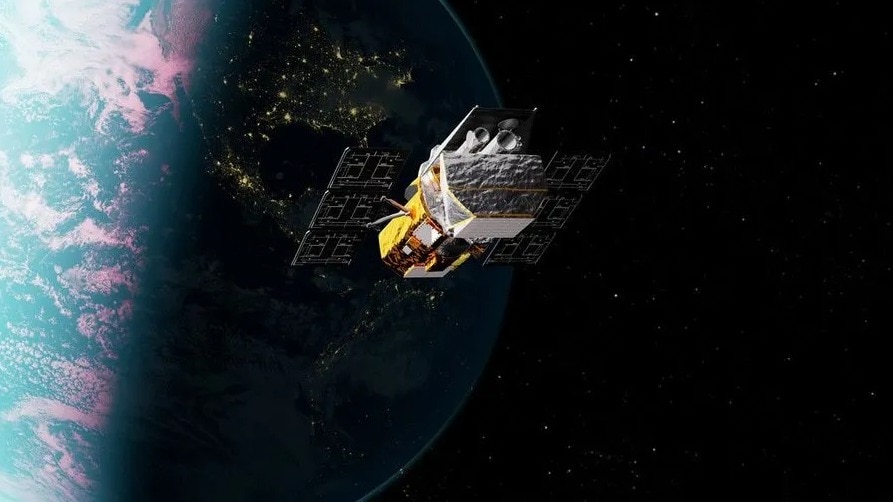

NASA’s Neil Gehrels Swift Observatory has resumed studying some of the universe’s most violent events, but its revived mission faces a steep deadline. The ageing space telescope is slowly falling toward Earth, and NASA expects its scientific operations to end in early to mid-October. On September 25, the agency confirmed that Swift’s third instrument, the Burst Alert Telescope, was operating again and that the observatory had regained its ability to turn automatically toward sudden flashes in the sky.
Swift was orbiting about 325 kilometres above Earth when NASA announced the recovery. Operating the spacecraft will become increasingly difficult if its altitude falls below roughly 300 kilometres. The observatory has orbited Earth since November 20, 2004, studying gamma-ray bursts-extraordinarily powerful flashes of high-energy light-as well as black holes, stars and other cosmic phenomena.
Swift uses three instruments in tandem. The Burst Alert Telescope, or BAT, detects gamma rays and alerts scientists to powerful cosmic explosions. The X-Ray Telescope then studies the X-ray radiation from those events, while the Ultraviolet/Optical Telescope observes the aftermath in ultraviolet and visible light.
The telescope’s renewed activity comes after months of reduced operations. Earth’s upper atmosphere creates drag even hundreds of kilometres above the surface, gradually lowering Swift’s orbit. Increased solar activity has accelerated that decline. NASA began preparing for the observatory’s possible reentry in December 2025 and suspended most scientific operations on February 11, 2026, both to limit drag and to preserve time for a planned orbital-boosting mission. BAT was switched off in April to conserve power and help Swift adopt an orientation that reduced atmospheric resistance.
NASA and Katalyst Space launched the robotic Link spacecraft from the Marshall Islands on July 3. Link was intended to rendezvous with Swift, capture it and raise it into a higher orbit. The attempt failed after the spacecraft developed attitude-control problems. By July 28, two of its three reaction wheels were unavailable, while its cold-gas thruster system also faced issues. On August 19, NASA and Katalyst Space said Link would no longer capture or boost Swift, reducing the mission to a demonstration of rendezvous and proximity-operation technologies.
Swift’s X-ray and ultraviolet/optical instruments restarted on August 26. BAT was confirmed to be detecting gamma rays on September 18, and automated pointing resumed three days later. Although the observatory is scientifically active again, it remains on a steadily declining orbital path, bringing one of NASA’s longest-running cosmic observers closer to the end of its mission.
Original Source: https://www.indiatoday.in/science/story/nasa-swift-telescope-falling-earth-atmospheric-drag-solar-activity-3003390-2026-09-26
Category:
Tags:
Publish Date: 2026-09-26 12:08:00