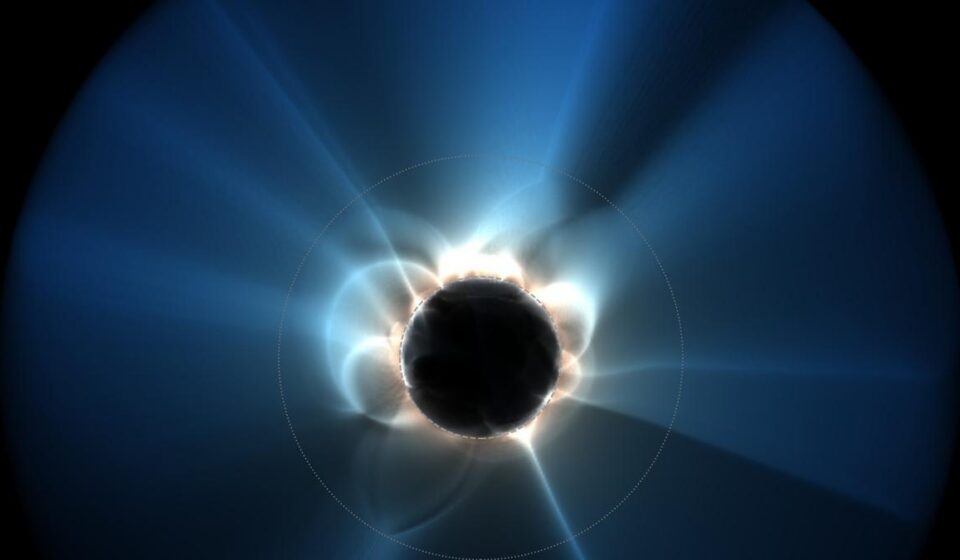

Solar physicists at the Raman Research Institute (RRI) in Bengaluru and their collaborators have predicted the magnetic structure of the Sun’s outer atmosphere-the corona-during the total solar eclipse on August 12, 2026, a celestial event visible in parts of Europe for the first time since 1999. The team says their forecast, based on data through August 10, 2026, indicates multiple large-scale petal-like structures with additional, more elongated local petals, suggesting a complex and potentially spectacular coronagraphic view during totality.
The researchers used a novel, two-pronged computational approach grounded in a theoretical framework developed by senior RRI professor Dibyendu Nandi and colleagues. One key element was a data-driven model with built-in memory spanning several years; the model was run forward to predict the Sun’s surface magnetic field distribution on August 12, 2026. “Calibrating the model with past solar observations is essential to obtain accurate estimations,” Nandi said.
A total solar eclipse provides a rare ground-based opportunity to observe the faint corona because the Moon occults the Sun’s bright disk. Without such occultation-or an artificial coronagraph on a satellite-the corona’s delicate structures are extremely hard to see. Observations during eclipses let theorists and modellers test and refine computational models of solar magnetism and space weather.
Understanding the corona’s magnetic structure matters because it is central to the origin of solar storms, flares and coronal mass ejections. Eruptions of plasma and energetic particles can disturb Earth’s outer atmosphere and technologies, triggering power outages, disrupting communications and GPS, damaging satellites and exposing astronauts to heightened radiation.
The forecasting team was led by Nandi and included Sagnik Saha (Raman Research Institute), Priyansh Jaswal (Centre of Excellence in Space Sciences India, IISER Kolkata), Shaonwita Pal (Indian Institute of Astrophysics and West Bengal’s Department of Technical Education and Skill Development), Soumyaranjan Dash (U.S. National Solar Observatory) and Chitradeep Saha (University of Reading, UK).
The eclipse is timed to begin at 9:04 pm IST on August 12, 2026, with totality lasting about two minutes and 18 seconds. It will not be visible from India because it occurs at night there; most of Spain and other parts of Western Europe, sections of northwestern Africa and select areas of the United States will observe total or partial phases.
“We strive to continuously improve our models by comparing our simulated predictions with observations – the best test for any theoretical model,” Nandi added, noting that comparing the team’s forecast to actual eclipse images will help refine forecasts of coronal magnetic field dynamics and improve space weather prediction.
Original Source: https://www.thehindu.com/sci-tech/science/team-led-by-rri-scientists-predicts-petal-like-structures-in-suns-corona-during-eclipse/article71336095.ece
Category:
Tags:
Publish Date: 2026-08-12 17:04:00