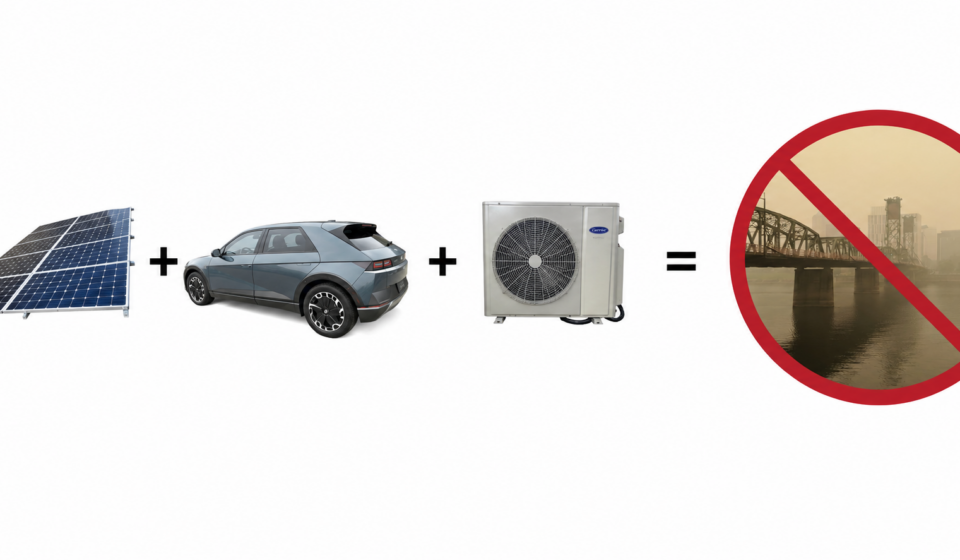
Platforming Electrification: Building Resilient Cities Against Wildfire Smoke

Fighting wildfire smoke by rethinking whole-system energy
We tend to treat heat pumps as another appliance on a homeowner’s checklist. That narrow view misses the strategic truth: electrifying space and water heating with heat pumps is a systems-level lever – one that simultaneously cuts emissions, reduces local air pollution, and shifts how utilities, builders, and enterprises must design for resilience.
Context
A recent editorial used wildfire smoke as a stark reminder that climate impacts are already eroding quality of life across geographies, and urged households to accelerate electrification (heat pumps, EVs, solar). The piece is a reminder that personal choices matter – but it also exposes deeper architectural challenges that enterprises and policymakers must own.
Why heat pumps matter beyond the appliance
As an enterprise architect I see three linked dynamics that make heat-pump adoption strategically important:
-
Demand vector shift: Moving heating and hot water from fossil fuels to electricity increases electrical load profiles and changes seasonal and diurnal demand shapes. That isn’t a purely operational issue; it requires grid planning, tariff redesign, and new control layers across distributed assets.
-
Emissions hinge on system context: Heat pumps reduce site emissions only when electricity decarbonizes or when paired with local renewables. That means their value proposition is weakest as an isolated retrofit and strongest as a coordinated part of DER (distributed energy resource) strategies – solar, storage, demand management, and thermal storage.
-
Resilience and public health co-benefits: During smoke events or fuel supply disruptions, electric heat pumps paired with airtight retrofits and filtration deliver breathable indoor air and basic thermal comfort – a form of climate adaptation that pays in health and continuity-of-service.
Architectural implications for enterprise and public leaders
For CTOs of utilities, real-estate CIOs, and technology founders, the heat-pump economy requires rethinking three architectural layers:
-
Grid and market architecture – Integrate long-horizon capacity planning with DER orchestration. Incentives and tariffs must reflect the value of shifting loads (time-of-use, seasonal credits), and markets should enable bundled offers: PV + storage + heat pump + service contract.
-
Digital control and interoperability – Standardized telemetry, open APIs, and secure OTA update paths are essential. Aggregators will need predictable control primitives for residential thermal loads to provide frequency response, capacity, or emergency demand reduction without sacrificing occupant comfort.
-
Financing & ops model – The biggest friction is upfront cost and installation complexity. Pay-for-performance, heat-pump-as-a-service, and integrated retrofit packages (envelope + controls + financing) convert a technical commodity into an investible asset class for institutions and ESCOs.
Trade-offs and risks
Speed vs. stability: Rapid scale-up without workforce training, quality installation standards, or grid upgrades will create backfills of poor installs, warranty failures, and unhappy users – politically and economically costly.
Innovation vs. fragmentation: A proliferation of proprietary control stacks frustrates aggregation. Open standards and minimum cybersecurity baselines prevent technical debt from locking in inefficiency.
Localization: what this means for India and the Northeast
While wildfire smoke has been front-of-mind for North America, the architectural lesson is universal. India’s cooling demand is skyrocketing, biomass and seasonal fires affect air quality in many regions, and electrified thermal solutions can reduce indoor air pollution and fossil-fuel dependence. For Northeast India, combining heat-pump rollouts with skill-development, localized supply chains, and incentive structures tailored to low-income retrofits would maximise both climate and public-health wins.
Practical takeaways for leaders
- Treat electrification as a systems programme, not an appliance subsidy: align grid planning, tariffs, and DER policy.
- Bundle technologies and services (PV + storage + heat pump + performance guarantee) to reduce customer friction.
- Invest in standards for telemetry, secure control APIs, and interoperable device management.
- Build workforce capacity and quality-assurance frameworks to avoid poor installs and reputational risk.
- Pilot performance-based financing models that convert energy savings into serviceable cashflows for ESCOs and banks.
Closing thought
Heat pumps are not merely efficiency devices; they are strategic nodes where decarbonization, resilience, and public health intersect – and where architecture choices made today will lock in outcomes for decades.
About the Author: Sanjeev Sarma is the Founder Director and Chief Software Architect at Webx Technologies. With a core focus on Generative AI integration, Cloud-Native Scalability, and Enterprise Software Architecture, he has spent over two decades driving digital transformation across Northeast India and beyond. Beyond his corporate leadership, Sanjeev is deeply invested in shaping the future of the IT industry. He serves as an Industry Expert on the Board of Studies for Assam Don Bosco University’s School of Technology, advises state technology committees, and actively mentors emerging tech startups at STPI. He brings a unique, dual perspective of high-level enterprise execution and future-ready academic curriculum development.