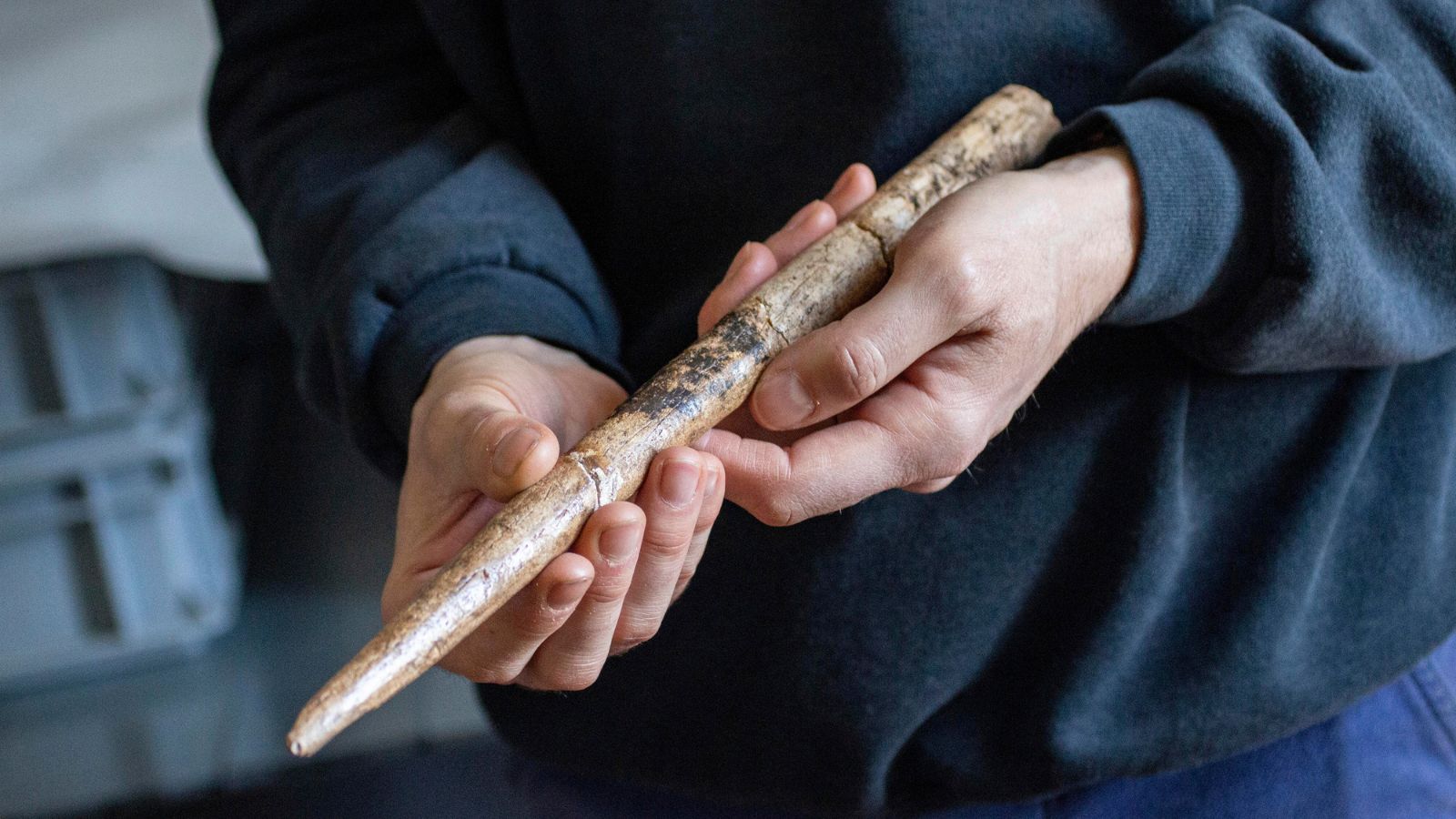
Unveiling Ancient Innovation: Scientists Reveal Stunning Discovery of 20,000-Year-Old Whale Bone Tools!

Scientists have uncovered the oldest known evidence of humans crafting tools from whale bones, pushing back the timeline for these ancient practices to approximately 20,000 years ago. The discovery, which involves meticulously shaped narrow projectiles used for hunting, originated from excavations in the Bay of Biscay, an area bordered by Spain and France. While the bones were unearthed over a century ago, recent technological advancements have allowed researchers to accurately date these artifacts, providing a clearer picture of human-whale interactions throughout history.
This groundbreaking research, published in the journal Nature Communications, primarily stems from an excavation led by Christian Normand in 2022, where teams uncovered dozens of whale bone tools in Pyrénées-Atlantiques, France. Notably, the bones were identified as belonging to various whale species including blue whales, fin whales, and sperm whales. According to Vicki Szabo, a historian of whaling at Western Carolina University who was not involved in the study, "Humans and whales have clearly been encountering one another for a long time."
While evidence of whale bone tools has previously been documented from around 5,000 years ago, this new research significantly extends that timeline. Notably, it suggests that ancient humans were not primarily engaged in hunting whales, but rather scavenging the remains of beached whales. Jean-Marc Petillon, a study author from the French National Centre for Scientific Research, posits that these prehistoric people were utilizing the dense, heavy bones for crafting tools designed for hunting reindeer and bison. This points to a resourceful relationship with their coastal environment, where they likely also gathered seashells and engaged in fishing.
The implications of these findings are considerable, as they highlight the integral role coastal habitats played in supporting ancient human societies. However, archaeologists face substantial challenges in recovering such historical evidence, particularly as rising sea levels increasingly disrupt coastlines worldwide. "It’s one more contribution to the importance of coastal environments for human groups, even in this long past," Petillon remarked, emphasizing the need for further exploration and study in these dynamic ecosystems.
This research not only enriches our understanding of early human behavior but also sheds light on the long-standing connections between humans and marine life. As we continue to learn more about our ancestors, this evidence encourages a deeper appreciation of how early communities adapted to and made use of their natural surroundings, showcasing a remarkable blend of ingenuity and survival instincts.
By revealing these ancient practices, scientists continue to piece together the complex narrative of human evolution, highlighting the importance of interdisciplinary research in uncovering the profound relationship between humanity and the environment. As we venture further into the past, each discovery serves as a reminder of the resilience and resourcefulness that have shaped human history.
This groundbreaking study not only offers a new perspective on prehistoric tool-making but also underscores the crucial role of coastal ecosystems in the survival and evolution of early human societies.
Original Source: https://indianexpress.com/article/technology/science/scientists-date-the-oldest-known-tools-made-from-whale-bones-to-20000-years-ago-10032550/
Category :
Tags:
Publish Date: 2025-05-27 21:02:00