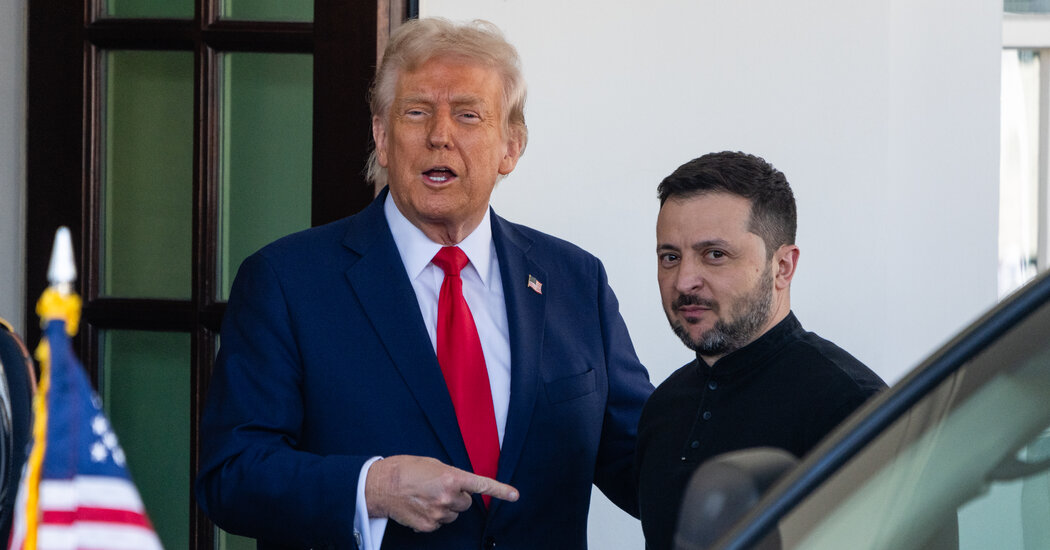

Following a recent phone conversation between former President Donald Trump and Ukrainian President Volodymyr Zelensky, the White House emphasized the perceived gratitude from Ukraine’s leader. According to the statement, Zelensky thanked Trump repeatedly for negotiating a potential ceasefire with Russia and expressed appreciation for Trump’s leadership. This narrative is consistent with the Trump administration’s approach to foreign diplomacy, underscoring Trump’s penchant for personal gratitude from allies.
Michael Froman, President of the Council on Foreign Relations, suggests that Trump’s diplomacy has a transactional nature, viewing U.S. assistance as a favor rather than a strategic national interest. “This approach questions the long-held belief that supporting our allies also serves our own interests,” Froman remarked.
A past incident exemplifies Trump’s insistence on acknowledgment. During an Oval Office meeting with Vice President JD Vance and Zelensky, Trump bluntly urged Zelensky to express explicit thanks for U.S. efforts in conflict resolution. As the meeting concluded, Trump remarked, “You’re not acting at all thankful. And that’s not a nice thing.”
In contrast, Trump’s interaction with Russian President Vladimir Putin seemed more subdued, with no mention of gratitude in public summaries of their call. Trump’s demand for acknowledgment marks a shift in U.S. diplomatic interactions. While it’s common for presidents to expect recognition for military or humanitarian support, such exchanges are typically held behind closed doors. A White House spokesperson defended this stance, stating, “It’s called respect,” arguing that every president should expect acknowledgment when substantial taxpayer money is involved.
Kori Schake, director of foreign and defense policy studies at the American Enterprise Institute, critiqued Trump’s approach, noting that he treats allies as subordinates rather than equals. “In this transactional framework, showing deference to the American president seems necessary to achieve diplomatic objectives,” Schake commented.
Foreign leaders have adapted to this dynamic. NATO Secretary General Mark Rutte and Irish Prime Minister Micheál Martin recently emphasized their gratitude when engaging with Trump. Rutte acknowledged Trump’s influence on NATO, while Martin keenly emphasized Trump’s personal investment in Ireland, diverting from Trump’s accusations of trade imbalances.
Even Trump’s cabinet members have joined this narrative. Secretary of State Marco Rubio participated in a social media exchange regarding SpaceX’s Starlink service in Ukraine, during which he insisted on gratitude from Poland for the company’s contributions. Rubio emphasized the importance of SpaceX’s role, asserting that without Starlink, the conflict’s outcome might have been vastly different.
Matt Duss, Executive Vice President at the Center for International Policy, argued that Trump’s approach to international relations mirrors a “dominance display,” likening it to a “protection racket.” Duss elaborated, “To secure American protection, one must show respect and pay tribute to the ‘boss.’”
These developments underscore a distinctive shift in U.S. diplomatic practices, with Trump’s administration advocating for a gratitude-centric approach. This evolving dynamic continues to shape international relations and influence interactions between the U.S., its allies, and adversaries.
Original Source: https://www.nytimes.com/2025/03/23/us/politics/trump-zelensky-foreign-diplomacy.html
Category : United States Politics and Government,United States International Relations,Russian Invasion of Ukraine (2022),Trump, Donald J,Zelensky, Volodymyr,Rubio, Marco
Tags:
Publish Date: 2025-03-24 00:01:00