Architecting Resilient Civic Logistics for Public Library Systems

At the end of a conveyor belt, there’s always a person waiting – a child excited for a new story, a commuter grabbing an audiobook, or a student collecting research material. We often celebrate throughput numbers and robotic arms, but we forget the human on the receiving end. A recent case – a large public library system in the U.S. replacing a 25‑year old distribution center with a modern automated sorter – is a useful prompt to think strategically about how automation should be designed, deployed, and governed in public infrastructure.
What happened (briefly)
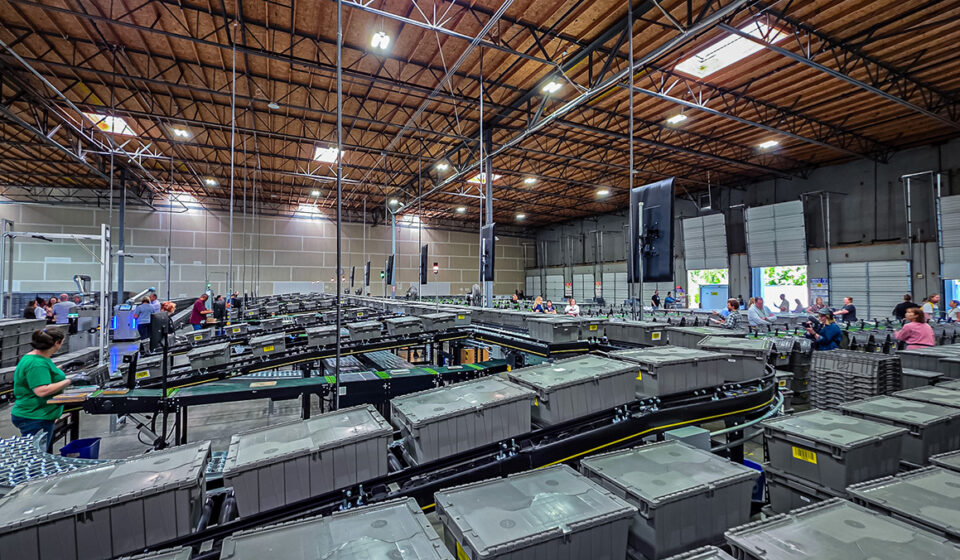
I recently came across a case where a county library system commissioned a new central sorter to handle tens of thousands of items daily. The system combines conveyors, destacking robots, barcode scanning, and 186 destination chutes – delivering clear gains in speed, ergonomics, noise reduction, and accuracy versus the legacy installation.
Why this matters to architects and public CTOs
This is not just a story about robots moving books. It’s a microcosm of the architectural problems every large public service faces when modernizing legacy operational infrastructure:
-
Modularity and maintainability beat raw capability. The legacy facility failed not because it was slow, but because maintenance became untenable – parts were sourced from marketplaces rather than suppliers. When designing physical-digital systems, modular hardware with defined interfaces reduces operational fragility and vendor lock‑in.
-
Observability is non-negotiable. Throughput metrics (items/hour) tell part of the story; error rates, mis-sorts, cycle times per tote, and worker-centric KPIs (ladder climbs avoided, decibel exposure) expose the real return on investment. Instrumentation and a telemetry-first approach enable data-driven operations and predictive maintenance.
-
Human-in-the-loop design reduces social friction. The new facility deliberately reduced manual strain (lower tote stacks, quieter motors) and kept humans in essential decision points (scanning, packaging verification). That balance preserves employment value and improves customer experience – a critical consideration for public institutions.
-
Redundancy and error-tolerance scale trust. A 1–2% mis-sort rate might seem acceptable on paper but erodes public trust in service delivery. Architectures that include destination redundancy, automated reconciliation, and self-healing processes convert marginal accuracy gains into perceptible improvements for citizens.
Actionable architecture principles
For CTOs, enterprise architects, and procurement teams planning similar modernizations:
- Design for replaceability: Specify hardware with standard mechanical/electrical interfaces and require documentation for spare parts availability over a 10–15 year horizon.
- API-first physical systems: Treat sorters, scanners, and conveyors as services with secure APIs, telemetry endpoints, and test harnesses so software can mock and test interactions before deployment.
- Instrument comprehensively: Collect fine-grained telemetry (throughput, queue lengths, error codes, worker interactions) and feed it into dashboards and ML models for predictive maintenance.
- Stage rollouts with fallbacks: Use phased adoption, A/B routing, and manual fallback lanes to avoid systemic failures during commissioning.
- Invest in skills and ergonomics: Automation succeeds when workers transition to higher-value monitoring, exception handling, and quality assurance roles; plan retraining and workplace redesign into the project budget.
- Procurement for lifecycle cost, not headline price: Evaluate TCO, spare parts supply chains, and local support ecosystems – a cheaper upfront machine can cost far more over its life.
Relevance for public systems in India (a practical bridge)
While the scale and context differ, the lessons apply to Indian public infrastructure – from distribution centers to DPI-enabled kiosks. Here, frugal innovation often meets supply-chain fragility. Prioritizing modularity, local vendor ecosystems for maintenance, and telemetry can make automation durable and affordable across varied geographies, including Northeast India’s unique logistics challenges.
Key takeaways
- Automation should be judged by its impact on people, not just throughput.
- Architect for observability, replaceability, and graceful degradation.
- Treat physical assets as part of the software stack – with APIs, telemetry, and versioning.
- Procurement must include lifecycle and spares planning; training budgets are not optional.
Closing thought
When we modernize public services, success is measured not by the sophistication of the machine, but by how reliably and equitably it delivers the next book, the next certificate, or the next essential service to a human being waiting at the other end.
About the Author: Sanjeev Sarma is the Founder Director and Chief Software Architect at Webx Technologies. With a core focus on Generative AI integration, Cloud-Native Scalability, and Enterprise Software Architecture, he has spent over two decades driving digital transformation across Northeast India and beyond. Beyond his corporate leadership, Sanjeev is deeply invested in shaping the future of the IT industry. He serves as an Industry Expert on the Board of Studies for Assam Don Bosco University’s School of Technology, advises state technology committees, and actively mentors emerging tech startups at STPI. He brings a unique, dual perspective of high-level enterprise execution and future-ready academic curriculum development.
