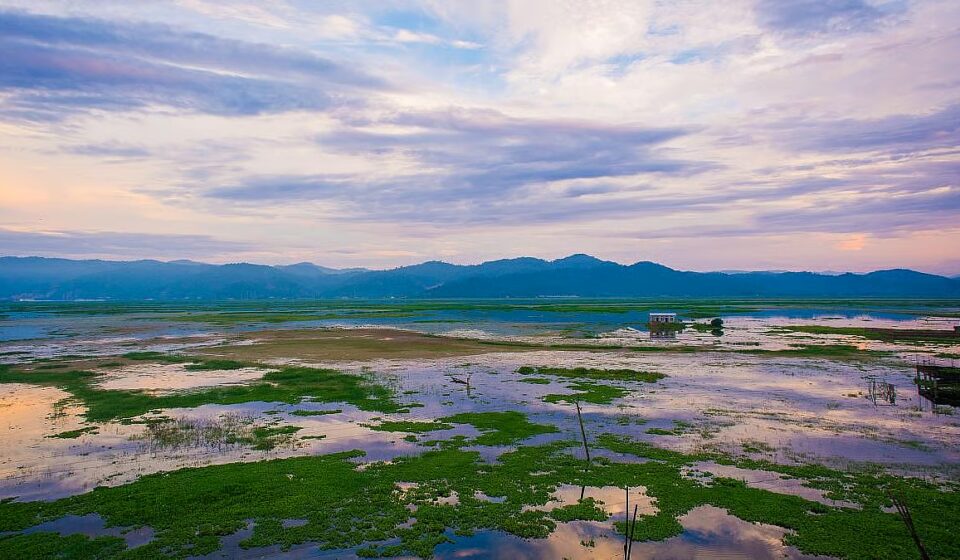

Trees felled from April 24 for a Rs 1,314.40-crore, 4.70-km elevated railway corridor near Deepor Beel have sparked protests from environmentalists, local residents and conservation groups worried that the cutting of an estimated 109–200 trees-many mature teak-will push this fragile wetland closer to irreversible damage. The government defends the project as essential infrastructure and says it will undertake compensatory afforestation, including planting ten times the number of trees felled, but opponents say saplings cannot replace decades of ecological value lost with mature trees.
Deepor Beel, on Guwahati’s southwestern outskirts, is one of the Brahmaputra Valley’s largest freshwater wetlands, a Ramsar site since 2002 and an Important Bird Area supporting more than 200 bird species, as well as elephants, reptiles, amphibians, fish and diverse aquatic life. It also serves as Guwahati’s natural stormwater reservoir, absorbing monsoon runoff and helping regulate urban flooding, and sustains the livelihoods of fishing and indigenous communities around its margins.
The elevated corridor is presented as a wildlife-friendly intervention: railway lines near the wetland have been linked to elephant deaths from collisions, and project planners say the design-reportedly informed by recommendations from the Wildlife Institute of India-aims to reduce animal fatalities while improving rail connectivity. Yet critics argue that the immediate habitat fragmentation and tree loss will further weaken an already stressed ecosystem and that long-term ecological costs are being downplayed.
Deepor Beel has long suffered from neglect and cumulative pressures. Urban expansion, illegal settlements, railway infrastructure, industrial activity, untreated sewage discharge and the Boragaon garbage dumping site have all degraded the wetland. Once nearly 4,000 hectares, the wetland has shrunk substantially over time, with pollution episodes causing fish kills, declining water quality and loss of habitat for migratory birds and aquatic species.
Legal authorities have repeatedly flagged the problem: the National Green Tribunal and the Gauhati High Court have expressed concern over unchecked development around Deepor Beel, yet encroachments and harmful construction persist. Activists and residents now say stronger enforcement of eco-sensitive zone regulations is urgently needed rather than assurances confined to policy documents.
Experts and local groups call for genuinely transparent, scientifically rigorous environmental impact assessments for all future projects in and around Deepor Beel, meaningful public consultations that include ecologists, hydrologists and affected communities, and exploration of alternative alignments or engineering solutions that minimise ecological harm. They also stress that compensatory planting cannot substitute for preserving intact wetland ecosystems.
Beyond project-specific measures, authorities must tackle the larger drivers of degradation: stop untreated sewage discharge, halt municipal waste dumping, and integrate wetland protection into Guwahati’s urban planning. Institutionalising community participation through conservation frameworks, ecotourism, education and sustainable livelihoods can build public ownership of the wetland’s protection.
Deepor Beel is both a biodiversity stronghold and critical natural infrastructure for Guwahati. Balancing development with conservation will require more than mitigation promises; it demands decisive, long-term action to ensure future generations inherit a functioning wetland rather than only its memory.
Original Source: https://www.sentinelassam.com/more-news/editorial/deepor-beel-and-the-challenge-of-balancing-development-with-ecology
Category: Editorial
Tags:
Publish Date: 2026-05-16 09:20:00