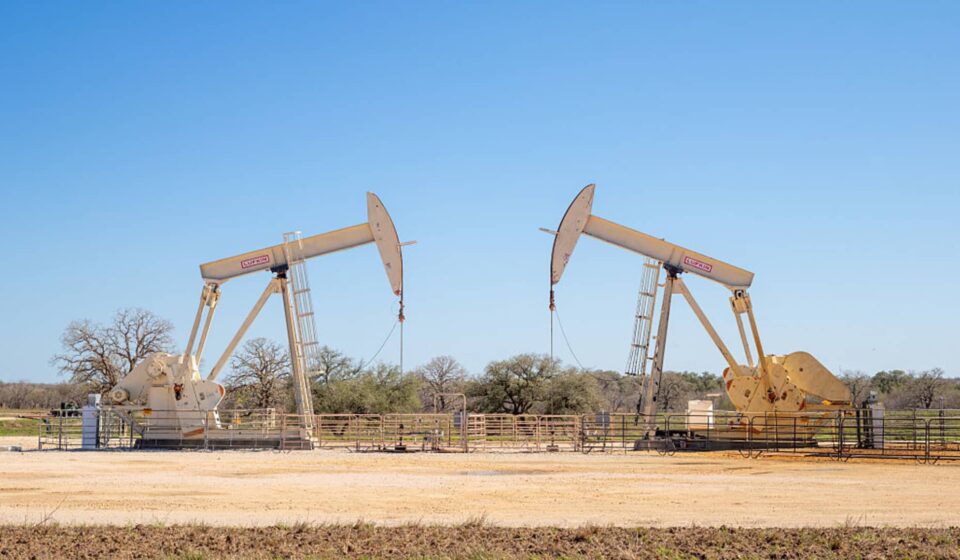

Pump jacks operated in a field in Gillett, Texas, on March 11, 2026, as Asia-Pacific markets experienced mixed trading on Friday, following a tumultuous session on Wall Street. Investor anxiety remains high amid ongoing conflict in the Middle East and significant disruptions to energy supplies.
Recent Iranian strikes on Qatar’s South Pars gas field marked a severe escalation, damaging the world’s largest gas facility and potentially leading to long-term energy supply issues. QatarEnergy CEO Saad al-Kaabi revealed that these attacks could reduce the country’s liquefied natural gas export capacity by 17% for the next three to five years, further fueling volatility in the energy markets. The ripple effects of this tit-for-tat conflict have caused energy prices to spike, with U.S. natural gas rising 1.5% to $3.112 per million British thermal units. April’s front-month Nymex RBOB gasoline reached nearly a four-year high, climbing almost 1% to $3.13. Conversely, oil prices dipped, with Brent crude down 2% to $106.45 per barrel, while U.S. West Texas Intermediate futures fell by 1.56% to $94.64. Saudi officials warned that if supply disruptions continue, prices could surpass $180 a barrel by late April, according to a report by The Wall Street Journal.
The conflict’s impact also extends to precious metals, with gold and silver witnessing declines of about 5% and 10%, respectively, before slightly stabilizing. “The recent drop in gold spot price on high volume suggests panic selling,” noted veteran investor Ed Yardeni, president of Yardeni Research, but he remains optimistic that a bottom may be reached soon.
In an effort to ease market fears, U.S. President Donald Trump announced that no ground troops would be deployed, while Israeli Prime Minister Benjamin Netanyahu emphasized that Israel would refrain from further attacks on Iranian energy facilities. Additionally, several U.S.-aligned nations, including Britain, Canada, France, Germany, and Japan, issued a joint statement expressing their commitment to ensuring safe passage through the Strait of Hormuz.
In Asia, the Australian S&P/ASX 200 index widened losses to 0.5%, while Hong Kong’s Hang Seng index decreased by 0.36%. The CSI 300 index in mainland China edged up by 0.43%, as the central bank maintained its benchmark lending rates for the tenth month in a row. Meanwhile, the Kospi in South Korea increased by nearly 1%.
Overnight, Wall Street saw the Dow Jones Industrial Average decline by 0.44% to 46,021.43 points, while the S&P 500 and Nasdaq Composite fell by 0.27% and 0.28%, respectively, ending at 6,606.49 points and 22,090.69 points. However, futures for the 30-stock index rose by 111 points, or 0.2%, indicating a potential rebound. S&P 500 and Nasdaq-100 futures gained roughly 0.3% and 0.2%, respectively.
Earlier this week, the Federal Reserve opted to keep interest rates unchanged. Chair Jerome Powell cautioned that the economic outlook remains uncertain amid intensifying hostilities in the Middle East.
In a rapidly shifting landscape, investors continue to grapple with the far-reaching implications of geopolitical tensions on the markets, keeping a watchful eye on developments in the region.
Original Source: https://www.cnbc.com/2026/03/20/asia-markets-today-nikkei-hang-seng-kospi.html
Category :
Tags:
Publish Date: 2026-03-20 07:18:00