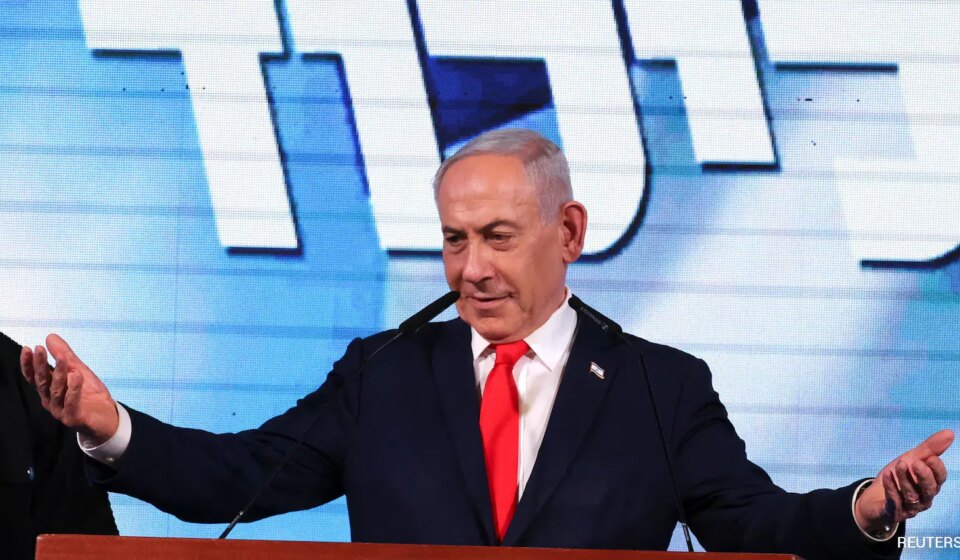

Five days after Israelis voted, the country still has no clear path to a new government. Prime Minister Benjamin Netanyahu has lost his parliamentary majority, and while the opposition appears to have the numbers to remove him, it has not agreed on how to do so.
Netanyahu’s right-wing and ultra-Orthodox bloc won 53 seats in the 120-seat Knesset. Opponents won 67 seats, but 19 of those belong to Arab-majority parties, whose support is highly controversial in Israeli politics. Lt. Gen. Benny Eisenkot, leader of the Yashar party, which won 21 seats, is now at the center of the coalition-building effort. Opposition parties agree on removing Netanyahu but disagree over the Palestinian issue, military conscription, religious policy and the role of Arab lawmakers.
Thousands of Israelis gathered in Tel Aviv on Saturday urging opposition leaders to unite with Arab parties to stop Netanyahu from returning to power. Netanyahu supporters also protested against any government dependent on Arab lawmakers, with some demonstrators calling for Israel not to have a government with “terrorists.”
The election’s biggest change is the surge in Arab representation. The Joint List, led by Yousef Jabareen, won 11 seats, while Mansour Abbas’s Islamist Ra’am won eight. About 840,000 people voted for Arab-led parties, up 64 percent from 2022, and Arab turnout reached about 80 percent, more than twice the previous election’s level. Jabareen said the Joint List was ready to back an alternative government from outside the coalition. “This was a historic opportunity,” he said, adding that Arab voters’ immediate demand was to end Netanyahu’s government, especially the influence of National Security Minister Itamar Ben-Gvir and Finance Minister Bezalel Smotrich.
Jabareen said supporting a government does not mean joining it. “We cannot be part of a government as long as our people in the West Bank are occupied,” he said, calling for an end to the war and a return to talks with Palestinian leaders. Ra’am is more willing to participate formally, and Abbas has been open to working with the opposition. That split could help Eisenkot build a minority government of Jewish-majority parties, possibly with Ra’am inside and the Joint List supporting from outside.
Former prime minister Naftali Bennett’s B’Yachad party said it would recommend that President Isaac Herzog give Eisenkot the mandate to form a government. Eisenkot has proposed a broad Zionist union open to those who accept principles including recognition of Israel as a Jewish and democratic state, compulsory national or military service, and recognition of Hamas as a terrorist organization. Those terms could complicate talks with Arab lawmakers.
Avigdor Lieberman’s Yisrael Beytenu, with seven seats, has ruled out serving under Netanyahu but has also repeatedly rejected any government dependent on Arab parties. He could use his seats to bargain for a bigger role. The opposition may also consider a confidence-and-supply agreement in which Arab parties stay out of government but support it on confidence votes and budgets.
Netanyahu’s Likud remains the largest party with 27 seats, but his bloc is eight short of a 61-seat majority. His camp has questioned the legitimacy of Arab parties’ gains, accusing them of electoral fraud and foreign interference, including from Qatar. Qatar denied the allegations, calling them a disinformation campaign. Jabareen denied the accusations, saying they were an attempt to delegitimize Arab citizens’ political power. Israel’s Central Elections Committee dismissed charges of systematic fraud as unfounded, though officials said the results would stand even if investigations found impropriety in specific cases.
Herzog urged leaders to compromise, saying the election results are “an established fact” and “the reality.” Results are due to be certified on November 4, and Herzog is to begin consultations with party leaders on Wednesday before choosing a lawmaker to try to form a government. The candidate is generally given 28 days, with an option to extend by 14 days. The new Knesset is to be sworn in on November 10. Before a government is formed, the 67 opposition lawmakers could try to replace the Knesset speaker and take control of key committees.
Eisenkot is also looking at United Torah Judaism, which has seven seats and has fallen out with Netanyahu over failed legislation protecting military service exemptions for ultra-Orthodox men. If UTJ abstained in a confidence vote, Eisenkot could form a minority government without Arab lawmakers, though concessions to UTJ could undermine a key opposition campaign promise.
Netanyahu is far from finished. He has extensive experience with fractured coalitions, and a national unity government with a rotating premiership remains a possibility. If no candidate can form a government in time, Israel would return to elections, with Netanyahu remaining caretaker prime minister. The result puts the political weight of Arab citizens at the center of government formation and highlights the difficulty of building a stable administration in a society divided over identity, religion, military service and the Palestinian question. The next government will have to decide what to do about Gaza, relations with Arab states, negotiations with the Palestinians and a possible new showdown with Iran.
Original Source: https://www.ndtv.com/world-news/why-netanyahu-may-remain-israel-prime-minister-despite-opposition-pushback-12273481#publisher=newsstand
Category:
Tags:
Publish Date: 2026-11-03 00:03:00