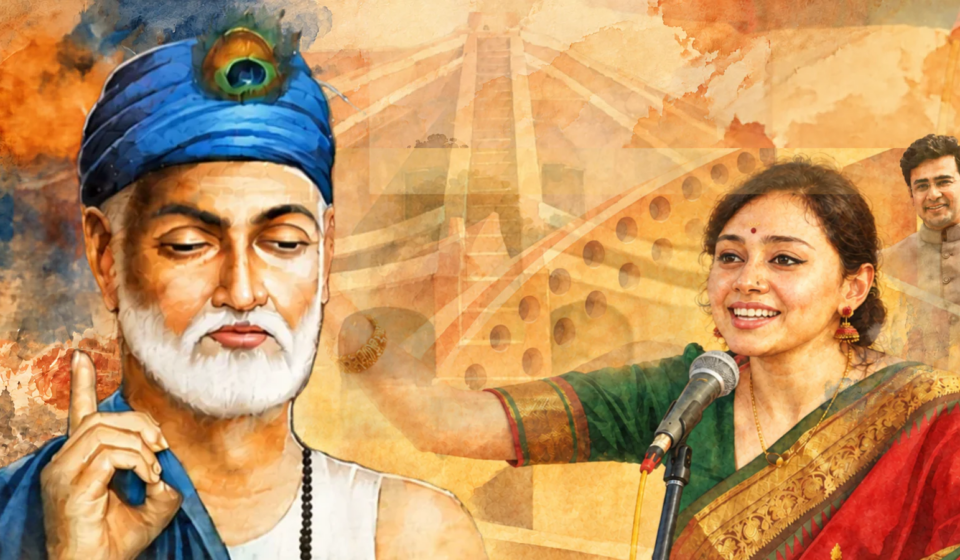

A video of Carnatic classical singer Sivasri Skandaprasad performing a bhajan attributed to the 15th-century saint-poet Kabir is being circulated as a political dig at recent protests at Delhi’s Jantar Mantar, even though the performance predates the agitation by about three years. Skandaprasad is the wife of Tejasvi Surya, a Bharatiya Janata Party Lok Sabha member from Bengaluru South, and that connection fuelled the viral claim.
X user Venkat Reddy shared the clip on October 25, asking what Jantar Mantar had to do with devotion to Ram and whether her husband’s party had not used the site in the past. The post drew around 150,000 views within a week.
The fact-check was straightforward. The full performance was uploaded in June 2024 by the YouTube channel of the Sri Jagannatha Perumal temple in Coimbatore, and a banner on the stage dates the event to 2023, before her marriage to Surya. The verse is also not new to her repertoire; she sang the same version in 2021.
The line she sings — “Jantar mantar latpat se nahin, Ram bhajan se hai mukti” — holds that liberation comes not through charms and spells but through devotion. In the devotional idiom, “jantar mantar” refers to occult rituals, rooted in the Sanskrit “yantra” and “mantra”. Delhi’s 18th-century observatory, which gave the protest site its name, shares those roots, with “jantar” being a colloquial form of “yantra”, meaning instrument.
The bhajan carries what is regarded as Kabir’s signature line, “Kahat Kabir, suno bhai sadho” (Kabir says, listen O seekers). Kabir is not known to have written any of his work down; his couplets and songs travelled orally, in a mixed language the Kabir Granthavali calls “panchmel khichdi”, drawing on Awadhi, Braj, Khari Boli, Punjabi, Rajasthani and Persian.
Bharat Ratna awardee Bhimsen Joshi recorded the bhajan for his 1989 album “Sun Bhai Sadho”, singing “jantar mantar latpat hove”, which keeps the meaning intact. The verse does not appear in the Kabir Granthavali compiled by Shyamsundar Das from manuscripts dated as early as 1504.
Hindi scholar Purushottam Agrawal, author of two books on Kabir, told NDTV that while the verse is absent from collected works, much of Kabir’s output travelled orally and the verse “could well be his”. He cautioned that dismissing such works as inauthentic is incorrect, but treating them as certainly his is equally so.
Kabir, born into a weaver community, rejected ritual, pilgrimage, idol worship and caste, and his legacy became a touchstone for anti-caste movements; B.R. Ambedkar counted him among his three gurus. His verses were included in the Adi Granth, compiled in 1604.
The clip surfaced at a charged moment. Protesters from the Cockroach Janta Party-led agitation, demanding the resignation of Chief Election Commissioner Gyanesh Kumar over alleged irregularities in the Special Intensive Revision of electoral rolls, were blocked from Jantar Mantar on October 10 and hundreds were detained, before the site was de-notified as a designated protest site. Surya has said people “should not confuse Jantar Mantar with the whole of India”. His wife, the article notes, was not singing about the place.
Original Source: https://www.ndtv.com/india-news/a-kabir-bhajan-tejasvi-suryas-singer-wife-sivasri-skandaprasad-and-the-meaning-of-jantar-mantar-12260362#publisher=newsstand
Category:
Tags:
Publish Date: 2026-10-30 22:06:00