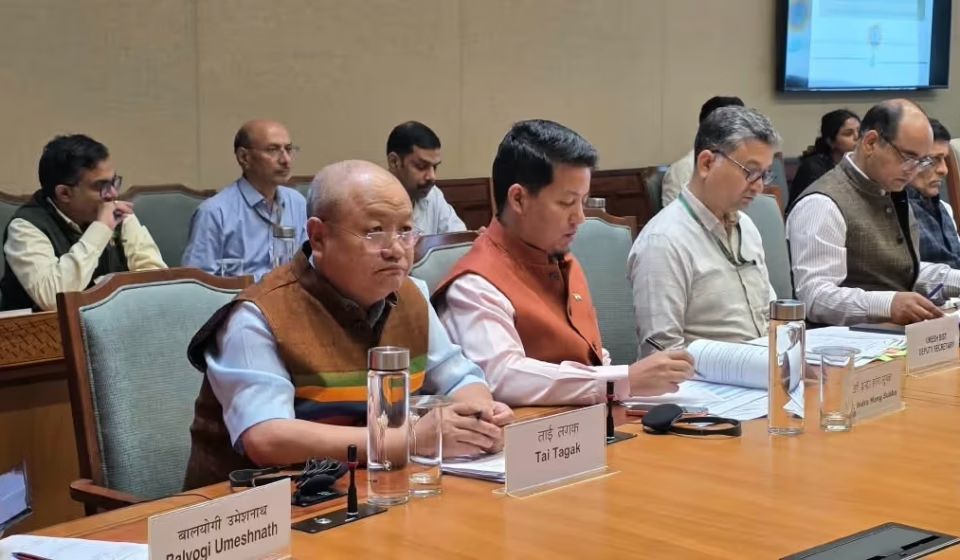

Rajya Sabha MP Tai Tagak has called for stronger flood management, continuous river monitoring, and comprehensive safety assessments of hydropower projects in Arunachal Pradesh and the wider Himalayan region, warning that the state’s difficult terrain, strategic borders, and exposed river systems demand urgent attention. Speaking at a meeting of the Parliamentary Standing Committee on Water Resources in New Delhi on October 30, Tagak urged the Centre to strengthen the Flood Management and Border Areas Programme (FMBAP) to support river protection, erosion control, and disaster mitigation infrastructure in the state.
The meeting was held as part of the committee’s examination of the project appraisal framework and accountability mechanisms of the Central Water Commission (CWC) and was attended by senior officials from the Ministry of Jal Shakti and the CWC.
Tagak drew attention to Arunachal Pradesh’s extensive river network, noting that the state shares international borders with China, Bhutan, and Myanmar. He said every district in the state is named after a river, underlining how closely its geography, ecology, and people’s livelihoods are tied to river systems. He expressed concern over what he described as inadequate monitoring by the CWC’s regional office and the Brahmaputra Board and called for systematic, continuous surveillance of rivers, water levels, and vulnerable stretches.
The MP also stressed the need for stronger early warning systems to identify flood threats and enable timely preventive action, especially given the state’s difficult terrain and exposure to extreme weather events. He sought adequate financial and technical support under FMBAP for river protection, erosion control, and disaster mitigation.
Highlighting the growing threat of Glacial Lake Outburst Floods, or GLOFs, in the Himalayan region, Tagak referred to the collapse of the Teesta-III hydroelectric dam in October 2023 and called for assessing the vulnerability of existing and under-construction dams to such events. Citing a Ministry of Jal Shakti statement issued on August 8, 2024, he noted that the CWC monitors 902 glacial lakes and water bodies in the Himalayan region annually between June and October. The ministry had also said the design flood of vulnerable dams would be reviewed to assess their capacity to withstand combined Probable Maximum Flood and GLOF scenarios. It had further informed that a Rs 150 crore GLOF risk mitigation project had been approved for Himachal Pradesh, Uttarakhand, Sikkim, and Arunachal Pradesh.
Tagak called for regular scientific assessments, monitoring, and mitigation measures to protect lives, livelihoods, and critical infrastructure. He also raised concerns about the safety and environmental implications of run-of-the-river hydropower projects in the Himalayan region, noting that while such projects generally involve limited or no large reservoir storage and use natural river flows, their operations depend on seasonal water availability. He said these projects require careful assessment of structural safety, hydrological vulnerabilities, and exposure to extreme flood events, including GLOFs.
Emphasising the fragile nature of the Himalayan ecosystem, Tagak said hydropower development must be backed by comprehensive scientific assessments, appropriate safety standards, and effective disaster preparedness. He also called for stronger coordination among the Ministry of Jal Shakti, the CWC, the Brahmaputra Board, the National Disaster Management Authority, and the Arunachal Pradesh government, and said the state’s specific geographical and climatic conditions must be considered while planning and implementing water resource and flood management projects.
Original Source: https://www.indiatodayne.in/arunachal-pradesh/story/arunachal-mp-flags-gaps-in-river-monitoring-demands-safety-review-of-himalayan-hydropower-projects-1469656-2026-10-30?utm_source=rssfeed
Category:
Tags:
Publish Date: 2026-10-30 21:22:00