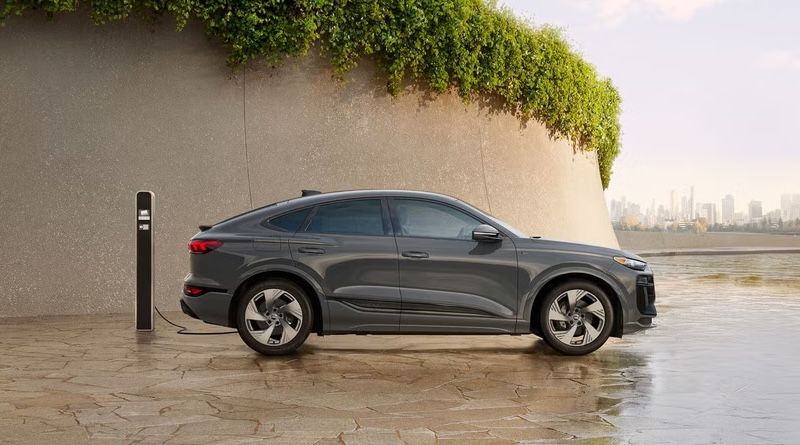
The Flexible Factory: Audi’s Hedge Against a Two-Speed EV Transition

Audi’s $4 Billion Bet Isn’t an EV Story. It’s an Architecture Story.
Everyone will read this week’s Audi announcement as a story about cars. It isn’t. Strip away the horsepower figures and the rally-stage politics, and what remains is one of the cleanest enterprise architecture case studies in recent memory – played out with lithium, steel, and a five-year clock ticking on every assumption behind it.
The news itself: Audi – the last premium automaker without a US plant – has announced a $4 billion factory in Peach County, Georgia, with full production not expected before 2031. Its American strategy leans on plug-in hybrids even as CEO Gernot Döllner predicts China and Europe will go fully electric within a decade; meanwhile, his stage appearance with President Trump has triggered a governance firestorm back in Germany, with VW supervisory board deputy chair Christiane Benner publicly calling it a breach of the company’s neutrality code.
One Roadmap Never Fits Every Market
Döllner’s forecast is refreshingly unsentimental: full battery-electric in China and Europe within ten years, combustion and hybrid dominance in the US for ten to fifteen. Anyone who has led a large-scale modernization program will recognize the shape of this instantly. You never migrate an entire enterprise on a single timeline – you segment by business unit, regulatory exposure, and user behavior. In software, we call this the strangler fig pattern: new capabilities grow around the legacy core, and the legacy retires quietly when – and only when – its replacement is genuinely ready. Audi is running a strangler fig migration on its own powertrain portfolio. The hybrids aren’t a retreat from electrification; they are the transition layer for a market whose infrastructure and habits haven’t caught up.
Designing for the Forecast to Be Wrong
The most architecturally interesting sentence in the entire announcement came from Georgia’s own press release: the plant will be “designed around Audi’s future manufacturing requirements, with a focus on efficiency, flexibility, and the ability to respond to evolving customer needs and market demand.” In my language, that’s loose coupling at industrial scale. A factory optimized for a single powertrain is cheaper to run; a flexible one is insurance against five years of rewrites – battery chemistry, tariffs, subsidies, consumer sentiment. Optionality always costs capital efficiency. But when forecast confidence is this low, optionality is the product. Add Georgia’s existing gravity – 35 EV-related projects and $23 billion already invested, with Rivian building next door – and the real wager is on ecosystem compounding, not any single vehicle.
The Debt Nobody Books on the Balance Sheet
Then there’s Benner’s rebuke – and every technology leader should study it. A $4 billion strategy executed without aligning the supervisory board and the workforce creates organizational debt, and I would argue it compounds faster than any technical debt I’ve encountered. I have sat through enough modernization reviews to know the technology is almost never what kills a program; unaligned stakeholders are. And note the quieter signal: Volkswagen cutting tens of thousands of German positions while greenfielding in Georgia. Capital flows – not press releases – reveal the real strategy.
What India’s Asymmetric Transitions Teach
There’s a lesson here for Indian industry too. Our most successful digital transitions honored uneven adoption: UPI grew alongside cash rather than replacing it, EVs electrified two- and three-wheelers long before cars, and hybrids remain hotly debated. Bridge technologies aren’t compromise – they are how a large, diverse market actually moves. For the manufacturing ecosystems emerging across India, including in the Northeast, Georgia’s playbook of clustered supply chains and flexible, phased capacity deserves close study.
Takeaways for Builders
- Segment your transition. A single roadmap across all markets or units is a forecast masquerading as a strategy.
- Price your optionality. Flexibility costs efficiency today; rigidity costs survival later.
- Treat bridge technologies as strategy, not hesitation – but define their sunset conditions.
- Stakeholder alignment is architecture. Governance debt compounds faster than technical debt.
- Watch capital flows, not stage performances.
The future rarely arrives on the schedule in the strategy deck. The architectures that endure – automotive or enterprise – are the ones designed to survive being wrong.
About the Author: Sanjeev Sarma is the Founder Director and Chief Software Architect at Webx Technologies. With a core focus on Generative AI integration, Cloud-Native Scalability, and Enterprise Software Architecture, he has spent over two decades driving digital transformation across Northeast India and beyond. Beyond his corporate leadership, Sanjeev is deeply invested in shaping the future of the IT industry. He serves as an Industry Expert on the Board of Studies for Assam Don Bosco University’s School of Technology, advises state technology committees, and actively mentors emerging tech startups at STPI. He brings a unique, dual perspective of high-level enterprise execution and future-ready academic curriculum development.