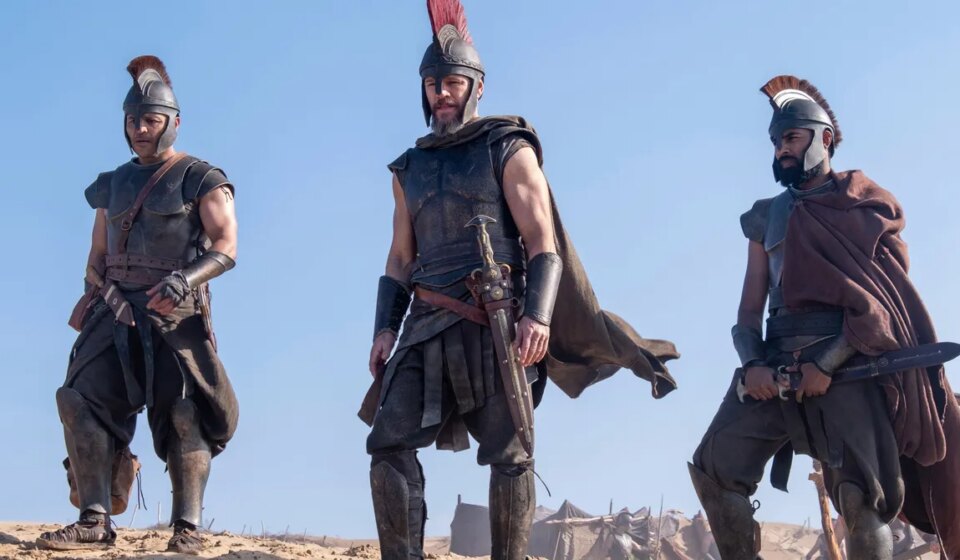

The Odyssey Test: What a Seven-Minute AI Video Teaches Us About the Gap Between Promise and Production
We often obsess over what generative AI can do, and almost never interrogate what it cannot yet sustain. A recent episode in the tech-culture wars makes that gap impossible to ignore.
The Signal
Earlier this year, the world’s richest man publicly vowed to produce a superior, “historically accurate” alternative to a blockbuster film adaptation of Homer’s Odyssey – generated entirely by his own company’s video model. Three months later, the deliverable arrived: not a full-length film, but a seven-minute episode. It exhibited classic signs of early-stage generative video – lip-sync drift, stilted dialogue, broken pacing, unearned narrative compression. And the sharpest critique came from an unexpected reviewer: the AI model itself, which, when asked, acknowledged that the output was neither historically accurate nor a faithful reconstruction.
The Demo-to-Delivery Gap
Strip away the personalities and the culture-war noise, and what remains is a deeply instructive engineering story. Long-form, coherent generative video remains one of the hardest open problems in AI research. A model can produce a stunning eight-second clip of waves on a Bronze Age shore. Sustaining character identity, temporal consistency, narrative logic, and emotional continuity across even seven minutes – let alone a feature film – requires architectural capabilities that don’t yet exist at production quality: persistent world-state memory, controllable narrative planning, and fine-grained multi-character direction.
This is the demo-to-delivery gap, and I have watched it play out in enterprise settings for two decades. Every hype cycle produces a dazzling capability demo, and every enterprise that commits budgets based on demos rather than sustained workloads learns the same expensive lesson. Generative AI is no different – the cost curve, the consistency problem, and the orchestration layer required for real production pipelines are where the actual engineering lives.
What CTOs Should Actually Extract
Three things deserve your attention here, none of which involve the product itself:
1. Narrative coherence is an architecture problem, not a model problem. The failures in this AI-generated episode weren’t failures of image fidelity. They were failures of state management – characters unnamed, timelines collapsing, dialogue dissociated from movement. Enterprises building agentic or generative pipelines will hit identical walls. Your RAG context windows, your memory hierarchies, your orchestration frameworks – that is where long-form coherence will be won or lost.
2. Self-referential AI critique is a new trust variable. The most remarkable part of this story is that the model itself, when queried, contradicted its owner’s marketing claim. As AI systems get embedded into enterprise workflows, we need to design for this: systems that can be audited, interrogated, and – crucially – trusted to report their own limitations. An AI that contradicts its owner is uncomfortable. An AI that cannot contradict its owner is dangerous.
3. Announcements are not roadmaps. When leadership commits to deliverables before the underlying R&D supports them, the technical debt is paid in credibility. This applies as much to a startup founder overpromising an AI feature as it does to a billionaire promising a film.
A Word for Builders and Students
If you are a young engineer watching this unfold, resist the temptation to read it as “AI video is a failure.” It is not. What happened here is that a frontier capability was prematurely wrapped in a commercial promise. The honest takeaway is more interesting: we are watching, in real time, the boundary of what current architectures can sustain – and that boundary is exactly where the next decade of research careers will be built. Learn where systems break. That’s where the real work is.
Closing Thought
Homer’s epic survived three millennia because it was, above all, coherent – a story that held together. Perhaps that’s the quiet lesson for our industry: before we promise machines that can tell humanity’s oldest stories, we should first engineer machines that can hold a narrative, and a truth, for seven consecutive minutes.