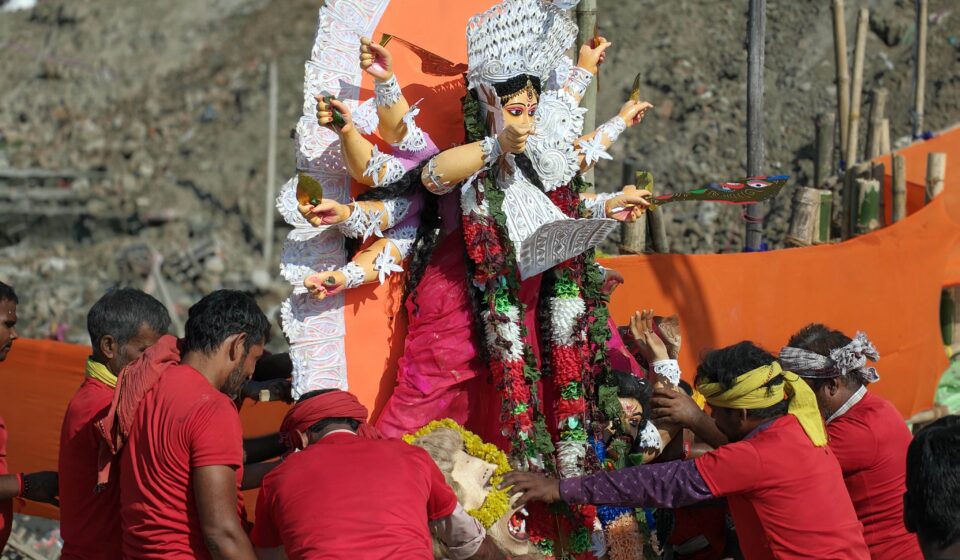

GUWAHATI: For several days, the city belonged entirely to Durga Puja — streets stayed awake longer, pandals glowed against the night sky and families lingered outdoors with no hurry to return home. But with Dashami and the immersion of the idols, that collective celebration has ended, leaving behind a quiet many residents say is hard to ignore.
During the festival days, life took on a different rhythm. Work waited, dinners happened late and sleep became negotiable. Friends who had not met for months found time for each other, children asked for one more ride and strangers walking the same crowded streets shared something intangible — the same lights, the same music and the feeling of being part of something larger than themselves. Even the traffic, a daily test of patience, folded itself into the Puja experience.
Then came Dashami. The dhaak continued to beat, but its rhythm carried a touch of sadness as the idols began their journey towards immersion. People gathered for one last glimpse of Maa Durga, folded their hands and watched her leave. The lights remained, the roads stayed crowded, yet the city seemed to have lost a little piece of itself.
The question many are asking is why the end of Durga Puja leaves such an emptiness behind. The answer, perhaps, lies in what the festival represents rather than the festival itself. The anticipation builds for months — plans are discussed, clothes are bought, meetings are promised, often long before the first dhaak is heard. And just as people settle into that happiness, it ends.
There is also a deeper truth woven into the tradition itself. Devotees welcome Maa Durga with joy while knowing her stay is temporary, and that Dashami will inevitably come. Embracing something fully despite knowing it cannot last may not be foolishness, but love. People do not stop celebrating because the festival will end; they celebrate because it came into their lives at all.
The transience also carries a personal weight. Next year, the lights will shine again and the dhaak will play again, but it will not be the same Puja. Children will have grown, friends may have moved away and some familiar faces may not return. Those who stand in the same pandal next year will not be exactly the people they were this year — which may be why festivals become memories even before they end.
Now, the pandals are disappearing, the festive clothes are going back into cupboards and phones are filling with photographs of moments that already feel further away than they are. Soon, the city will return to its familiar routine.
Yet the memories remain. A child will recall a balloon bought on Saptami, a family will talk about an evening spent together, and someone will remember a loved one who was missing this year. Slowly, sadness will give way to anticipation, and the waiting will begin again. The lights may have gone out on the streets, but the festival has left something glowing within — and that, perhaps, is how a celebration truly lives on: not in the pandals that remain standing, but in the memories people carry long after they are gone.
Original Source: https://assamtribune.com/opinion/on-second-thought-why-does-guwahati-feel-a-little-empty-after-puja-1620850
Category: Opinion
Tags:
Publish Date: 2026-10-21 21:52:00