
The Agentic AI Land Grab Has Begun. The Trust Layer Hasn’t.
Here is the contrarian view almost nobody is pricing in: the biggest constraint on agentic AI is not model capability – it is institutional trust.
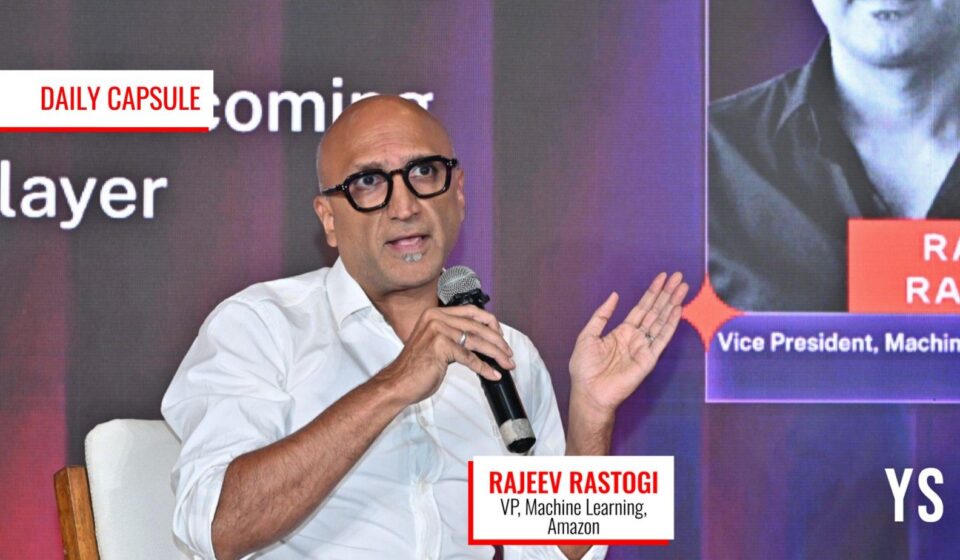
For four decades, enterprise software earned its seat in the org chart by being predictable. Same input, same output, same audit trail. Agentic AI breaks that contract by design. An agent that “prepares plans dynamically,” as Amazon’s Rajeev Rastogi put it at TechSparks 2026, is software whose next action no engineer fully wrote in advance.
The market signalled this week that the debate is over: Cognizant and Google Cloud have expanded their partnership with a dedicated Gemini Frontier Capability Group backed by 18,000 associates, while Rastogi described Rufus and autonomous seller assistants already operating as a conversational enterprise layer. CleverTap’s Anand Jain drew the maturity line most leaders are quietly avoiding – AI that generates content is a productivity tool; AI that makes real-time decisions is a business-model change. The scale of these commitments says one thing: agents are moving from keynote to operating budget.
From Software That Executes to Software That Decides
This is not an incremental upgrade. It is an architectural inversion. For forty years, the pattern was: human decides, software executes. The agentic pattern is: software decides, human supervises. That flips the entire control plane of the enterprise – and most legacy stacks were simply never designed for it.
I have seen enough modernization programmes to make one prediction with confidence: agents do not fix bad architecture – they expose it. An agent is only as good as the tools it can invoke. If your backend is a tangle of undocumented integrations, your agent will not rescue it; it will amplify it, faster and more confidently than any human ever could.
Three engineering realities deserve board-level attention. First, observability must evolve: log the reasoning trail, not just the outcome, because when an autonomous system misfires, “the model decided” is not an answer any auditor will accept. Second, unit economics change shape: chatbots were costed per token; agents must be costed per resolved outcome – if you cannot measure cost-per-task, you cannot scale cost-per-trust. Third, identity management must extend to non-human actors. Least privilege cannot remain a doctrine for employees alone; every agent needs scoped credentials, approval gates, and a kill switch as first-class architecture.
The Frontline Frontier: Where Bharat Meets Autonomy
The most underrated signal this week was Hunar.AI’s Rs 40 crore Series A for AI built for frontline-intensive industries. That is where agentic AI becomes genuinely Indian-scale. Our frontline is where digital infrastructure meets the citizen – the ASHA worker, the FPO aggregator, the logistics partner navigating Guwahati in the monsoon. Natural-language agents layered over the India Stack can collapse the distance between complex systems and users who will never love a dashboard. And with grocery overtaking mobiles as e-commerce’s biggest category, even our highest-frequency commerce now runs on margins thin enough that automation is no longer optional. Here lies the leapfrog: regions that never absorbed legacy ERP can go straight to agentic service delivery, without paying the migration tax.
The Architect’s Takeaways
- Treat your tool and API layer as the moat. Model capability will commoditize; well-designed, semantically rich tools will not.
- Design auditability in from day one. Trace the “why,” not just the “what.”
- Budget by outcome, not by token. Cost-per-resolved-task is the new unit of AI ROI.
- Extend zero trust to machines. Agents are identities too.
- For founders: domain depth beats demo polish. The frontline whitespace is enormous, but it is won in the messy last mile, not the slick keynote.
One closing thought. This newsletter’s trivia reminded us that the first Mickey Mouse cartoon, Plane Crazy, was silent. Agentic AI today feels similar – dazzling motion, but the sound hasn’t arrived yet. The sound is accountability. Whoever engineers it first will own the next decade of enterprise software.
About the Author: Sanjeev Sarma is the Founder Director and Chief Software Architect at Webx Technologies. With a core focus on Generative AI integration, Cloud-Native Scalability, and Enterprise Software Architecture, he has spent over two decades driving digital transformation across Northeast India and beyond. Beyond his corporate leadership, Sanjeev is deeply invested in shaping the future of the IT industry. He serves as an Industry Expert on the Board of Studies for Assam Don Bosco University’s School of Technology, advises state technology committees, and actively mentors emerging tech startups at STPI. He brings a unique, dual perspective of high-level enterprise execution and future-ready academic curriculum development.