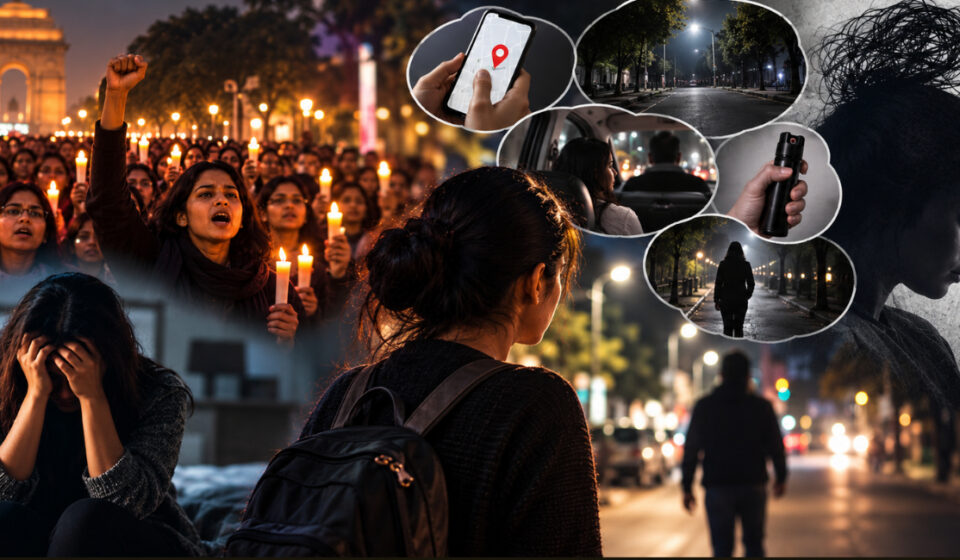

Nearly 14 years after the Nirbhaya case sparked nationwide outrage in India, psychologists argue that the conversation around women’s safety continues to ignore a crucial dimension: the constant mental calculation of risk that shapes women’s everyday lives. Writing in a recent commentary, Muskan Shah and Moitrayee Das of FLAME University, Pune, contend that while public attention cycles through outrage after each horrific assault and then fades, women carry an invisible psychological burden that crime statistics never capture.
The authors describe this burden as an “invisible workload” of safety decisions that precede even simple tasks like buying groceries. Should I take a cab at this hour? Why is that person walking behind me? Should I share my location? Can I drink if I’m getting home alone? Individually, these seem like ordinary questions. Collectively, researchers Vera-Gray and Kelly have called this “safety work” — a process that restricts women’s use of public space and places the responsibility for preventing violence on potential victims themselves.
The calculation follows a pattern, the authors explain. It begins with scanning surroundings, moves into assessing what could go wrong, then shapes behaviour — which route to take, when to leave, which transport to use, which places to avoid. Emotionally, it raises a persistent question: is it safe to relax here? The body remains vigilant too, responding not to actual threats but to the possibility of one. Autonomy suffers as women weigh what freedoms — a party, a drink, a late dinner — to give up in exchange for feeling safer.
The authors are careful to distinguish vigilance from pathology. A woman checking the child lock in a cab is not hypervigilant; she is rationally responding to real risk. But chronic exposure to perceived threat, amplified by constant news of sexual assaults, can produce anticipatory anxiety that affects daily life. Biologically, a nervous system repeatedly mobilised for danger struggles to return to a genuinely restorative state, meaning even moments of physical safety offer limited psychological relief. True safety, they argue, is not merely the absence of assault but the ability to stop anticipating one.
The commentary also critiques the well-meaning advice every woman receives — don’t travel alone, don’t stay out late, carry pepper spray, share your location. While individually practical, such instructions collectively deliver a disturbing message: safety is your responsibility. The authors point to recent cases, including a sexual assault in a public park near Lady Shri Ram College in Delhi that led to classes moving online rather than increased protective measures, and a case at Cornell University in the US, as evidence that institutional betrayal is not geographically limited.
Their prescriptions include accessible, trauma-informed psychological care for women before incidents occur, not only after, attention to sleep, anxiety, shame and trust, institutional responses that do not retraumatise survivors, and grave punishments that signal such behaviour is unacceptable. Society, they conclude, must stop individualising women’s safety. Teaching women to manage danger is no substitute for addressing its sources. A psychologically healthy society, the authors write, is one in which safety does not require constant mental calculation.
Original Source: https://nenow.in/opinion/the-vigilance-tax-psychological-cost-of-an-unsafe-world.html
Category: Opinion,Top News
Tags:
Publish Date: 2026-10-20 22:50:00