Beyond the Swipe: The New Architecture of Real-World Social

The Next Social Platform Will Coordinate Groups, Not Just Connections
We have spent two decades teaching digital platforms to predict what one individual wants. The more consequential challenge now may be helping a small group safely decide what it wants to do together. That is the strategic signal behind the recent move by Tinder and its peers toward group-based, activity-oriented dating.
From Endless Browsing to Shared Intent
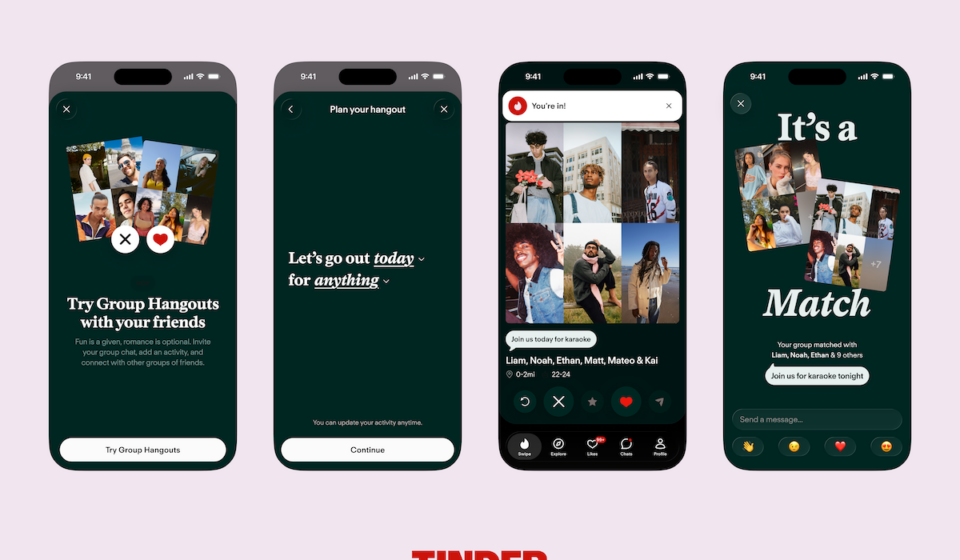
Younger users are showing fatigue with endless one-to-one discovery. Tinder’s Group Hangouts lets small friend groups discover other groups around shared activities and open a shared chat when there is mutual interest; the move follows Double Date and local Events, while Bumble is pursuing a similar direction with Plans. The commercial context matters-Tinder is responding to declining revenue and active users-but the deeper story is a shift from a profile marketplace to a coordination platform.
The Matching Unit Is Changing
The obvious question is how to make recommendations better. I think the more important question is what the system is now managing: not just an individual profile, but a bounded, temporary group identity with shared intent.
That sounds simple, but it changes the domain model. A group needs membership, roles, visibility, activity context, and lifecycle states. One member’s interest can initiate a connection, but it cannot commit everyone. The platform must model partial preference, delegated authority, and eventual multi-party confirmation.
Many existing systems are brittle here because they assume one user, one account, and one transaction per action. A social plan, by contrast, may be proposed by one person, accepted by some, declined by others, and abandoned without ending the friendship. This is a distributed workflow, not merely a messaging thread.
For architects, the implication is to design group-aware identity from the start: separate the durable relationship graph from the ephemeral group session; attach consent and permissions to actions; and use event-driven workflows for invitations, RSVPs, changes, cancellations, and outcomes. These are capabilities enterprises will need as communities, learning cohorts, marketplaces, and collaboration products become more group-oriented.
Trust Must Become a System Primitive
The most revealing detail is the separation between leaving a conversation and leaving the friend group, alongside blocking or reporting an individual participant. Social safety cannot be a single account-level switch. It must be contextual and enforceable at the level of a conversation, participant, group, and activity.
More context can improve relevance, but it can also expose sensitive information. Recommendation systems may identify compatible groups, yet they should not infer or manipulate private attributes. Automation can rank options; it should not manufacture consent. Explainable preferences, granular controls, and auditable moderation will matter as much as matching quality.
This is also where responsible AI belongs. The objective is not maximum prediction, but calibrated assistance that preserves user agency. A model that produces a plausible match while obscuring why it did so-or treating a group profile as unanimous consent-creates architectural and ethical debt.
Measure the Outcome, Not the Scroll
Success metrics must change too. Swipes and time spent are easy to count, but they reward browsing rather than meaningful action. Better indicators include accepted plans, repeat participation, healthy group retention, and user-reported safety. A platform can generate activity without creating belonging.
The network effect also shifts. Individual networks scale through contacts; group networks scale through compatible circles, shared activities, and reliable coordination. Those effects depend on local liquidity, thoughtful onboarding, and safety at scale. A phased rollout is therefore not a temporary product inconvenience; it reflects the operational reality of moderation and learning.
What Leaders Should Carry Forward
CTOs, founders, and researchers must design for multi-party decisions rather than individual profiles alone. It is essential to treat consent, privacy, and moderation as core architecture. Finally, organizations must optimize for completed, safe outcomes rather than attention alone.
For students and young entrepreneurs, the opportunity is to build the coordination layer that many products still leave to group chats and spreadsheets. The future of social technology may not be a better version of endless scrolling. It may be a quieter transition from “Who should I meet?” to “How can we safely do something together?”
About the Author: Sanjeev Sarma is the Founder Director and Chief Software Architect at Webx Technologies. With a core focus on Generative AI integration, Cloud-Native Scalability, and Enterprise Software Architecture, he has spent over two decades driving digital transformation across Northeast India and beyond. Beyond his corporate leadership, Sanjeev is deeply invested in shaping the future of the IT industry. He serves as an Industry Expert on the Board of Studies for Assam Don Bosco University’s School of Technology, advises state technology committees, and actively mentors emerging tech startups at STPI. He brings a unique, dual perspective of high-level enterprise execution and future-ready academic curriculum development.