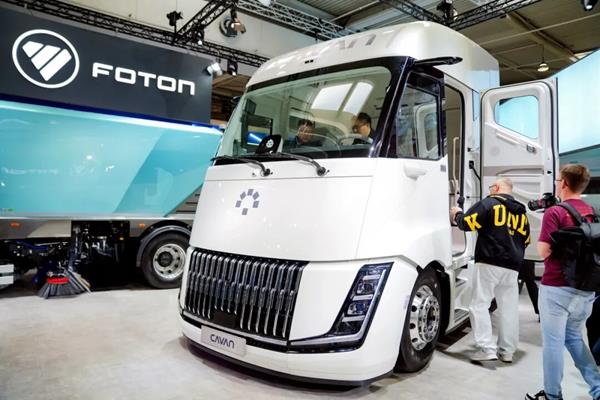

Heavy Transport’s Next Breakthrough Is Not a Better Truck. It Is a Better System
We often reduce heavy-transport electrification to a chemistry contest: how much energy a battery can store, how quickly it can recharge, or how far hydrogen can carry a truck. That framing misses the deeper signal from IAA Transportation 2026. BAIC Foton’s presentation connected modular powertrains, very-high-power charging, software-defined driving, local assembly, and service operations into a single ecosystem.
From an enterprise-architecture perspective, I see the truck as no longer an isolated asset. It is an edge node in a cyber-physical system connecting vehicles, depots, electricity networks, chargers, telematics, maintenance teams, and planning software. The strategic question is therefore not simply, “Which powertrain wins?” It is, “How do all these components behave as one reliable service?”
The Truck Is Becoming a System
The modular architecture deserves scrutiny. Supporting battery-electric, battery-swapping, gaseous-hydrogen, and liquid-hydrogen variants can preserve strategic flexibility as regulations, infrastructure, and freight economics evolve. But optionality has a cost.
Multiple powertrains and operating configurations increase certification, diagnostics, inventory, training, cybersecurity, and maintenance complexity. Furthermore, flexibility creates value only when energy infrastructure, fuel economics, and customer demand are sufficiently mature.
A modular platform creates value only when it is governed by stable interfaces and disciplined configuration management. Otherwise, it becomes a large collection of technical exceptions-and long-term architectural debt.
Charging Speed Is a Systems Problem
The reported ability to move from 20% to 80% charge in roughly 18 minutes is impressive. However, 1.44-megawatt charging is not merely a faster dispenser. It becomes a power-plant and site-engineering problem involving grid capacity, transformers, switchgear, cooling, energy storage, redundancy, and demand management.
Fleets will require real-time orchestration so that vehicles, electricity tariffs, renewable generation, and site constraints are coordinated intelligently. The meaningful KPI is not peak charging speed; it is uptime and the time returned to revenue-generating service.
For architects, this changes the design boundary. A charging platform must incorporate vehicle state, charger availability, grid constraints, route plans, and operational schedules as part of one coherent control system.
Software Is Now Safety Infrastructure
Advanced driver assistance, telematics, fleet scheduling, and over-the-air updates turn the truck into a long-lived software platform. That demands safety-case engineering, signed updates, secure data exchange, network segmentation, and clear data ownership.
Route, payload, energy-use, and maintenance data are commercially sensitive. Operators need enough portability to avoid vendor lock-in, while safety-critical functions must remain isolated from commercial analytics.
A truck may be electric, but its weakest architecture can still be a fragile software supply chain.
Localization Is Architectural, Not Cosmetic
European assembly and engineering plans reveal that localization is no longer about lower labour costs alone. It also concerns regulatory fit, supply-chain resilience, service responsiveness, and institutional trust.
For India, the lesson is not to copy a European product catalogue. Given diverse duty cycles, climate conditions, fleet economics, and grid constraints, the priority should be open charging protocols, interoperable fleet APIs, certified maintenance, grid-aware scheduling, and corridor-based deployment.
Founders should focus on enabling layers that allow heterogeneous vehicles and operators to work together-not simply another closed dashboard.
CTOs and fleet operators should validate pilots against real payloads, gradients, weather, utilization, battery degradation, and financing costs. Controlled demonstrations are a starting point, not a business case.
Key Strategic Implications
Fleet operators must recognize that range is an ecosystem outcome rather than merely a vehicle headline. Modularity creates advantage only when supported by common standards, interfaces, and controls. Furthermore, megawatt charging requires resilient, grid-aware site architecture, not just high-powered hardware.
In addition, software, service, data, and skills are as strategically important as the physical vehicle. Finally, localization must be designed from day one, rather than being retrofitted later.
The next transport revolution will not be won by the truck with the most impressive specifications, but by the ecosystem that keeps delivering every day.