Enterprise Solar Architecture: Earth-Mount Design, Autonomous O&M, and LCOE

Rethinking “rack-and-steel” as an architectural choice, not a constraint
We are used to seeing solar projects as combinations of panels, inverters, and rows of steel racking. A recent case study about an earth‑mounted, flat-panel deployment for a municipal water treatment site reminded me that many assumptions baked into solar project economics are actually choice points in system architecture – and that rethinking those choices can shift where costs, risks, and value land on the developer, operator, and end customer.
What the case showed (briefly)
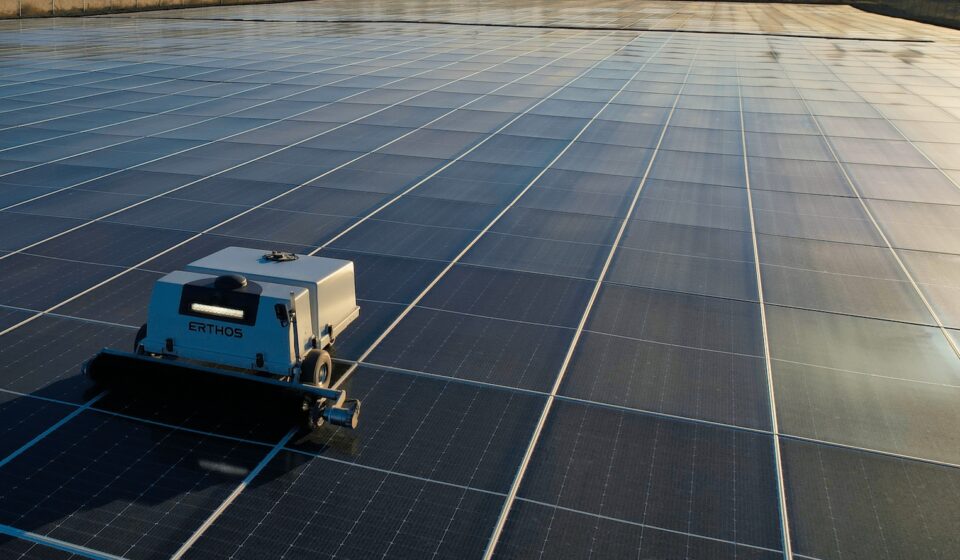
A commercial developer deployed a utility-scale, earth-mounted PV array that places modules directly on the ground rather than on conventional steel racking, paired with autonomous dry-cleaning robots and an energy services agreement for operations and maintenance. The result reported was higher energy density per acre, lower installed costs, and early production consistently above projections.
Why architects and CTOs should care
At an enterprise level, this is not merely an engineering curiosity; it’s an example of systems-level optimization that changes procurement, O&M, contractual risk allocation, and long-term asset management.
- Design-for-cost vs. design-for-performance: Eliminating racking reduces CAPEX, but it also changes thermal, drainage, and mounting behavior. Lower upfront cost can be appealing, yet the true metric for most adopters is levelized cost of energy (LCOE) over decades. Architects must model both immediate savings and the implications for module cooling, soiling losses, and degradation rates.
- Density trade-offs and land use: Higher energy per acre is strategically valuable where land is scarce or expensive. For enterprises planning onsite generation (factories, water utilities, campuses), increased power density means better utilization of constrained footprints – but denser layouts also alter maintenance access, shading behavior, and emergency response plans.
- O&M becomes the differentiator: Autonomous cleaning robots and centralized Energy Services Agreements (ESAs) shift risk from asset owners to service providers. That’s attractive for organizations that want predictable utility-like pricing, but it demands strong SLAs, transparent telemetry, and failure-mode analysis. I advise insisting on clear uptime and yield guarantees and a shared data feed for independent performance verification.
- Supply‑chain and resilience: Reducing reliance on specific structural materials or labor types improves resilience to commodity shocks. However, new architectures introduce novel single points of failure (robot fleets, proprietary anchors). Diversifying suppliers and requiring modular, replaceable subsystems reduces long-term tech debt.
Practical evaluation checklist for decision-makers
If you’re assessing whether a ground‑mounted, low‑profile architecture is right for your site, consider these points up front:
- Site geotechnics: soil bearing, frost heave, erosion and drainage under monsoon or extreme rainfall.
- Thermal performance: flat-mounted modules often run hotter – model degradation and expect different performance curves.
- Access & safety: emergency access routes, vegetation control, and fire risk management at higher density.
- O&M guarantees: robot uptime, cleaning efficacy in local dust/pollen conditions, and battery backup for the robots.
- Contract clarity: who owns what telemetry, who pays for replacements, and how are performance shortfalls remedied?
A note for India (and the Northeast)
There is a clear parallel for parts of India where land is fragmented and slopes are common. The ability to tolerate modest slopes and reduce heavy structural steel could lower barriers for municipal and industrial rooftop‑scale projects in hilly regions. The dry-cleaning approach is particularly attractive in water‑stressed areas. That said, India’s heavy monsoon season and sensitive hilltop ecologies impose stricter requirements on erosion control, drainage design, and community consent – so local pilots with tight geotechnical study and community engagement are essential before scaling.
Takeaways for leaders
- Treat mounting architecture as a strategic variable, not a fixed commodity.
- Focus procurement on total system LCOE and verifiable SLAs, not just CAPEX.
- Require transparent telemetry and independent performance verification.
- Pilot novel approaches in sites where site geology, hydrology, and community context are well understood.
Closing thought
Engineering choices that reduce visible cost often surface hidden complexity – a reminder that the job of an architect is not just to minimize price, but to align design, operations, and governance so the system keeps delivering value across its lifetime.
About the Author: Sanjeev Sarma is the Founder Director and Chief Software Architect at Webx Technologies. With a core focus on Generative AI integration, Cloud-Native Scalability, and Enterprise Software Architecture, he has spent over two decades driving digital transformation across Northeast India and beyond. Beyond his corporate leadership, Sanjeev is deeply invested in shaping the future of the IT industry. He serves as an Industry Expert on the Board of Studies for Assam Don Bosco University’s School of Technology, advises state technology committees, and actively mentors emerging tech startups at STPI. He brings a unique, dual perspective of high-level enterprise execution and future-ready academic curriculum development.