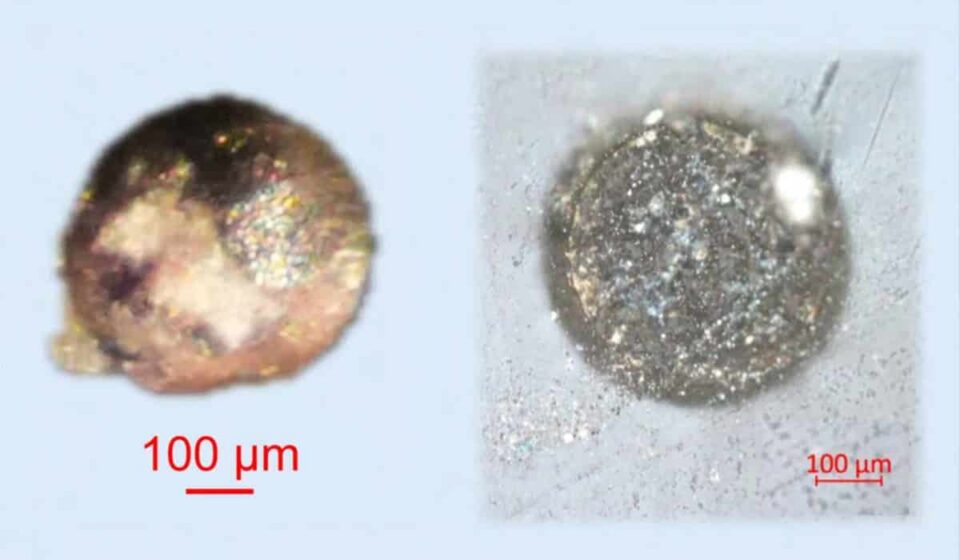

A speck of metal no wider than a red blood cell, recovered from a glassy droplet in Hiroshima Bay sand, contains a previously unknown, silicon-rich alloy whose atoms froze into an orderly crystal born in the fireball of the August 6, 1945, atomic blast. Reported by Luca Bindi and colleagues in Science Advances, the finding identifies a grain roughly 10 micrometers across made mostly of iron with substantial chromium, silicon and nickel plus manganese, molybdenum and aluminum — elements likely vaporized from buildings and urban materials during the 15-kiloton airburst about 600 meters above Hiroshima.
The researchers examined 34 of these so-called “hiroshimaites,” glass spherules formed when the blast vapor condensed and cooled. One spherule contained metal flecks that made up only about 1–3% of the object. The team removed four metal grains by hand and analyzed them; three were ordinary iron–chromium alloys, but the fourth showed an unexpected internal order. Chemical mapping revealed its mixed composition, and single-crystal X‑ray diffraction — a technique that uses X‑ray scattering to reveal atomic positions — showed the grain adopted a cubic AlAu4‑type structure, an ordered relative of the beta‑manganese lattice. That arrangement is surprising because multicomponent, stainless‑steel–like alloys with similar elements usually form simpler, more disordered lattices; here, a crowded chemical mix sits in a highly organized framework, bridging complex alloys and ordered compounds rather than matching known “high‑entropy” behavior.
Scientists think the alloy formed when vaporized metals mixed in the fireball, condensed into a tiny molten droplet and froze nearly instantaneously as it cooled in flight, locking atoms into a configuration not previously observed on Earth. Previous work on hiroshimaites has shown that much of this condensation occurred within seconds as the cloud cooled from thousands of kelvins; research on other nuclear‑blast glasses and on Trinity test debris has likewise revealed exotic, previously unknown materials produced by extreme heat and rapid quenching.
The new particle has two broad implications. In nuclear forensics, the chemical makeup and crystal structure of such grains could record temperatures, oxidation states and cooling rates of a blast, helping identify the materials involved or locate clandestine tests. In materials science, reproducing similar rapid‑solidification conditions by nonexplosive methods might yield novel alloys with useful properties. Major caveats remain: the claim rests on a single microscopic grain, so the material is not yet a practical alloy or a manufacturing recipe, and the grain’s existence does not lessen the human tragedy that created it.
Original Source: https://www.zmescience.com/science/news-science/strange-alloy-hiroshima/
Category:
Tags:
Publish Date: 2026-07-31 05:27:00