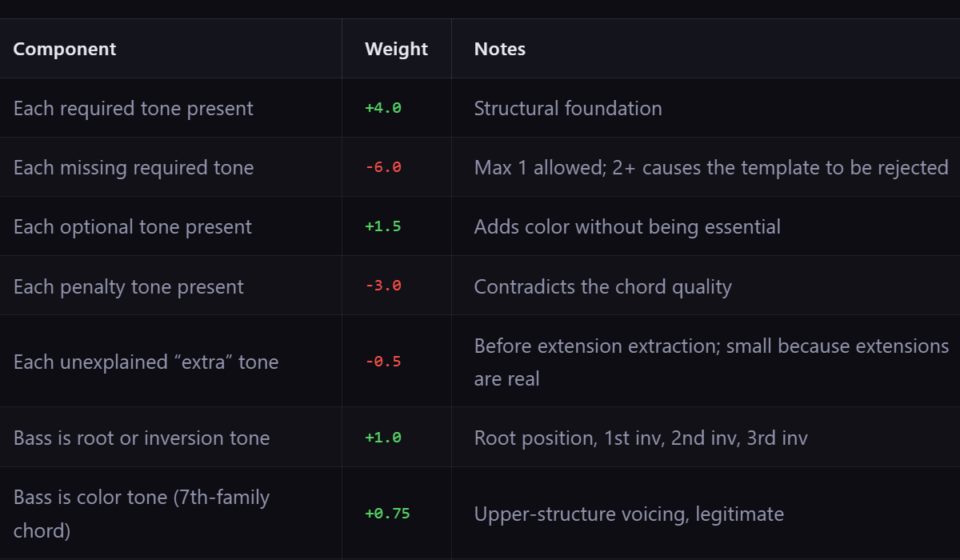

We spend a lot of time chasing bigger models and flashier AI demos, but sometimes the most interesting engineering conversations live in how we turn ambiguous, real‑world signals into crisp, actionable labels. I recently came across an elegant example of that problem-space in a project called WhatChord – a small tool that identifies musical chords from sets of notes using a carefully weighted scoring approach rather than an opaque classifier. That design choice contains lessons every CTO and architect should file away.
The signal: WhatChord treats chord identification as a constrained scoring problem. Required intervals add positive weight; dissonant or mutually exclusive intervals impose penalties; unexplained tones and edge‑case extensions add further adjustments. The result is a ranked set of candidate chords with an explicit reasoning path behind each score.
Why this matters for systems design
– Ambiguity is the norm, not the exception. In many domains – music, medical diagnostics, fraud detection, or natural language tagging – inputs map imperfectly to canonical labels. Building a scoring layer that captures domain rules, penalties and confidence gives you a predictable, debuggable first line of inference.
– Explainability beats mystique. Rule‑weighted scoring makes the “why” visible: which note pushed the score up, which penalty disqualified a candidate. That transparency is priceless for domain experts who must validate outputs, and for regulatory or audit needs.
– Lean, domain-aware systems are often more robust than blind ML. A small rule set informed by expert knowledge can outperform a data‑hungry model when labelled data is scarce or the consequences of mistakes are high. And when you do add ML, the rules provide a clear scaffolding for hybrid systems.
Architectural trade‑offs (what to think about)
– Speed vs. nuance: Simple rules are fast and predictable; comprehensive rule‑sets and cascading penalties grow in complexity. Keep a fast path for common inputs and deeper analysis for ambiguous cases.
– Maintainability vs. coverage: Rule logic tends to crystallize into business logic debt unless it’s externalized and versioned. Treat musical intervals like any domain taxonomy – separate config, audit trails, and test suites.
– Build vs. buy: If the domain is narrow and core to your product, build a configurable scorer. If it’s tangential, evaluate best‑in‑class tools that offer hooks for explainability and exportable reasoning.
Operationalizing the pattern
– Expose confidence and top candidates: Don’t return a single label. Return ranked hypotheses with scores and the key rules that determined them so users can judge or override.
– Feedback loop: Log mismatches and let domain experts tune weights. Use that data to guide whether to invest in statistical models later.
– Configurable rules UI: Give product owners control over weights and penalties. What’s a deal‑breaker in jazz might be acceptable in pop.
– Monitoring and drift: Track how often the scorer returns low‑confidence outputs; that signals either taxonomy gaps or changing input distributions.
A brief, practical note for India (and similar emerging markets)
Tools like WhatChord show how focused, explainable logic can democratize specialist knowledge. In India’s edtech ecosystem – including music schools and rural coaching – a lightweight, offline‑capable chord identifier with clear explanations could be far more valuable than a large cloud model. It would help teachers, students, and community music groups incorporate immediate feedback into practice sessions where connectivity and labelled data are limited.
Takeaways for leaders
– Treat ambiguity as a first‑class design requirement.
– Prioritize explainability and configurability over opaque accuracy claims.
– Start with rules and domain knowledge; add ML where data and business value justify it.
– Instrument for feedback and make the scorer tunable by experts.
Closing thought
Good systems don’t just output labels; they capture intent and make that intent negotiable. Whether you’re classifying chords or customer journeys, aim for models that explain themselves and invite correction – that’s how software becomes a partner to expert human judgement, not a mystery.
About the Author Sanjeev Sarma is the Founder Director of Webx Technologies Private Limited, a leading Technology Consulting firm with over two decades of experience. A seasoned technology strategist and Chief Software Architect, he specializes in Enterprise Software Architecture, Cloud-Native Applications, AI-Driven Platforms, and Mobile-First Solutions. Recognized as a “Technology Hero” by Microsoft for his pioneering work in e-Governance, Sanjeev actively advises state and central technology committees, including the Advisory Board for Software Technology Parks of India (STPI) across multiple Northeast Indian states. He is also the Managing Editor for Mahabahu.com, an international journal. Passionate about fostering innovation, he actively mentors aspiring entrepreneurs and leads transformative digital solutions for enterprises and government sectors from his base in Northeast India.