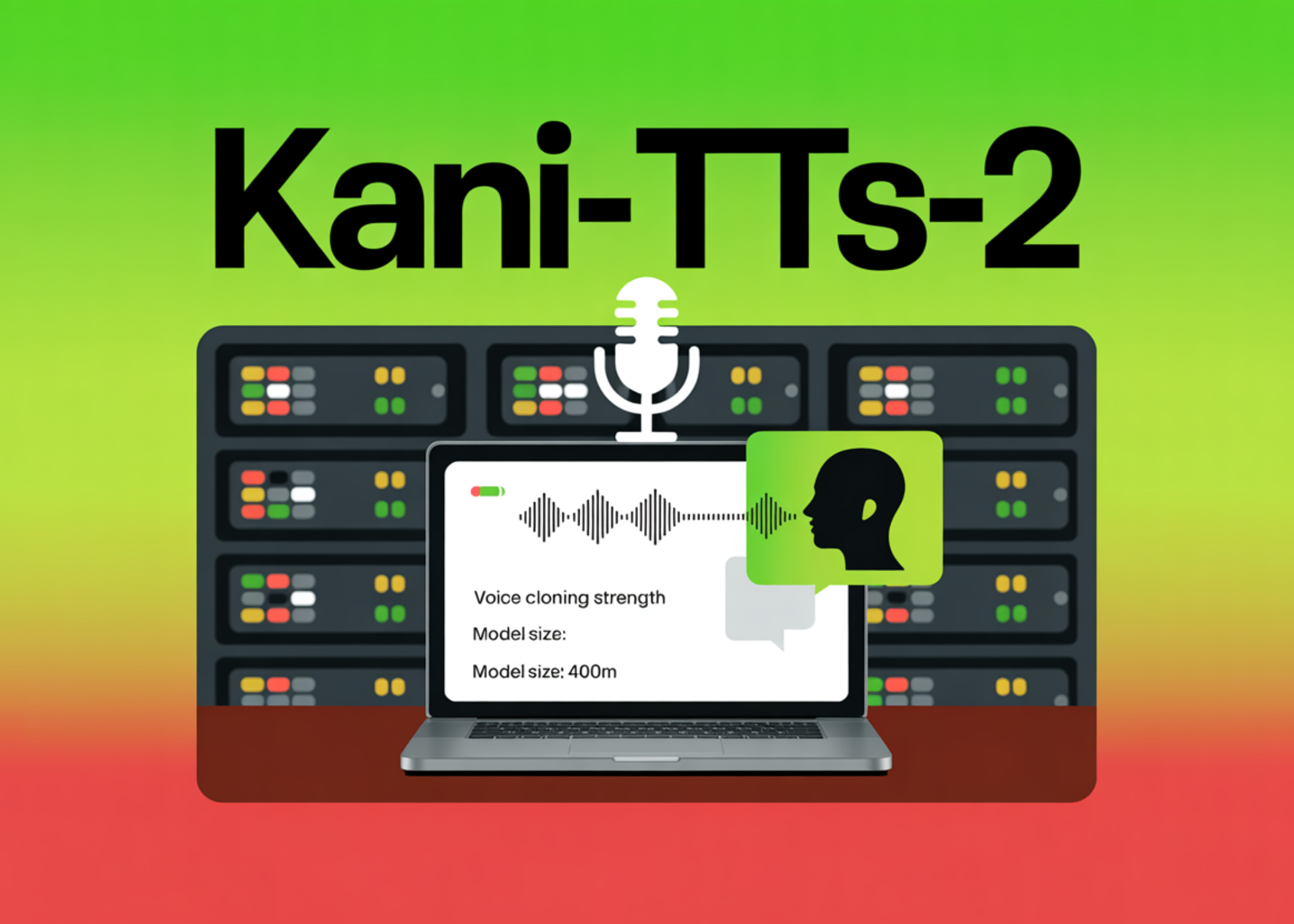

We have spent the last five years equating “bigger” with “better” in generative audio – larger parameter counts, longer pretraining, and cloud-only inference. The recent arrival of Kani‑TTS‑2 is a welcome corrective: it demonstrates that architecture and representation (audio-as-language + neural codecs) can deliver high‑fidelity, low‑latency speech without the heavy operational footprint we’ve come to accept.
The signal: an open‑source model (Kani‑TTS‑2) built on an efficient language backbone and a lightweight neural codec promises consumer‑grade TTS and zero‑shot voice cloning with only ~400M parameters and ~3GB VRAM requirements. The maintainers report fast training at scale and an Apache 2.0 license that permits commercial use.
Why this matters to architects and CTOs
– The “efficiency first” pattern changes the economics of voice: local inference on consumer GPUs becomes practical, reducing dependency on expensive cloud TTS APIs and their recurring costs, latency, and data egress.
– Treating audio as discrete language tokens – paired with a neural codec – is an important design shift. It preserves prosody and speaker characteristics while enabling smaller backbones to do the heavy lifting. That matters when you must balance throughput, latency, and infrastructure cost.
– Zero‑shot speaker embeddings open new product flows (instant cloning, personalization at scale) but simultaneously surface clear ethical and governance risks. Voice is biometric – misuse can be reputational, legal, and criminal.
Trade-offs and architectural considerations
– Quality vs. footprint: Smaller models can match perceived quality for many applications, but edge cases (emotional nuance, noisy inputs, low-resource languages) may still need larger or adapted models.
– On‑prem vs. cloud: Local deployment reduces latency and protects data sovereignty – attractive for government and regulated enterprises. But it shifts burden to teams for updates, security, and model governance.
– Operational complexity: Supporting model updates, monitoring audio quality, and enforcing consent for cloning adds new operational responsibilities. This is not “lift and forget” infrastructure.
Actionable guidance for CTOs and founders
– Run a focused PoC: evaluate intelligibility, prosody, and cloning fidelity on representative samples – include noisy channels and regional accents.
– Quantify TCO: compare cloud API costs (per-minute billing) vs. one‑time infrastructure and ops cost for local inference (hardware, maintenance, staff).
– Implement governance early: consent flows, usage logging, speaker consent records, and technical watermarking or detection mechanisms to deter abuse.
– Secure the pipeline: protect speaker embeddings, model weights, and inference endpoints with role‑based access, encryption at rest/in transit, and anomaly detection.
– Hybrid strategy: keep cloud fallbacks for high‑quality or rare‑language synthesis while using edge models for common, latency‑sensitive paths.
A practical Bharat/Northeast lens
In regions with intermittent connectivity and tight budgets – including many parts of Northeast India – low‑VRAM, offline‑capable TTS is not just convenient, it’s transformative. Imagine offline IVR for public health alerts, localized voice assistants in tribal languages, or low‑latency voice UX for last‑mile government services. However, local deployments must be paired with clear consent mechanisms and community engagement when voice cloning is enabled.
Ethics and policy first
The ability to clone voices instantly mandates proportional policy and detection investments. Organizations should treat voice cloning capability as sensitive functionality: require documented consent, implement visible markers for synthetic output, and prepare a rapid response plan for misuse.
Takeaways
– Efficiency is a strategic lever – it enables local-first, low-latency voice services without the cloud tax.
– New architectures (audio-as-language + neural codecs) make smaller models surprisingly capable, but production readiness requires governance, security, and monitoring.
– For governments and enterprises in resource‑constrained environments, this opens practical paths to inclusive voice services – if implemented responsibly.
Closing thought
The next wave in generative audio will be decided less by sheer scale and more by how thoughtfully we deploy capability – balancing accessibility, privacy, and the social cost of synthetic voices.
About the Author
Sanjeev Sarma is the Founder Director of Webx Technologies Private Limited, a leading Technology Consulting firm with over two decades of experience. A seasoned technology strategist and Chief Software Architect, he specializes in Enterprise Software Architecture, Cloud-Native Applications, AI-Driven Platforms, and Mobile-First Solutions. Recognized as a “Technology Hero” by Microsoft for his pioneering work in e-Governance, Sanjeev actively advises state and central technology committees, including the Advisory Board for Software Technology Parks of India (STPI) across multiple Northeast Indian states. He is also the Managing Editor for Mahabahu.com, an international journal. Passionate about fostering innovation, he actively mentors aspiring entrepreneurs and leads transformative digital solutions for enterprises and government sectors from his base in Northeast India.