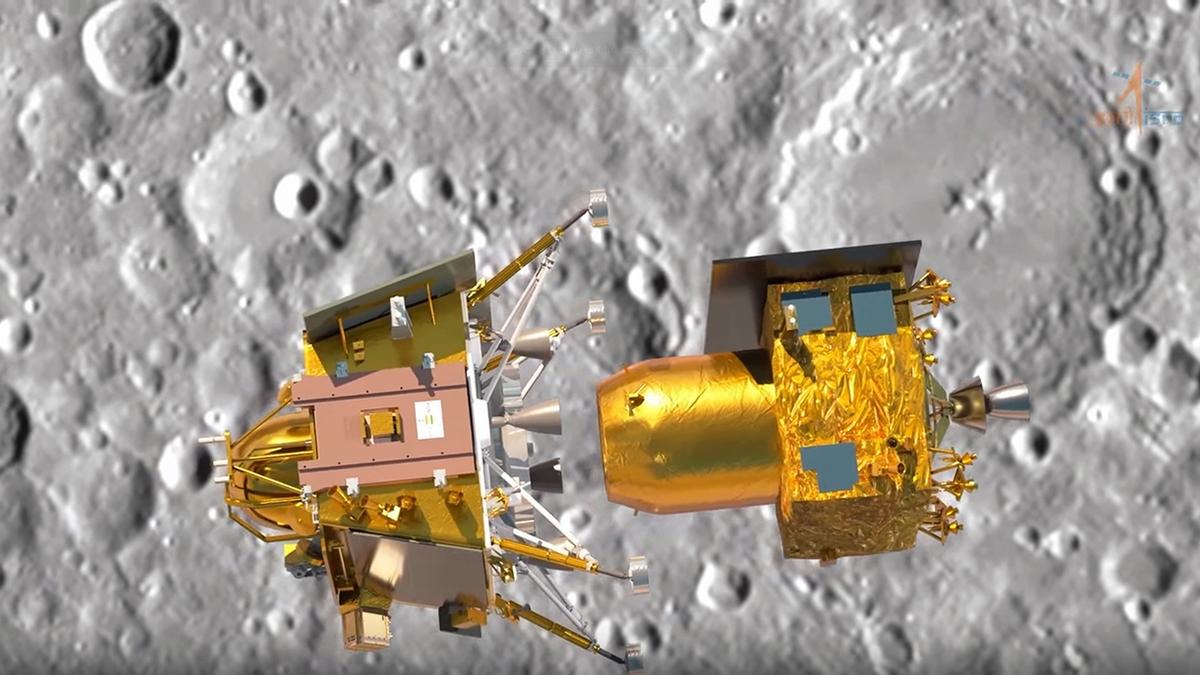
Unleashing Cosmic Wonders: How the Moon Elevated Chandrayaan-3’s Journey to a Stunning New Orbit!

On December 30, 2025, renowned astronomer Jonathan McDowell shared intriguing news on X.com regarding the Chandrayaan-3 propulsion module, which had been abandoned in a large orbit around Earth. Initially left in a 125,000 x 305,000 km orbit in 2024, the module experienced significant gravitational interactions with the Moon in November. It is now located in a striking new orbit measuring 365,000 x 983,000 km at an inclination of 22 degrees. McDowell, known for his meticulous documentation of space endeavors through Jonathan’s Space Report, emphasizes the unpredictable nature of objects that have orbits crossing the Moon’s vicinity.
Spaceflight often encounters challenges when spacecraft are left in uneven orbits, especially those nearing the Moon’s gravitational influence. McDowell’s mention of “Moon-orbit-crossing” indicates that the propulsion module’s path around Earth brought it within a range comparable to the Moon’s average distance of approximately 384,000 km. This proximity means that the module could experience gravitational nudges from the Moon, which complicate its trajectory in unpredictable ways.
In lower Earth orbits, where the gravitational pull of our planet dominates, satellites follow more predictable paths. However, as you venture toward the Moon, a three-body dynamic emerges: the Earth, the Moon, and the satellite all exert gravitational forces, resulting in rapid changes in motion and position. Minor variations can lead to significant orbital alterations, a phenomenon McDowell aptly described as “chaotic.”
The Chandrayaan-2 mission faced setbacks when its lander crashed on the Moon’s surface in 2019, but the mission’s orbiter continued to function. The subsequent Chandrayaan-3 mission featured a propulsion module, lander, and rover. After successfully landing on the lunar surface in August 2023, the propulsion module was positioned in its initial eccentric orbit. However, close passes by the Moon in November led to major changes in its orbital parameters.
According to an ISRO statement, the propulsion module entered the Moon’s “sphere of influence” on November 4 and exited on November 14. During this time, it made two close approaches, coming within 3,740 km and 4,537 km of the lunar surface on November 6 and 11, respectively. These close encounters resulted in an expanded orbit; the apogee increased significantly, now measuring over 727,000 km according to ISRO, while McDowell reported it as 983,000 km. This shift clearly indicates that the Moon’s gravitational influence fundamentally reshaped the propulsion module’s trajectory.
The new orbit not only reached higher altitudes but also altered its overall shape and orientation. The propulsion module’s perigee, the point nearest Earth, settled at about 365,000 km, moving it far from its original 125,000 km mark. Additionally, the orbit tilted by 22 degrees due to the gravitational interactions, demonstrating that the Moon’s pull changed the module’s angular momentum.
ISRO noted that they meticulously monitored the propulsion module’s trajectory and interactions with other space objects during this process, affirming that its performance remained stable throughout these encounters. Tracking teams have since identified the propulsion module, previously mistaken for an asteroid named CE1M9G2, thanks to the collaborative efforts of amateur astronomers like Sam Deen, Luca Buzzi, and software developer Bill Gray.
In summary, the Chandrayaan-3 propulsion module’s recent journey underscores the dynamic interactions between celestial bodies and highlights the complexities of modern space exploration.
Original Source: https://www.thehindu.com/sci-tech/science/how-the-moon-kicked-chandrayaan-3-propulsion-module-into-a-new-orbit/article70451842.ece
Category :
Tags:
Publish Date: 2025-12-30 08:37:00