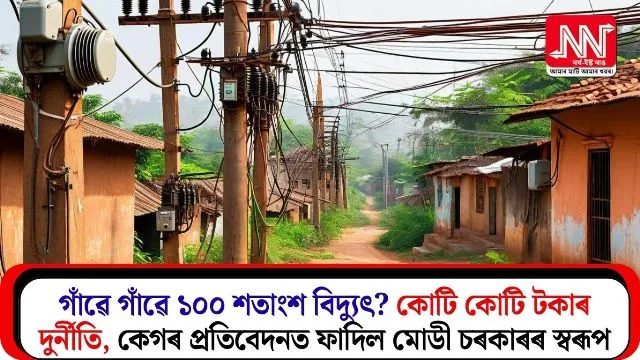

The Indian government has launched initiatives to ensure adequate electricity services reach every household, especially in rural areas, under the Prime Minister’s “Saubhagya” scheme and the Deen Dayal Upadhyaya Gram Jyoti Yojana. These projects were announced after Narendra Modi’s government came to power in 2014, with claims of achieving 100% electrification in rural regions.
However, recent reports from the Comptroller and Auditor General of India raise questions about these claims, citing financial irregularities associated with both schemes. The report states that reaching 100% rural electrification is far from possible, and the actual connection rates are markedly lower than government assertions.
The Rajiv Gandhi Grameen Vidyutikaran Yojana was a major electrification initiative under the previous Manmohan Singh administration, which Modi’s government rebranded after renaming it in honor of Deen Dayal Upadhyaya. This initiative included a total of 605 projects, but it was reported that 494 of these were not implemented properly. Specifically, there was a lack of accurate surveys on which villages would receive these projects within the scheduled timeframe.
Committees were formed in each state to oversee the quality checks and preparation of detailed project reports prior to the initiation of the projects. However, it appears these reports were submitted directly to the central government, bypassing state-level regulations, and were accepted without objections.
According to the report, the central government has already disbursed approximately ₹5,420 crore under these schemes. Yet, in many cases, the project management organizations were engaged only 360 days after receiving these funds. Moreover, the distribution of funds did not follow the completion of preliminary tasks, with ₹16,040 crore allocated significantly ahead of schedule.
What is the real status of the Saubhagya scheme? Initially, the government stated that it would provide electricity connections to 30 million homes. This figure was later revised down to 26.3 million. While Modi announced that this target would be fully met by March 2019, the actual number of homes connected by that time was only 15.2 million, indicating a significant disparity between claims and reality. Reports also note that over 1.9 million homes in seven states remain without electricity.
The intended result of both the Deen Dayal and Saubhagya schemes was for customers to obtain electricity connections through either initiative. However, a study found that around 17,000 homes received connections via both schemes simultaneously, suggesting that contracting companies were charging for connections under both programs. Not only regular consumers but also certain electricity distribution companies have reportedly charged for the same work under two different schemes.
For the Saubhagya scheme, where the cost to the central agency exceeded ₹350 crore, funds were allegedly borrowed from the market beyond the approved budget, totaling ₹500 crore. By the end of the project, only ₹95 crore had been spent, with the remaining funds left unaccounted for. This raises serious questions regarding transparency, as the CAG has highlighted these financial irregularities under Modi’s government, which claims to champion transparency.
Original Source: https://assam.nenow.in/cag-audit-exposes-gaps-in-rural-electrification-claims-by-center/
Category: অসম,উত্তৰ-পূব,দেশ,শীর্ষ সংবাদ
Tags:
Publish Date: 2025-12-30 10:06:00