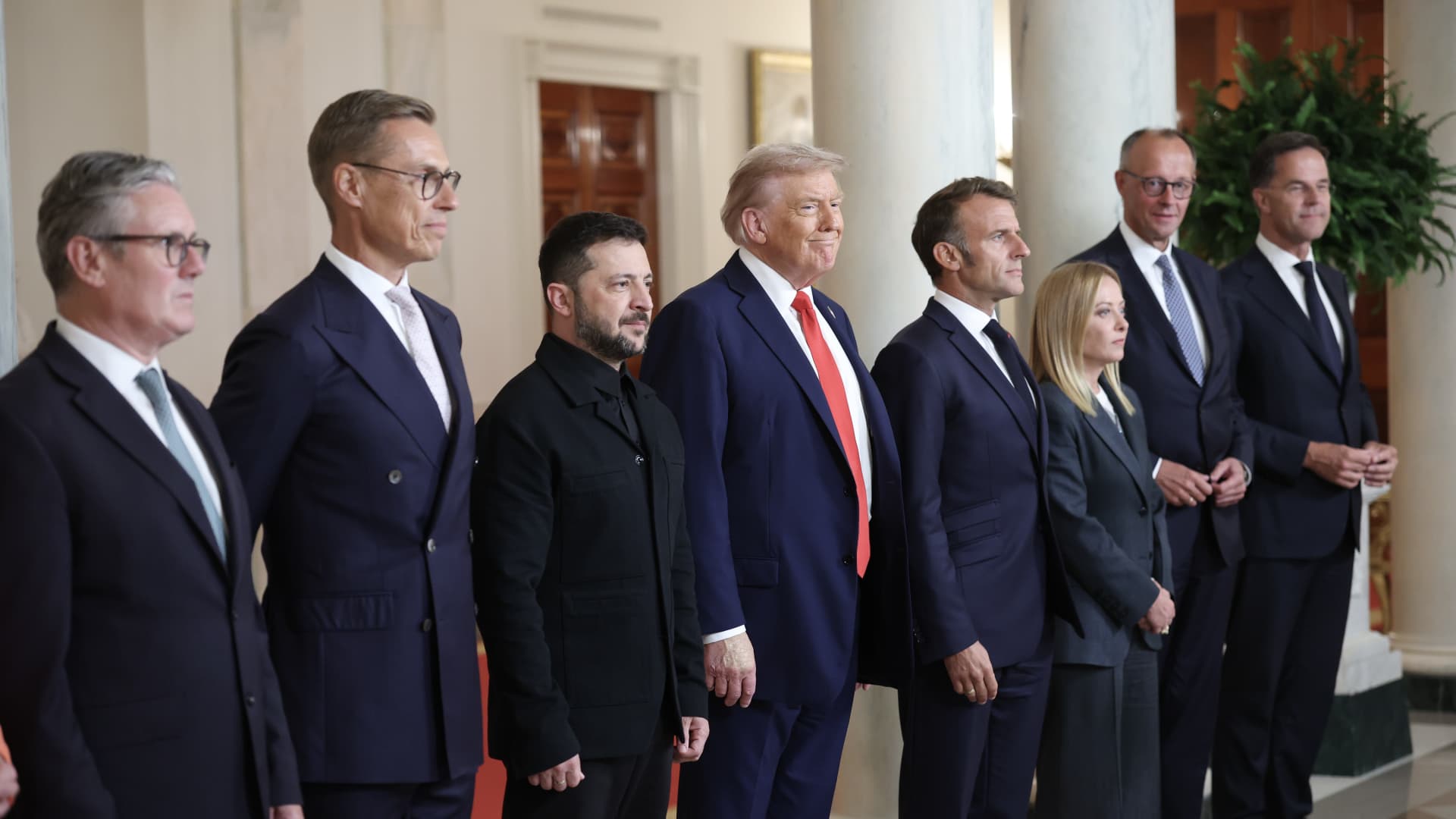
Trump’s Bold Critique of ‘Weak’ European Leaders: A Timely Call for Strength Amid Global Turmoil

U.S. President Donald Trump has once again sparked controversy with his remarks regarding Europe, branding the continent’s leadership as “weak” and its region as “decaying” during a recent interview with Politico. This criticism comes at a time when European nations are striving to demonstrate unity and decisiveness in their response to pressing issues, including immigration and the ongoing war in Ukraine. Trump’s comments are particularly jarring given Europe’s recent diplomatic efforts, including military and financial support for Ukraine-efforts he has frequently minimized.
In his interview, Trump stated, “I think they don’t know what to do,” dismissing European leaders’ attempts to address the war. Such remarks are unsettling for Europe as analysts and leaders recognize that the resolution of nearly four years of conflict is vital for regional security. This backlash comes on the heels of Ukrainian President Volodymyr Zelenskyy’s visit to London, where he met with European leaders to discuss security guarantees for Ukraine, emphasizing their joint opposition to any territorial concessions demanded by Russia.
European discussions also included future funding strategies for Ukraine, particularly the potential use of frozen Russian assets for reconstruction. However, these plans face significant hurdles and resistance from certain EU countries. Trump seemed unfazed by Europe’s efforts, asserting, “They talk but they don’t produce. And the war just keeps going on and on.”
The relationship between Trump and Europe is complex, marked by moments of rapport with leaders like the United Kingdom’s Prime Minister Sir Keir Starmer and Italy’s Giorgia Meloni, contrasted with a strained dynamic with Germany’s Chancellor Friedrich Merz and French President Emmanuel Macron. Trump’s tendency to belittle political adversaries is well-documented, yet his willingness to jeopardize longstanding alliances forged since World War II raises alarms in Europe.
Last week, Trump’s new national security strategy warned that Europe faces the threat of “civilizational erasure” within two decades, questioning the reliability of European allies while advocating for improved relations with Russia. This shift in strategic focus has drawn praise from the Kremlin, which noted the alignment with its perspective.
Analysts view this change as a significant transformation in U.S.-European relations. Ian Bremmer, founder of the Eurasia Group, commented that Trump’s worldview positions a united Europe as a threat rather than an asset. Bremmer highlighted that Trump perceives the European Union as an entity capable of delivering unwelcome critiques, altering the dynamics of their interactions.
In summary, Trump’s recent remarks and strategic pivot signal a profound alteration in the transatlantic relationship, calling into question the future of U.S.-European collaboration. As Europe navigates these challenges, it faces a delicate balancing act in addressing both internal and external pressures-a reality that may reshape its approach to global security and diplomacy in the years to come.
Original Source: https://www.cnbc.com/2025/12/10/trump-criticism-of-european-leaders-as-weak-comes-at-the-worst-time.html
Category :
Tags:
Publish Date: 2025-12-10 14:41:00