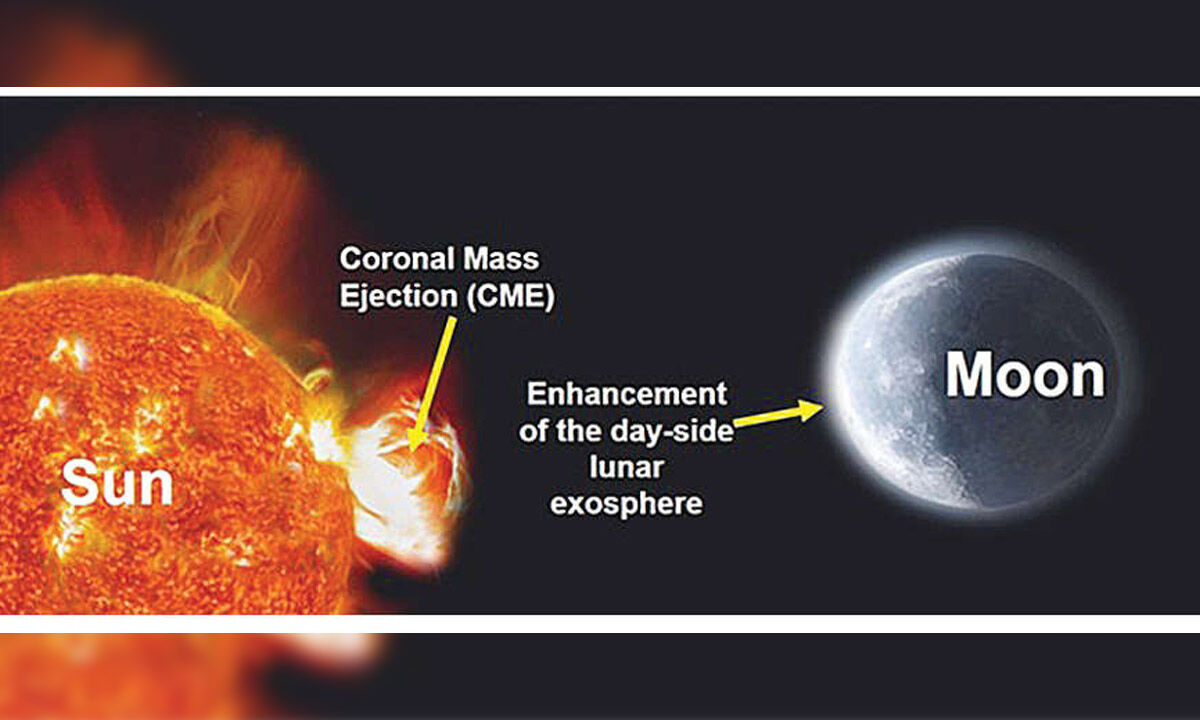

In a groundbreaking development, the Indian Space Research Organisation (ISRO) has made history with its lunar orbiter, Chandrayaan-2, by observing the first-ever effects of Coronal Mass Ejections (CMEs) from the Sun on the Moon. This stellar achievement, announced from ISRO’s headquarters in Bengaluru, marks a significant step forward in understanding the Moon’s exosphere-the thin layer of atmosphere that envelops it-and how space weather influences its surface conditions.
Launched on July 22, 2019, from Sriharikota aboard the GSLV-MkIII-M1 rocket, Chandrayaan-2 was outfitted with eight scientific payloads. The orbiter successfully entered an elliptical orbit around the Moon on August 20, 2019. While communication was lost with the Vikram lander during its landing attempt on September 7, 2019, the orbiter itself remains fully operational, maintaining a stable orbit approximately 100 kilometers above the lunar surface.
ISRO revealed that the Chandra’s Atmospheric Compositional Explorer 2 (CHACE 2) payload has been instrumental in recording the impact of CMEs on the lunar exosphere. CHACE 2’s primary mission is to assess the composition and distribution of the Moon’s neutral exosphere and to monitor its variations over time. A particularly notable observation occurred on May 10, 2024, during a rare solar event when multiple CMEs struck the Moon, resulting in a remarkable spike in pressure within the dayside lunar exosphere.
According to ISRO scientists, the number density of neutral atoms and molecules in the lunar exosphere surged by more than an order of magnitude, thereby validating theoretical predictions that had previously gone unconfirmed through direct observation. The Moon’s exosphere, categorized as a surface boundary layer, is particularly responsive to solar activity due to the lack of a global magnetic field. The CME event temporarily enhanced the release of atoms from the lunar surface, shifting the atmospheric conditions in ways that had not been observed before.
These findings not only contribute to a deeper scientific comprehension of lunar space weather but also carry significant implications for future lunar exploration and the potential design of human habitats on the Moon. By gaining insights into how solar events affect the Moon’s atmosphere, researchers can better prepare for the challenges that might arise during future manned missions.
ISRO’s achievement underscores the importance of continued exploration and observation of celestial bodies beyond Earth. The importance of such missions goes beyond scientific curiosity; they pave the way for sustained human activity in space and the exploration of our solar system.
This milestone emphasizes the critical role that ISRO plays in advancing our understanding of space phenomena. As scientists continue to analyze the data collected by Chandrayaan-2, the implications for lunar science and future interplanetary exploration become increasingly significant.
The observations made by Chandrayaan-2 not only enrich our knowledge of the Moon but also highlight the potential for ongoing discoveries as we turn our gaze toward the cosmos. With each new piece of information, we draw closer to demystifying the intricate relationship between solar activities and the lunar environment.
Tags: ISRO, Chandrayaan-2, Coronal Mass Ejections, lunar exosphere, space weather, lunar missions, scientific discovery.
Original Source: https://www.thehansindia.com/technology/tech-news/chandrayaan-2-catches-suns-fury-hitting-moon-1016184
Category :
Tags:
Publish Date: 2025-10-20 07:56:00