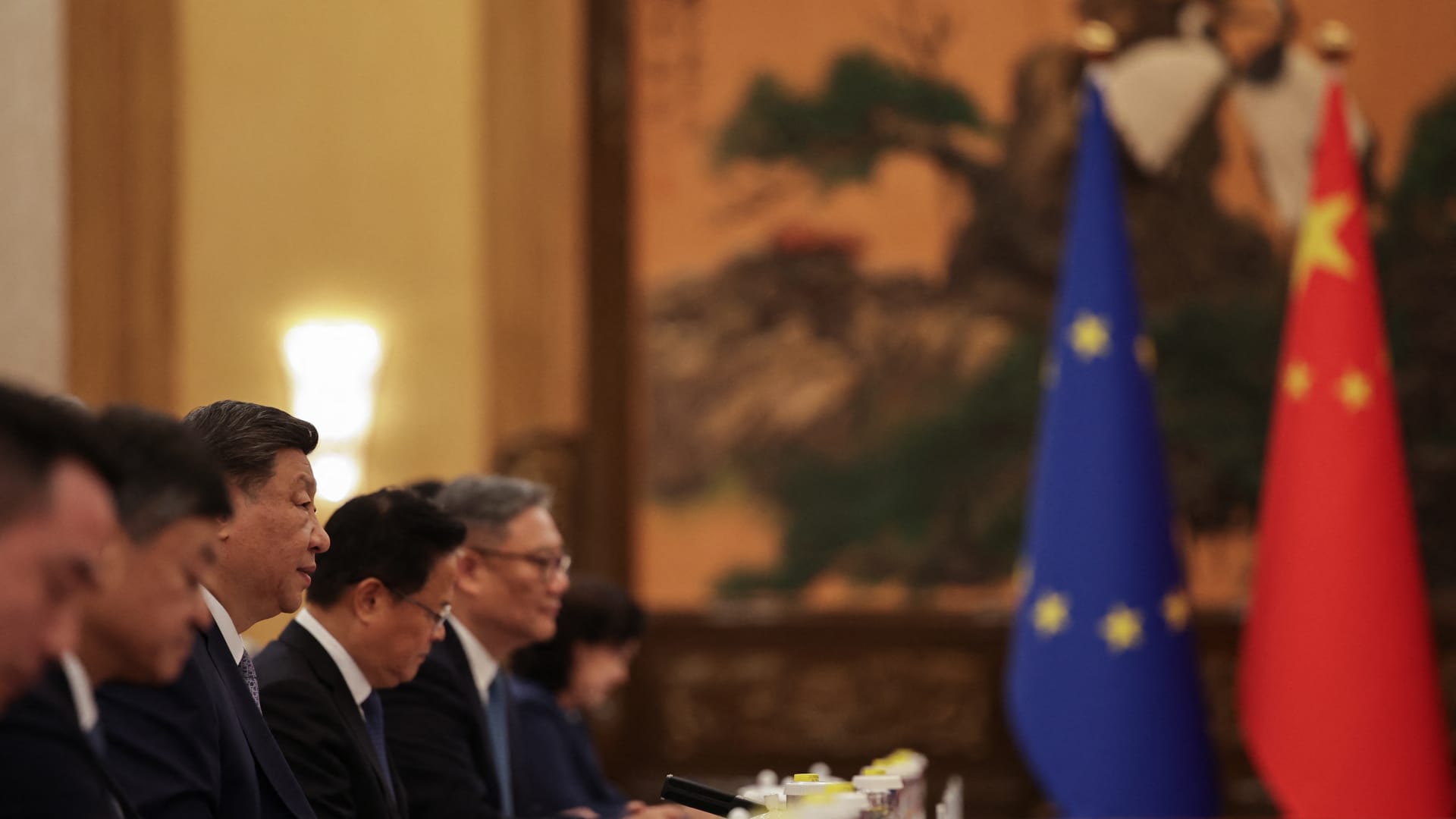

Chinese President Xi Jinping underscored the importance of strengthening ties with the European Union during the 25th EU-China Summit, which was held in Beijing on July 24, 2025. However, the gathering also revealed significant underlying tensions, particularly concerning a growing trade imbalance. Xi characterized the bilateral relationship as “mutually beneficial,” emphasizing that as global geopolitical challenges increase, enhancing communication and cooperation between China and the EU becomes vital. “The more severe and complex the international situation is, the more we should strengthen mutual trust and deepen cooperation,” Xi stated, as reported by CNBC.
In contrast, European Commission President Ursula von der Leyen adopted a more assertive stance, urging Xi to address the escalating trade disparity between the two economies. “We have reached an inflection point. Rebalancing our bilateral relation is essential,” she remarked, highlighting the need for both sides to recognize their concerns and propose tangible solutions. This firm tone reflects the ongoing strain in EU-China relations, particularly as trade tensions have mounted globally.
China has experienced a goods-trade surplus of nearly $143 billion with the EU in the first half of this year-up 21% from a year prior-exacerbating existing imbalances. Last year, the EU imposed tariffs on Chinese electric vehicles to shield its domestic industry, prompting Beijing to initiate anti-dumping investigations into European products, including brandy, dairy, and pork. This cyclical pattern of retaliatory measures illustrates the divergent goals and frustrations harbored by both parties.
Daniel Balazs, a research fellow at the S. Rajaratnam School of International Studies, noted that both sides echoed their established positions without significant progress. While the EU seeks a more balanced economic relationship and desires China to leverage its influence to bring Russia to dialogue over the Ukraine conflict, Beijing is focused on rolling back EU restrictions on Chinese firms and tariffs on its electric vehicles. Earlier in July, von der Leyen criticized China, claiming it was “enabling Russia’s war economy.”
Beyond trade imbalances, challenges over market access and China’s stance on Russia’s actions in Ukraine further complicate EU-China relations. Recently, China implemented measures limiting government procurement of medical devices from European firms following Brussels’ moves to restrict Chinese companies from EU public tenders for medical equipment. Similarly, China’s curbs on rare-earth exports have led to production halts for several European automakers, though the country has since taken steps to ease these restrictions.
Despite these concessions, analysts at the Eurasia Group describe the “weaponization of rare earth elements” as leaving a substantial impact on Europe, with officials in Brussels expressing frustration over Beijing’s policies. This may accelerate the EU’s efforts to ‘de-risk’ its economic dependence on China.
Originally scheduled to take place in Brussels, the high-stakes summit was relocated to Beijing and condensed from two days to one, a shift interpreted as indicative of the fragile state of EU-China ties. The Eurasia Group attributed this alteration to the increasingly hardened attitudes and misaligned expectations between the two global powers, reinforcing the notion that the road ahead for EU-China relations remains fraught with challenges.
This summit highlights not just the urgency of collaboration in an increasingly complex international landscape, but also the necessity for both sides to find common ground amid their differing interests.
Original Source: https://www.cnbc.com/2025/07/24/eu-china-summit-xi-courts-eu-while-brussels-demands-trade-rebalance.html
Category :
Tags:
Publish Date: 2025-07-24 14:48:00