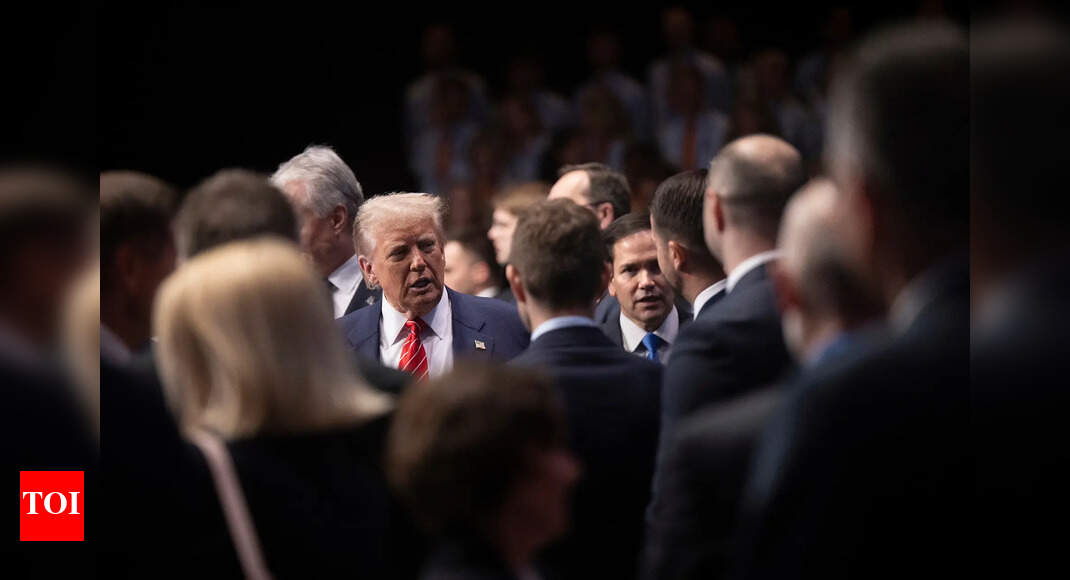
Under Trump’s Pressure: NATO Unleashes a Bold Commitment to 5% Defense Spending by 2035, Reinforcing an Ironclad Promise of Collective Defense

NATO leaders recently gathered in The Hague, where they committed to a significant increase in defense spending, targeting 5% of GDP annually by 2035. This decision comes amid escalating security concerns and has been widely interpreted as a direct response to pressure from U.S. President Donald Trump.
The 32-member alliance reiterated its “ironclad commitment” to mutual defense under Article 5, which states that an attack on one member is regarded as an attack on all. However, prior remarks from Trump cast a shadow of uncertainty, leading to unease among allies. During discussions, he noted that his support for Article 5 “depends on your definition,” a statement that prompted concern. “I stand with it, that’s why I’m here,” he clarified in a meeting with Dutch Prime Minister Dick Schoof, attempting to stabilize his prior comments.
In addition to the budgetary commitment, a mid-point review is scheduled for 2029 to evaluate collective progress and potential threats, particularly from Russia. The summit also saw the UK ramping up its military contributions, with Prime Minister Keir Starmer announcing the provision of 350 air defense missiles to Ukraine, funded by £70 million ($95 million) derived from seized Russian assets. Furthermore, the UK is set to procure 12 U.S.-made F-35 fighter jets, enhancing its nuclear capabilities.
Finland’s President Alexander Stubb heralded the developments as the “birth of a new NATO,” emphasizing a shift toward shared burdens and stronger deterrents against potential threats. However, not all members resonated with the 5% goal; Spain’s reluctance drew Trump’s criticism, highlighting ongoing challenges within the alliance.
The summit also featured Trump’s vocal discontent with U.S. media over reports on leaked intelligence assessments that suggested American airstrikes on Iran merely delayed the country’s nuclear ambitions. He labeled the reports “disgusting” and “unfair” to the military personnel involved. The White House backed Trump’s position, referencing a statement from Israel’s Atomic Energy Commission declaring that the strikes had significantly hampered Iran’s program.
Discussions regarding Russia’s threat to NATO were complicated by Hungarian Prime Minister Viktor Orbán, a known ally of Russian President Vladimir Putin, who downplayed concerns, asserting that Russia was “not strong enough to represent a real threat to us.”
The summit was marked by logistical challenges as mobile networks across the Netherlands experienced outages, with authorities investigating potential cyberattack implications. Although no cyberattack was confirmed, Dutch cybersecurity officials remained vigilant.
Amid these tensions, Trump enjoyed royal hospitality, staying at Huis Ten Bosch palace and meeting with King Willem-Alexander and Queen Máxima, describing them as “beautiful and spectacular people” in a post on social media.
As NATO Secretary-General Mark Rutte opened the summit, he emphasized the need for unity and equity in defense spending, stating, “For too long, one ally, the United States, carried too much of the burden. That changes today.” This remark encapsulates the essence of the summit: a pivotal moment for NATO, poised to adapt to evolving global security challenges.
Keywords: NATO summit, defense spending, Donald Trump, Article 5, UK military commitment, Finland, Hungary, Russia threat, security challenges, The Hague.
Original Source: https://timesofindia.indiatimes.com/world/us/under-trumps-pressure-nato-commits-to-5-defense-spending-by-2035/articleshow/122072425.cms
Category :
Tags:
Publish Date: 2025-06-25 19:04:00