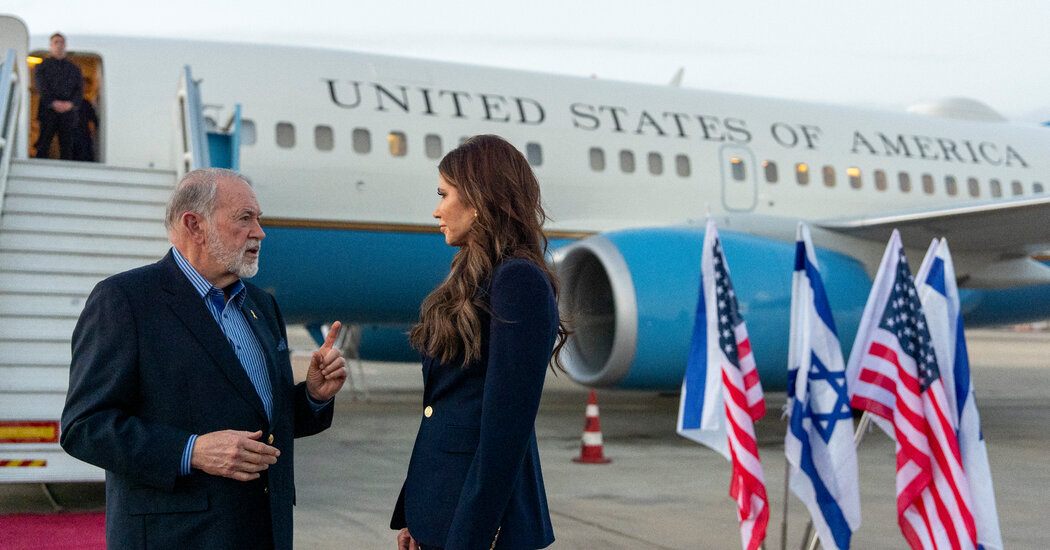
Mike Huckabee Challenges Palestinian State Policy: A Bold Stand for Justice and Peace in the Middle East

The American ambassador to Israel, Mike Huckabee, has sparked controversy by suggesting that Muslim countries should take the initiative in establishing a Palestinian state on their territories, rather than in regions recognized globally as Palestinian lands. If Huckabee’s statements reflect the position of the U.S. administration, it would mark a significant departure from the longstanding American policy supporting a two-state solution to the Israeli-Palestinian conflict.
In a recent interview with the BBC, Huckabee remarked, “Muslim countries have 644 times the amount of land that are controlled by Israel. So maybe, if there is such a desire for a Palestinian state, there would be someone who would say we’d like to host it, we’d like to create it.” Historically, the U.S. has advocated for a two-state solution that would see Palestinians gaining sovereignty over the Israeli-occupied West Bank and Gaza Strip, a position cemented in the Oslo Accords of 1993.
However, Huckabee expressed concern in a Bloomberg News interview about the implications of recognizing Palestinian statehood in these contested territories. He responded negatively to a question about whether the Trump administration endorsed a two-state solution, emphasizing the need for clarity on where such a state should be located. While he acknowledged past American and European efforts to promote a two-state framework, he raised questions about its feasibility.
The U.S. State Department was quick to respond to Huckabee’s remarks. Spokeswoman Tammy Bruce stated, “I think he certainly speaks for himself,” urging the media to consult the White House for the official American stance. Currently, at least 146 of the 193 United Nations member countries, along with the Holy See, support Palestinian statehood in the West Bank and Gaza. While no member of the Group of Seven (G7) industrialized nations recognizes Palestine as a state, France and the United Kingdom are reportedly discussing potential steps toward recognition.
Next week, French President Emmanuel Macron will co-chair a U.N. conference in New York with Saudi Crown Prince Mohammed bin Salman, focusing on the creation of a Palestinian state-a clear indicator of ongoing international efforts to address this complex issue.
Huckabee, who previously stated that “there’s really no such thing as a Palestinian,” has shown a pattern of controversial rhetoric regarding the Israeli-Palestinian conflict. Before his ambassadorship this year, he articulated views that aligned closely with hardline pro-Israel sentiment, asserting that all of the West Bank belongs to Israel. Nevertheless, he has committed to adhering to the policies set by President Trump during his tenure as envoy to Israel, stating, “I won’t make the policy.”
As discussions surrounding the future of Palestinian statehood gain momentum, Huckabee’s comments raise critical questions about U.S. foreign policy and the ongoing quest for peace in the region. The dialogue around establishing a Palestinian state remains more relevant than ever, with international stakeholders keenly interested in fostering a viable resolution to this decades-long conflict.
This evolving narrative will undoubtedly shape international relations and the dynamics of the peace process, underscoring the need for concerted efforts to find a sustainable solution for both Palestinians and Israelis.
Tags: International Relations, Palestinians, United States International Relations, Muslims and Islam, Politics and Government, Peace Process, Huckabee, Mike, United States, Israel, West Bank, Gaza Strip.
Original Source: https://www.nytimes.com/2025/06/11/world/middleeast/mike-huckabee-israel-palestinian-state.html
Category : International Relations,Palestinians,United States International Relations,Muslims and Islam,Politics and Government,Peace Process,Huckabee, Mike,United States,Israel,West Bank,Gaza Strip
Tags:
Publish Date: 2025-06-11 22:01:00