Trump’s Bold Pledge to the Middle East: A Promise to End ‘Lectures’ and Empower Sovereign Freedom

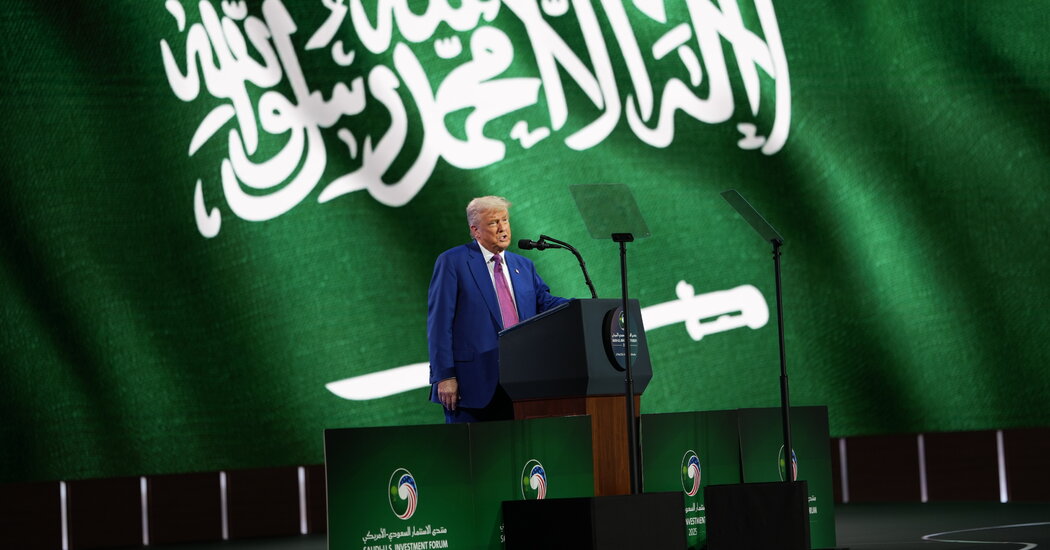
In a striking departure from American foreign policy, President Trump declared at a high-profile event in Riyadh, Saudi Arabia, that the United States would cease its “nation-building” initiatives and stop “giving lectures on how to live.” His comments, met with enthusiastic applause from the audience, signaled a profound repudiation of decades of U.S. involvement in the Middle East, resonating with long-felt grievances across the region.
During his speech at an investment conference, Trump stated, “In the end, the so-called nation builders wrecked far more nations than they built,” criticizing past interventions in complex societies. He encouraged Middle Eastern nations to “chart your own destinies in your own way,” a message that was quickly shared across social media platforms in the region.
Reactions varied widely. Sultan Alamer, a Saudi academic, noted that Trump’s rhetoric echoed the ideas of Frantz Fanon, a 20th-century anti-colonial thinker. Meanwhile, Syrians celebrated Trump’s announcement of a potential end to American sanctions on their beleaguered country, viewing it as a chance for their revitalization. In Yemen, Abdullatif Mohammed, a restaurant manager, expressed both frustration and agreement with Trump’s approach to sovereignty, questioning when nations would finally be acknowledged and allowed to thrive independently.
The President’s remarks came at the beginning of a four-day tour through Saudi Arabia, Qatar, and the United Arab Emirates—primarily focused on securing over $1 trillion in business investments. However, the speech hinted at broader diplomatic intentions. Trump expressed hopes that Saudi Arabia might join the United Arab Emirates and Bahrain in recognizing Israel, emphasizing his desire for a nuclear deal with Iran, stating he “never believed in having permanent enemies.”
An unexpected moment occurred when Trump met Ahmed al-Shara, a former opposition leader in Syria, which has raised eyebrows and elicited surprise across the Arab world. Mohammed remarked, “Dude, what happened is truly unbelievable,” reflecting the incredulity many felt at Trump’s friendly overtures.
Despite the applause, the speech also raised concerns. In a region still grappling with the repercussions of American military actions in Iraq and Afghanistan, some expressed anxiety over the implications of reduced U.S. pressure regarding human rights. Ibrahim Almadi, whose father was recently arrested in Saudi Arabia for criticizing the regime, lamented that Trump’s approach to Saudi governance would normalize such imprisonments.
Trump’s praise for Crown Prince Mohammed bin Salman stood in stark contrast to President Biden’s previous criticisms of the Prince regarding human rights violations, particularly related to the murder of journalist Jamal Khashoggi, enhancing the divide in U.S.-Saudi relations. Trump characterized the Crown Prince as an “incredible man,” indicating a profound shift in tone from prior administrations.
While Trump’s rhetoric may resonate with a certain audience, Abdullah Alaoudh, a Saudi opposition member, viewed the speech as a public relations endeavor benefiting the Crown Prince while ironically downplaying local dissent. Observers noted that Trump’s message, though it bore elements typically associated with anti-imperialist sentiments, might simply reflect a pragmatic approach focused on U.S. interests.
Prominent Egyptian human rights lawyer Negad el-Boraie cautioned against reading too much into Trump’s statements, insisting that they primarily served American interests, regardless of the rhetoric around morality and justice.
In the ballroom of Riyadh, Trump’s address may have garnered a standing ovation, yet it has left many questioning the future of U.S. engagement in the Middle East, particularly concerning the balance between security, business, and human rights.
As Trump’s first significant international engagement in years unfolds, its consequences may ripple across diplomatic, humanitarian, and economic landscapes.
Original Source: https://www.nytimes.com/2025/05/14/world/middleeast/trump-middle-east-nation-building.html
Category : United States Politics and Government,United States International Relations,Politics and Government,International Relations,Human Rights and Human Rights Violations,War and Armed Conflicts,Terrorism,War Crimes, Genocide and Crimes Against Humanity,Muslims and Islam,Mohammed bin Salman (1985- ),Trump, Donald J,Middle East,Saudi Arabia
Tags:
Publish Date: 2025-05-15 04:01:00