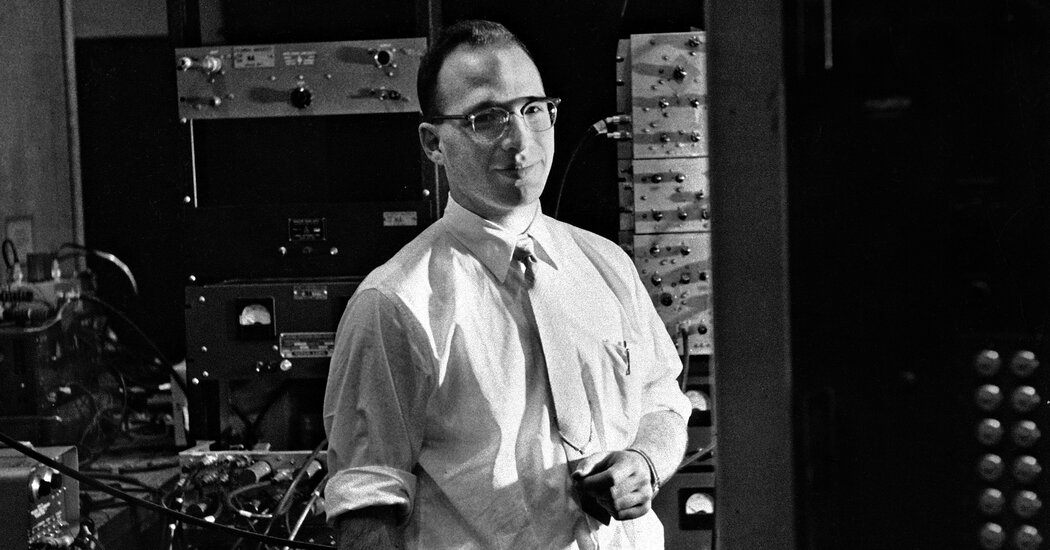

Richard L. Garwin, the celebrated physicist and key architect behind America’s hydrogen bomb, passed away at the age of 97 on Tuesday at his home in Scarsdale, N.Y. His death was confirmed by his son, Thomas Garwin. Renowned for his extensive contributions to defense policies and scientific advancements, Garwin’s legacy extends from the Cold War era to breakthroughs in medical technology and computing.
Garwin, a polymathic thinker, was only 23 years old when he designed the world’s first fusion bomb while serving as a consultant at the Los Alamos National Laboratory. Although the concept was developed by Edward Teller and Stanislaw Ulam, Garwin’s innovative application of their theories culminated in the experimental device known as Ivy Mike, which was tested at Enewetak Atoll in 1952. Weighing 82 tons and resembling a giant thermos, Ivy Mike was a proof-of-concept rather than a deliverable weapon. When detonated, it unleashed a fireball that dwarfed the atomic bomb dropped on Hiroshima, creating a mushroom cloud that reached 25 miles high.
Despite this monumental achievement, Garwin remained largely unknown to the public for years, overshadowed by figures such as Teller, who later credited him with a pivotal role in the design during a 1981 statement. Reflecting on his development of the hydrogen bomb, Garwin conveyed a nuanced perspective: “I think it would be a better world if the hydrogen bomb had never existed. But I knew the bombs would be used for deterrence.”
After the hydrogen bomb project, Garwin faced a career crossroads in 1952, ultimately choosing the flexibility offered by International Business Machines Corporation (IBM) over a return to academia. This decision set the stage for a fruitful 40-year tenure during which he contributed to groundbreaking technologies, including magnetic resonance imaging, high-speed laser printers, and touch-screen monitors.
While a key figure in scientific innovation, Garwin also served as an advisor to several U.S. presidents, from Dwight D. Eisenhower to Bill Clinton. His expertise shaped national defense strategies, particularly concerning nuclear arsenals, where he advocated for a balanced nuclear deterrence against the Soviet Union. Despite his advisory roles, Garwin was critical of certain military projects, including the controversial B-1 bomber and the Star Wars missile defense initiative proposed during the Reagan administration.
Garwin’s influence extended beyond defense technology; his insights were instrumental in national policies regarding arms control and nuclear weaponry. In 2021, he joined a group of 700 scientists advocating for a commitment from President Joseph R. Biden Jr. against the first-use policy of nuclear weapons, a politically sensitive issue that garnered limited response.
Born on April 19, 1928, in Cleveland, Ohio, Garwin exhibited an exceptional aptitude for science from a young age, earning his degrees under the mentorship of Nobel laureate Enrico Fermi. His substantial body of work includes more than 500 scientific papers and numerous patents, reflecting his enduring impact on various fields.
Garwin was recognized with prestigious honors, including the National Medal of Science in 2002 and the Presidential Medal of Freedom in 2016. His remarkable career and innate curiosity paved the way for innovations that transformed technology and defense. As President Obama noted, “Reconnaissance satellites, MRI technology, GPS— all bear his fingerprints.”
In addition to his son Thomas, Garwin is survived by another son, Jeffrey; a daughter, Laura; five grandchildren; and one great-grandchild. His passing marks the end of an era, but his influence will resonate in scientific and military communities for generations to come.
Original Source: https://www.nytimes.com/2025/05/14/science/richard-l-garwin-dead.html
Category : Garwin, Richard L,Deaths (Obituaries),Nuclear Weapons,Cold War Era,Hydrogen bomb,Inventions and Patents,Science and Technology,United States Defense and Military Forces,United States Politics and Government,Defense Department,International Business Machines Corporation,Fermi, Enrico (1901-54)
Tags:
Publish Date: 2025-05-14 22:45:00