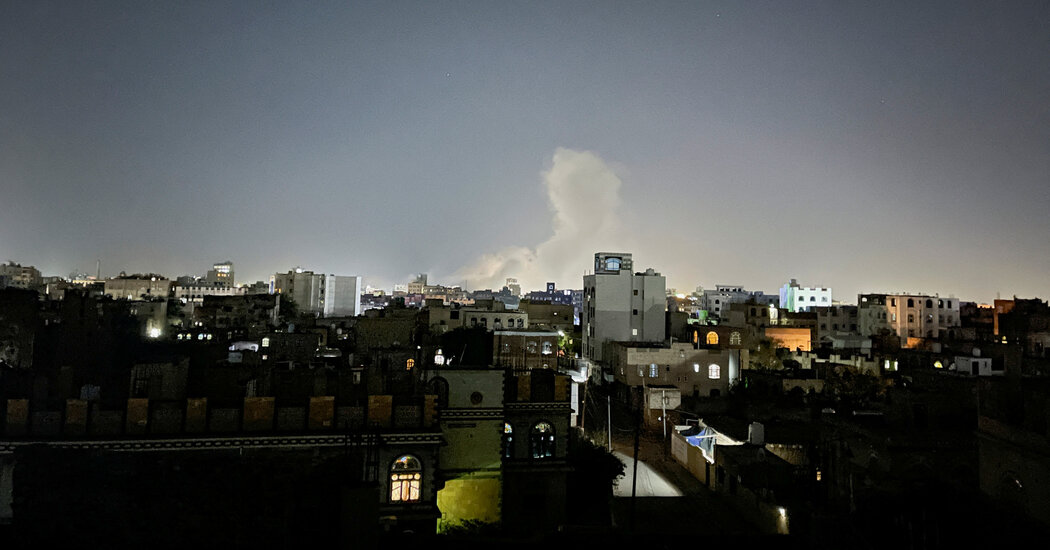

In a surprising diplomatic development, the United States and Yemen’s Houthi rebels have brokered a deal to halt American airstrikes in exchange for a cessation of attacks on U.S. vessels in the Red Sea. This agreement was revealed by President Trump during a meeting with Canada’s prime minister, catching even Pentagon officials by surprise.
“They just don’t want to fight,” President Trump stated, indicating the Houthis’ willingness to cease hostilities. However, the clarity of the truce remains in question, as it’s uncertain whether the U.S. has succeeded in stopping the Houthis from disrupting international shipping—an issue central to their recent seven-week campaign.
While the Houthis have agreed to stop targeting American military interests, they have not declared a complete cease-fire and vow to continue their fight against Israel. This nuanced stance was emphasized by Mohammed Al-Bukhaiti, a senior Houthi politician, who confirmed that military operations would persist until Israel lifted its blockade on Gaza.
The cost of the U.S. military campaign against the Houthis over the past year has exceeded $1 billion, raising concerns among strategists regarding military readiness for other potential conflicts. Oman played a vital mediation role, with Foreign Minister Badr Albusaidi confirming the agreement that aims to ensure safe navigation and flow of commerce through the Red Sea and Bab al-Mandab Strait.
In response to President Trump’s sudden announcement, confusion spread through the Pentagon, as officials sought clarity on how this deal would affect ongoing military policies. Yet, the broader implications of this truce may influence U.S. negotiations with Iran over its nuclear program. Iranian officials indicated that they used their influence over the Houthis to facilitate the cease-fire, although they maintain that Houthis act independently.
Despite these developments, skepticism prevails regarding the Houthis’ commitment to the agreement. The militia has framed the deal as a triumph over the United States, using social media to propagate the message “Yemen defeats America.” Defense Secretary Pete Hegseth has hinted at possible actions against Iran, further complicating the regional political landscape.
Iran’s public disassociation from the Houthis underlines the complexity of these dynamics. However, observers like Ahmad Zeidabadi, a reformist analyst, view the cease-fire as positive, noting it challenges hard-liners in Iran who back proxy militias.
The cease-fire’s potential longevity remains doubtful. The Houthis continue to assert their attacks as part of a holy war supporting Palestinians in Gaza, a region mired in hardship due to an Israeli siege following Hamas attacks in October 2023. As noted by Gregory Johnsen, a former UN expert on Yemen, the trustworthiness of this truce heavily influences the resumption of commercial shipping through the Red Sea.
In the broader context, the agreement signifies a momentary pause in hostilities but does not definitively address deeper geopolitical tensions involving the United States, Yemen, Iran, and Israel. As negotiations continue, the world watches to see if this truce will lead to lasting peace or serve as a temporary reprieve in a deeply entrenched conflict.
Original Source: https://www.nytimes.com/2025/05/06/us/politics/trump-houthis-bombing.html
Category : United States Politics and Government,United States Defense and Military Forces,Trump, Donald J,Yemen,Israel,Hegseth, Pete,Hamas,Houthis,Defense Department
Tags:
Publish Date: 2025-05-07 08:57:00