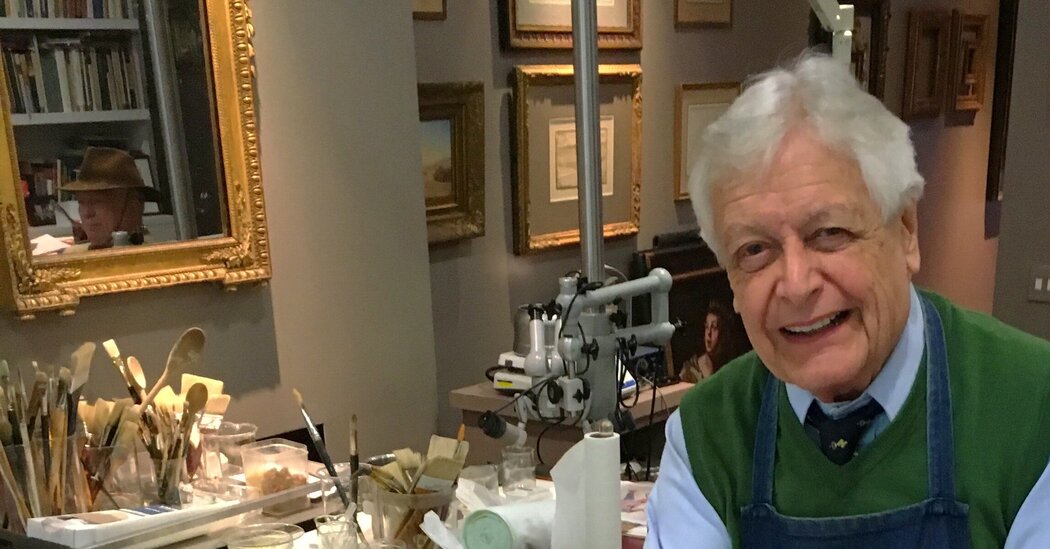
Farewell to a Master: Marco Grassi, the Revered Restorer Who Breathed New Life into Timeless Art, Passes Away at 90

Marco Grassi, a revered art critic known for his tactile and deeply sensory critiques, left an indelible mark on the world of art criticism. Noted for his insightful analyses, Grassi brought a hands-on sensibility to his reviews, according to Roger Kimball, his editor at The New Criterion. “His interactions with art were profoundly sensory,” Kimball noted, emphasizing the depth and richness of Grassi’s engagement with the artworks he reviewed.
One of his most lauded critiques was of the “Madonna and Child” by Duccio di Buoninsegna, a masterpiece of the early 14th century. Acquired by the Metropolitan Museum of Art in 2004 for over $45 million, it marked the museum’s largest purchase at that time. Grassi’s essay on this artwork reveals his sensitivity to visual nuance. “Although tiny, it escapes the ‘magnifier dependency’ typical of miniatures,” Grassi observed. He described how Duccio positioned the Virgin at an angle, behind a parapet, with the Madonna gazing into the distance while the child reaches for her veil. This composition, according to Grassi, showcases Duccio’s intent to depict “sublime tenderness and poignant humanity.”
Grassi was a staunch advocate for the art of the Middle Ages, often overshadowed by the Renaissance’s celebrated masterworks. He championed this so-called “primitive period,” arguing it was far from primitive, noting its historical importance and artistry during an interview with the art firm Disegno. His dedication to these periods reflects a profound respect for artistry often overlooked by modern critics.
Born in Florence on July 7, 1934, Marco Grassi was immersed in art from an early age. The son of art dealer Arturo Grassi and Cornelia Lemky Grassi, an American from Indianapolis, his upbringing was rich in cultural exchanges, especially during WWII. As the war drew to a close, the Grassi household hosted American generals, including Mark Clark, which aided the family’s move to New York in 1945. This relocation paved the way for Grassi’s education at the Delbarton School in New Jersey, followed by his graduation from Princeton University in 1956 with a degree in art history.
Throughout his career, Grassi maintained a commitment to exploring and restoring lesser-known art from Italy’s historical periods. His critiques and restorative work contributed significantly to preserving and honoring these periods and their artists. As a deeply respected figure in the art world, Grassi’s insights and advocacy for Middle Ages art continue to influence curatorial and critical perspectives globally.
In summing up his life’s work, Marco Grassi elevated art criticism to a new level through his deep sensory engagement and articulate prose, leaving a legacy that continues to inspire appreciation for the nuanced history of art. His passing marks a significant loss, but his work endures, prompting modern audiences to look more deeply at the art he so passionately championed.
Original Source: https://www.nytimes.com/2025/04/23/arts/marco-grassi-dead.html
Category : Grassi, Marco,Art,Middle Ages (Historical Period),Deaths (Obituaries),Italy,Restoration and Renovation
Tags:
Publish Date: 2025-04-24 07:20:00