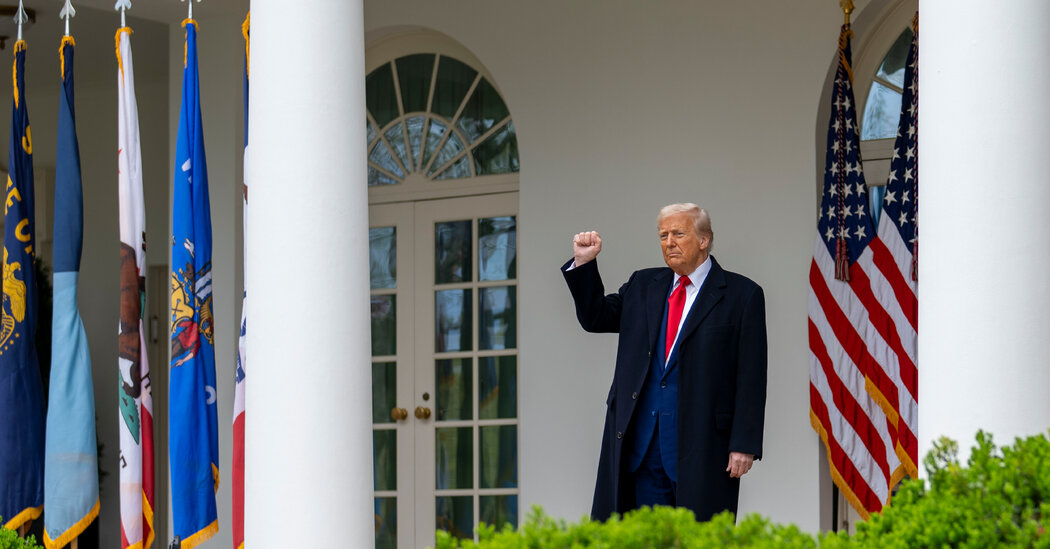

In a move reminiscent of Brexit’s shockwaves, former President Donald Trump has declared a so-called “liberation day,” imposing broad tariffs on the United States’ major trading partners. This decision mirrors Britain’s controversial exit from the European Union nearly nine years ago, as both acts challenge the prevailing global trade order. Trump’s tariffs risk pulling the United States away from its integral role in the global economy, similar to Britain’s exit from the Europe-wide trading bloc, a choice some Brexiteers viewed as liberating.
The ripple effects of Trump’s tariffs are profound, given the size of the U.S. economy and its pivotal position in global commerce. Like Brexit, the long-term impact of these tariffs remains uncertain. Markets may plunge, forcing Trump to reconsider, or he might ease tensions with selective trade deals. Regardless, experts suggest that the momentum of free trade is likely irreversible. The global community may find ways to sustain the trade system, with or without the United States at its helm. Optimists remind us that the European Union remained intact after Britain’s departure, though the process was tumultuous.
Cornell University’s trade policy expert, Eswar S. Prasad, asserts, “It will not be the end of free trade, but it is certainly a retreat from unfettered free trade.” He anticipates a world where countries scramble to prioritize their own interests over collective trade liberalization. While trade wars seldom evolve into military conflicts, history records instances where trade disputes have ignited wars. A full-scale trade war between the United States and China could exacerbate tensions in an already volatile relationship, posing significant geopolitical risks.
Economists note that the U.S., with its consumer demand for products like German cars and Chinese electronics, wields significant influence. Consequently, many nations might aim to negotiate deals with Trump, as Britain’s Prime Minister Keir Starmer has recently suggested following a U.S. tariff on British exports. Others, however, might retaliate with their own tariffs to improve bargaining positions.
China reacted swiftly with retaliatory tariffs, suggesting that alliances might form, albeit in complex and unpredictable ways. The European Union warns against countries redirecting cheap exports back into its market, complicating the trade landscape further. As MIT’s Simon Johnson highlighted, the EU grapples with balancing its trade relationships, underscored by the potential difficulty in absorbing more Chinese exports.
Despite criticisms, Trump’s tariffs address a real challenge: China’s rising dominance in global trade. The narrative of American manufacturing’s decline, attributed to China’s tactics, has been a consistent theme across multiple U.S. administrations. Even before Trump’s presidency, figures like President Barack Obama questioned the liberal trade policies that facilitated China’s ascent.
The global trading system, already under strain from China’s rise, cannot easily revert to self-sustaining autarkies due to interdependent supply chains spread from Taiwan to Canada. Low-income commodity exporters, particularly in Africa, face increased economic vulnerability under such trade disruptions. The WTO predicts a 1% drop in global merchandise trade volume by 2025 due to Trump’s tariffs alone, a significant downgrade.
Yet, amid these challenges, some suggest that Trump’s policies may catalyze newfound cooperation among other nations. By withdrawing from the Trans-Pacific Partnership, the U.S. inadvertently paved the way for a renegotiated trade pact excluding itself but including other major Pacific economies. Other countries may follow suit, forging bilateral or regional agreements that effectively sideline the United States.
Even Brexit, with its assertions of greater trade autonomy, has not led to protectionism as some feared. Jason Furman of Harvard Kennedy School sees Trump’s tariffs as a pivotal point for the United States, but not necessarily a death knell for free trade globally. As the world reorients its trading relationships, it signals a move toward a future less dominated by American economic policy but still deeply rooted in the principles of global trade.
Original Source: https://www.nytimes.com/2025/04/06/world/europe/trade-trump-tariffs-brexit.html
Category : International Trade and World Market,Trump, Donald J,Customs (Tariff),International Relations,World Trade Organization,Starmer, Keir,Great Britain Withdrawal from EU (Brexit),European Union
Tags:
Publish Date: 2025-04-06 18:36:00