Urgent Wake-Up Call: U.S. Strikes in Yemen Struggle to Succeed Amidst Explosive Munitions Challenge

President Donald Trump recently declared that the Iranian-aligned Houthi militants in Yemen have been severely weakened by an aggressive military campaign initiated on March 15. However, this assertion contradicts the more nuanced accounts offered privately by Pentagon and military officials to Congress and international allies. These confidential briefings reveal limited success in dismantling the Houthis’ extensive, predominantly subterranean arsenal, including missiles, drones, and launchers, as relayed by congressional aides and allies.
Reports suggest that the current offensive, dubbed Operation Rough Rider by Defense Secretary Pete Hegseth, appears significantly more intense than previous efforts under President Joseph R. Biden Jr. According to officials, the Houthis, renowned for their resilience, have fortified their bunkers, complicating U.S. attempts to disrupt their missile capabilities aimed at Red Sea shipping lanes.
The operation’s financial burden is substantial, with the Pentagon reportedly expending $200 million worth of munitions in three weeks. The deployment involves two aircraft carriers, B-2 bombers, fighter jets, and air defense systems like Patriot and THAAD in the Middle East. Projections indicate costs exceeding $1 billion, potentially necessitating additional congressional funding.
Combat reports highlight a massive deployment of precision munitions, including advanced long-range weapons. This has raised concerns about munitions stocks, particularly given potential geopolitical challenges such as a possible confrontation with China over Taiwan. U.S. officials maintain that the strikes have disrupted the Houthi command structure and weakened their ability to launch effective counterattacks, setting the stage for further operations.
The operation, marked by its secrecy, spurred controversy following an inadvertent leak of sensitive details on a commercial messaging app involving Trump administration officials. The mishap has cast a shadow over the campaign, raising questions about the administration’s strategies and objectives.
The Trump administration’s aggressive stance is partly driven by a desire to curb disruptions to international shipping caused by the Houthis over the past year, and to hinder their missile attacks on Israel, which have reportedly decreased recently. The Biden administration previously conducted narrower strikes targeting military infrastructure, but its efforts had limited impact, prompting criticism from some lawmakers demanding clearer strategy explanations from the current administration.
The U.S. remains tight-lipped on specific operational outcomes, with Central Command sharing limited visuals but withholding comprehensive target data. Notably, some of the longest-range weapons in the U.S. Navy’s arsenal are being used, including AGM-154 Joint Standoff Weapons and other long-range munitions, aligning with strategic needs against defending adversarial air defenses.
Saudi Arabia and its allies, who led a prolonged but ultimately unsuccessful campaign against the Houthis, are now supporting the U.S.-led operations. Unlike Biden’s centralized command approach, Trump has delegated target selection to regional commanders for swifter decision-making.
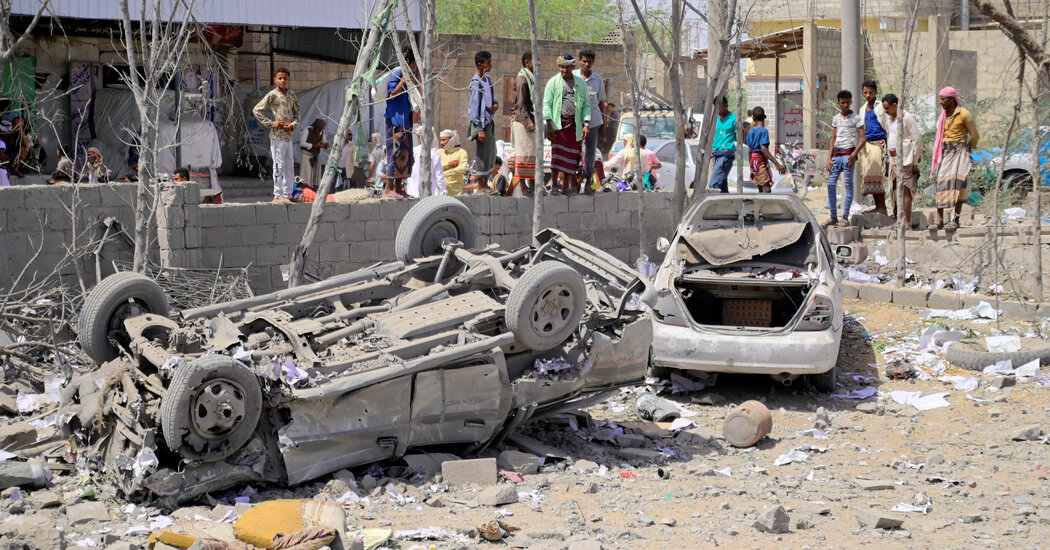
In the region, U.S. officials face criticism over civilian casualties, with reports from organizations like Airwars highlighting the risk to civilians, particularly in densely populated areas. Despite these challenges, President Trump remains resolute, issuing stern warnings to Iran over its support for the Houthis and emphasizing continued military pressure until the Houthis cease to be a threat to maritime freedom in the Red Sea.
This complex and costly military campaign illustrates not only the ongoing challenges in Yemen but also the broader geopolitical dynamics affecting regional stability, underscoring the United States’ significant military commitment, as well as the critical roles both diplomacy and strategic intelligence play in contemporary conflict scenarios.
Original Source: https://www.nytimes.com/2025/04/04/us/politics/us-strikes-yemen-houthis.html
Category : United States Defense and Military Forces,Terrorism,Civilian Casualties,Drones (Pilotless Planes),Signal Chat Leak (Trump Administration),Piracy at Sea,Houthis,Defense Department,Biden, Joseph R Jr,Hegseth, Pete,Trump, Donald J,Red Sea,Yemen
Tags:
Publish Date: 2025-04-04 09:31:00