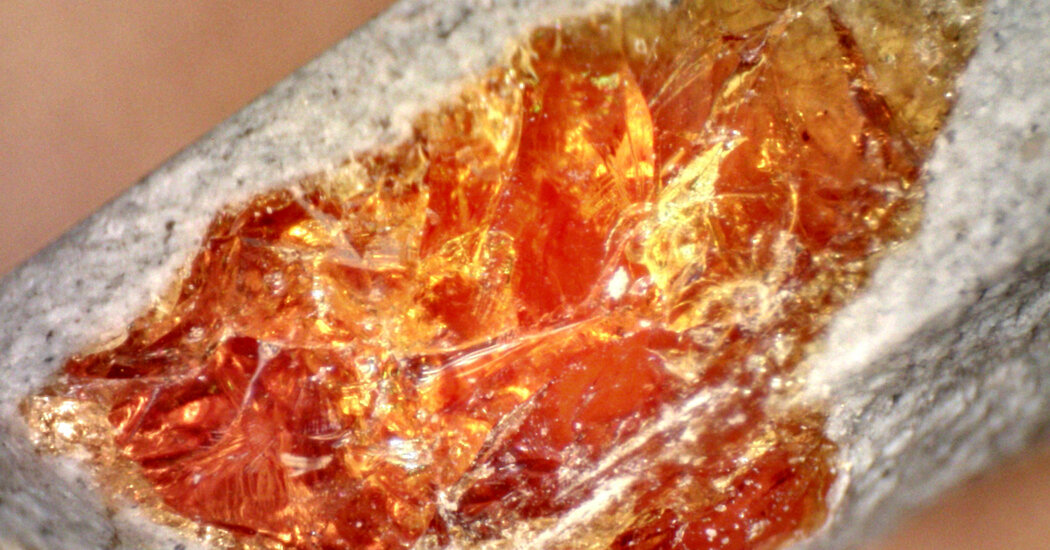

Amber, treasured globally not only as a decorative gem but as a window into prehistoric life, typically forms over millions of years through the fossilization of tree resin. However, recent scientific advances have managed to replicate this ancient process in just 24 hours, developing amber-like substances from pine resin. This breakthrough, reported in the journal Scientific Reports, offers a new lens into the intricate development of amber’s unique properties that have largely been shrouded by time.
Researchers like Evan Saitta, a research associate from the Field Museum in Chicago, and independent paleontologist Thomas Kaye, have utilized a device ingeniously crafted from components such as a medical pill compressor and air canisters to simulate the process. Described by Saitta as akin to using an "Instapot," this technique subjects samples to both heat and pressure, mimicking diagenesis—the critical, slow transformation required for sediment to consolidate into rock. "Diagenesis is the ultimate hurdle you need to pass to become a fossil," Saitta explained, likening it to "the final boss."
The endeavor wasn’t without its initial hiccups. Some synthetic samples mimicked amber’s physical characteristics such as darkened color and luster, while other attempts fell short. An oversight in the selection of the pine family used highlighted an important discovery; they initially used a common pine instead of the Sciadopitys family, mainly associated with real amber, underscoring the necessity of precise biological inputs.
Maria McNamara, a paleontologist at University College Cork, highlighted the significance of these findings while urging future studies to explore a broader range of resin types to better understand resin polymerization speeds. She emphasized the importance of conducting thorough chemical analyses on the synthetic amber to authenticate its fidelity to natural amber.
Despite certain limitations, McNamara recognized the value of simulated fossilization as a research tool within paleontology. Simulations in her own laboratory have delved into the preservation of biological molecules under various conditions. "Without such simulations, we’re just trusting the fossil record," she remarked, noting experiments help discern historical accuracies from misconceptions.
Saitta and Kaye envision embedding biological remains like insects and feathers in synthetic amber in future experiments. This approach tackles the challenge of studying valuable real specimens, which often fetch high prices, making them unsuitable for destructive analysis. A lab-made equivalent, as Saitta noted, provides an invaluable, non-precious alternative.
The scope of their research extends beyond amber. Their methodology could be adapted to explore fossilization related to modern-era biology, possibly investigating how Anthropocene organisms—with their exposure to microplastics and industrial pollution—might fossilize. Though actual fossilization would unfold over millions of years, this pressured evolution offers a timely preview into the planet’s geological transformation.
This pioneering work represents a fascinating intersection of advanced experimentation and paleontological inquiry, transforming our understanding of fossilization. The pressure-cooker style technique doesn’t just illuminate ancient processes but potentially casts light on a future where synthetic fossils reveal the Anthropocene era’s legacy. 출발
Original Source: https://www.nytimes.com/2025/03/24/science/amber-fossils-synthetic.html
Category : Amber,Paleontology,Fossils,Scientific Reports (Journal),Research,your-feed-science
Tags:
Publish Date: 2025-03-24 19:24:00