
Averages Comfort. Distributions Convince.
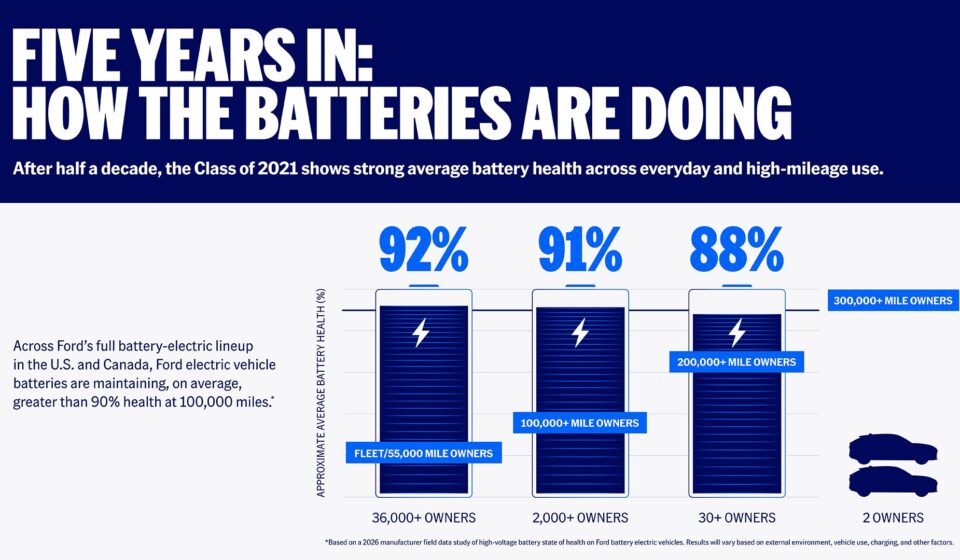
When a manufacturer says its batteries retain 92% health after five years, the instinct is to nod at the headline. The more interesting number is the spread behind it.
The Signal
A major automaker recently published a fleet-wide analysis of about 36,000 first-generation electric SUVs. The vehicles have logged roughly two billion electric miles, and 95% of them sit between 87% and 97% battery state-of-health. Even the 30-odd vehicles past 200,000 miles average around 88%. The company says it is using this field data to shape battery management, charging guidance, and its next vehicle platforms.
Validation Is a Hypothesis; Telemetry Is the Verdict
The product matters less to me than the architecture. Lab validation, simulation, and accelerated aging tests are essentially hypotheses about the real world. A connected fleet is the experiment that confirms or refutes them. The pattern here is a closed feedback loop: model, test, ship, observe, and feed the observations back into the next design. That loop is what separates a product company from a data-driven engineering system.
Enterprise software teams will recognise this. We have long preached observability for production systems, yet many organisations still treat the field as someone else’s problem. Five years of longitudinal data on a single cohort is an asset that no amount of pre-launch testing can substitute for.
Reading the Data Like an Architect
I would add some healthy scepticism, because that is part of the discipline.
- State-of-health is an estimate. It is computed by software, so it depends on the estimation algorithm. A “92%” figure is only as trustworthy as the model behind it, and the definition of “usable capacity” matters.
- Provenance matters. This is manufacturer-reported data. Independent validation, whether from third-party fleets, regulators, or researchers, is what turns a corporate claim into an industry standard.
- Survivorship and selection bias are real. Who is in the cohort, and who dropped out through warranty replacement or resale?
- Software is part of the battery. The guidance on charging habits, preconditioning, and chemistry-specific behaviour shows that longevity is co-produced by chemistry and code. Battery management systems are effectively a continuously updated service layer over a physical asset.
That last point is the shift I find most significant. The asset is no longer static hardware. It is a hardware-plus-software system whose behaviour can be tuned after sale, which brings the same trade-offs we know from cloud systems: over-the-air agility versus validation rigour, and data collection versus user privacy.
The Bharat Connection
For India, and Northeast India especially, this matters directly. Our climate is demanding, with heat, humidity, heavy rain, steep gradients, and uneven grid quality. Battery data from temperate markets cannot simply be assumed to transfer. As EV adoption grows here, we need locally collected, openly governed performance data. That means telemetry standards, data-sharing frameworks in the spirit of our Digital Public Infrastructure, and clear rules on who owns vehicle data. The same data will also support battery second-life and recycling ecosystems, which could become real frugal-innovation opportunities for local startups.
Key Takeaways
- Instrument everything you ship. Without field telemetry, you are guessing.
- Demand the distribution, not the average. Variance reveals risk that means hide.
- Treat estimated metrics with care. Know how a “health score” is calculated before relying on it.
- Design for post-deployment learning. Systems that improve through updates beat systems frozen at launch.
- Govern the data early. Ownership, privacy, and independent verification are architectural decisions, not afterthoughts.
Closing Thought
Trust in any complex system is not declared at launch; it is accumulated, mile by mile, through data honest enough to show its own spread.
About the Author: Sanjeev Sarma is the Founder Director and Chief Software Architect at Webx Technologies. With a core focus on Generative AI integration, Cloud-Native Scalability, and Enterprise Software Architecture, he has spent over two decades driving digital transformation across Northeast India and beyond. Beyond his corporate leadership, Sanjeev is deeply invested in shaping the future of the IT industry. He serves as an Industry Expert on the Board of Studies for Assam Don Bosco University’s School of Technology, advises state technology committees, and actively mentors emerging tech startups at STPI. He brings a unique, dual perspective of high-level enterprise execution and future-ready academic curriculum development.