Beyond Spreadsheets: How AI Agents Are Rewiring Enterprise Benefits

Agentic AI’s Real Test Is the Contract, Not the Chatbot
We keep measuring AI by how fluently it writes. The harder, more useful test is whether it can tell you that your vendor contract and your actual claims data disagree – and cite the page where it happens.
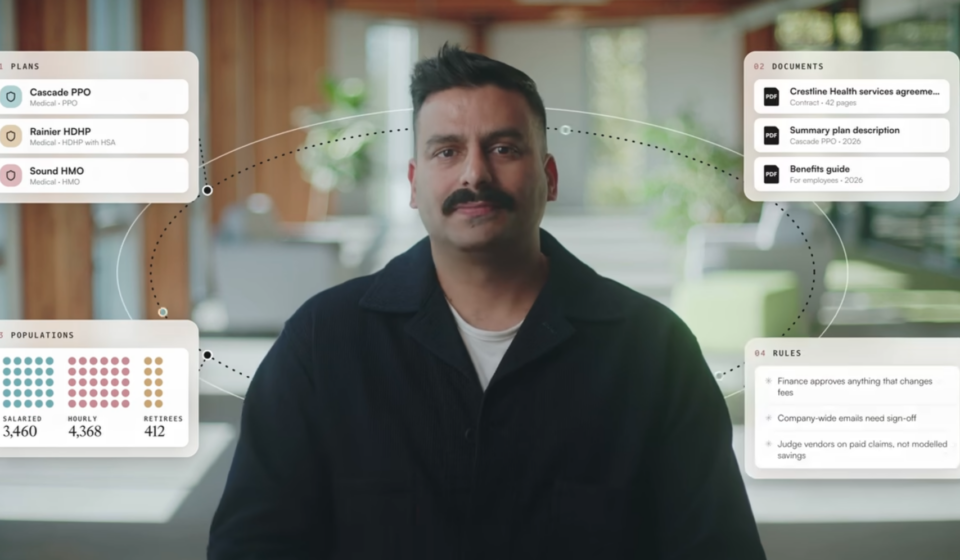
That is precisely the kind of unglamorous work Seattle-based Avante is aiming its agents at. The company just closed a $30 million Series A led by Frist Cressey Ventures, with Sorenson, Hearst Ventures, Morgan Stanley Next Level Fund and Fuse participating, taking its total to $40 million. Its pitch: AI agents that reconcile benefit vendor contracts against real claims, audit plan documents for errors, prep renewals, and answer employees’ coverage questions – across more than 70 customers and roughly 385,000 covered lives.
So what? Plenty, if you read it as an architecture story rather than a funding announcement.
Where the model stops being the story
Benefits administration is the archetype of a class of enterprise problem I have spent years arguing deserves more attention than chatbots: negotiated, document-bound, multi-party data. You have structured claims feeds, unstructured plan documents, legal contracts, and a renewal calendar that forces everything to agree by a deadline. The agent’s job is not generation. It is reconciliation and audit.
That distinction matters enormously. In reconciliation, the output is verifiable – either the contract line and the claim line match or they don’t. Deploying probabilistic systems where ground truth exists is the responsible pattern. Deploying them where ground truth is opinion is where enterprises get hurt.
The moat is the schema, not the model
Every founder in 2026 can access a frontier model. Almost none of them can normalize data sitting inside Workday, ADP, carrier portals, TPA claim files, and a broker’s spreadsheets. The defensible asset here isn’t inference – it’s the integration surface, the canonical data model, and the lineage that lets an auditor reconstruct why an agent said what it said.
Two design consequences follow. First, anything touching money or coverage determination needs deterministic guardrails, source citations at the field level, and a deliberate abstention path – a system that says “I cannot verify this” is worth more than one that is confidently wrong. Second, the audit trail is a product feature, not a compliance afterthought.
The go-to-market choice is equally instructive. Avante is partnering with advisory firms – Gallagher, OneDigital, Segal Benz, Howden, USI – rather than trying to route around them. In regulated markets, the intermediary owns trust. Build under the advisor, not against them. The opposite instinct has quietly killed a generation of “disintermediation” startups.
Reading the same pattern from India
The Indian analogue is almost one-to-one: group mediclaim and GPA policies, TPA claim adjudication, EPFO and ESIC filings, and a broker ecosystem that still runs on email threads and Excel. Whether it is Ayushman Bharat claim scrutiny or a 300-person MSME’s annual renewal, the bottleneck is the same – nobody can cheaply verify that the policy wording and the settled claim agree.
That is a frugal-innovation opening, and a genuine one for builders in the Northeast: you do not need a foundation model to build a category. You need a painful workflow, a verifiable source of truth, and the patience to model the data properly.
Takeaways
- Automate verification, not just conversation. Where ground truth exists, agents earn their keep.
- Treat the schema as the moat. Model access is a commodity; clean interoperability is not.
- Design for abstention and audit. In financial or clinical decisions, explainability is survivability.
- Sell with the intermediary. Trust layers are distribution channels, not obstacles.
- Let cost pressure lead. A projected 9.2% rise in employer health costs is a stronger adoption driver than any demo.
The most consequential AI companies of this decade may never ship a chatbot. They will quietly sit between systems of record and human judgement, making the paperwork agree with itself.
About the Author: Sanjeev Sarma is the Founder Director and Chief Software Architect at Webx Technologies. With a core focus on Generative AI integration, Cloud-Native Scalability, and Enterprise Software Architecture, he has spent over two decades driving digital transformation across Northeast India and beyond. Beyond his corporate leadership, Sanjeev is deeply invested in shaping the future of the IT industry. He serves as an Industry Expert on the Board of Studies for Assam Don Bosco University’s School of Technology, advises state technology committees, and actively mentors emerging tech startups at STPI. He brings a unique, dual perspective of high-level enterprise execution and future-ready academic curriculum development.