Beyond the School Register: Architecting Continuity for Migrant Children

Identity Is Not Access: What the Brick Kilns of Sheikhpura Taught Me About Designing for People Who Move
For a decade, those of us in India’s technology ecosystem have celebrated Digital Public Infrastructure as the great leveller – Aadhaar, DBT, Ayushman. But a recent story from the brick kilns of Sheikhpura, Bihar, forced me to confront an uncomfortable architectural truth: an identity that cannot travel with you is merely a record. Access is a system.
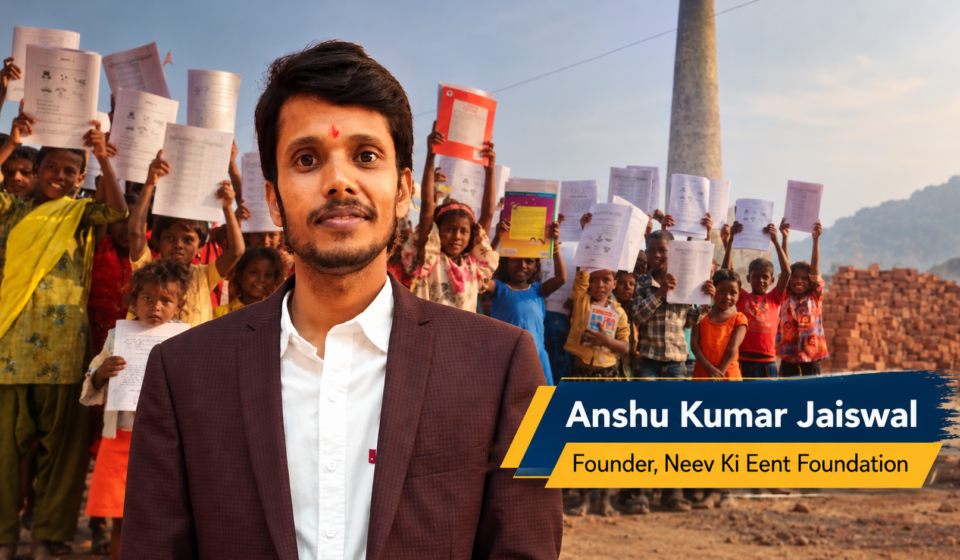
The story itself is simple, and quietly powerful. Anshu Kumar Jaiswal, a former Gandhi Fellow, first came face to face with brick kiln communities in Sheikhpura and saw how seasonal migration quietly severs children from education and families from their own entitlements. He went on to found the Neev Ki Eent Foundation, whose Project Swabhimaan – led by District Magistrate Shekhar Anand alongside the district administration – pairs Akshar Learning Centres at the kilns with massive documentation drives and a fellowship of local youth, reaching some 55 kilns and over 15,000 documentation needs.
But what struck me was not the compassion of the model. It was the systems thinking hiding inside it.
Every system assumes a stationary user
This is the flaw we rarely name. School records, ration entitlements, scheme eligibility – almost every civic system is architected around a fixed address and a stable user. Seasonal migration, the lived reality of millions of Indians, violates that assumption at the schema level. No dashboard fixes a data model that assumes the citizen doesn’t move.
There is a difference between identity and access. Aadhaar answers “who are you?” Entitlements must answer “what can you claim – here, now, wherever here is?” That second question is a portability problem, and it is the next frontier of DPI.
Civil society as middleware
What impressed me most is what the foundation refused to do: build a parallel system. Anshu’s own framing – reduce the distance between communities and the system – is, in my language, an integration layer. The state holds the resources and the mandate; the organisation sits between citizen and department, translating intent into action in both directions.
And the Swabhimaan Fellowship is, frankly, the most elegant design decision in the entire model. Local young people trained to support education and navigate schemes are the human API of the welfare state. In enterprise architecture, we talk endlessly about trusted endpoints; here, trust is the protocol. A young person from the same community can authenticate to a family in ways no portal, app, or helpline ever will.
It is also the right call on the classic trade-off between scale and depth. Parallel systems scale poorly and breed duplicated data and debt. Federated models – administration, civil society, and community each doing what they do best – scale without the architectural debt of building everything twice.
The moving citizen is not a Bihar-only problem
Look closely, and the Northeast lives this too: families displaced by floods and bank erosion, tea-garden communities on seasonal cycles, households on shifting river islands. The lesson generalises – build for continuity of the person, not permanence of the address. India’s first DPI decade solved identity at population scale. The next must solve entitlements in motion: portable education records, portable health and food security, portability as a first-class design principle.
What I would take from Sheikhpura
- Design for the mobile user. Records must follow the person, not the PIN code.
- Don’t build parallel systems; build integration layers. Augment the state, don’t compete with it.
- Human infrastructure is infrastructure. A trained local youth remains the most reliable last-mile protocol we have.
- Measure continuity, not registrations. A name in a school register is a transaction; a child who keeps learning is an outcome.
The founders named it Neev Ki Eent – the brick of the foundation. It is the right metaphor for the decade ahead: the strongest foundations of digital India will not be poured in data centres. They will be laid, brick by patient brick, wherever a family’s life happens to move next.
About the Author: Sanjeev Sarma is the Founder Director and Chief Software Architect at Webx Technologies. With a core focus on Generative AI integration, Cloud-Native Scalability, and Enterprise Software Architecture, he has spent over two decades driving digital transformation across Northeast India and beyond. Beyond his corporate leadership, Sanjeev is deeply invested in shaping the future of the IT industry. He serves as an Industry Expert on the Board of Studies for Assam Don Bosco University’s School of Technology, advises state technology committees, and actively mentors emerging tech startups at STPI. He brings a unique, dual perspective of high-level enterprise execution and future-ready academic curriculum development.