The End of Feature Engineering: Foundation Models Meet Relational Data

The Feature Engineering Tax Is Finally Coming Due
For fifteen years, the most expensive line item in enterprise AI hasn’t been GPUs. It has been the human cost of turning a relational database into a spreadsheet.
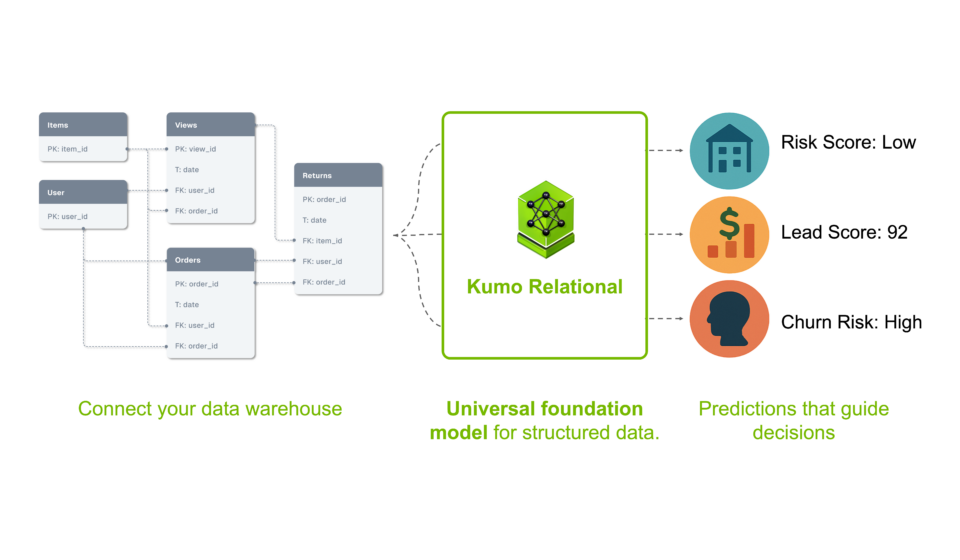
That premise – that models cannot reason about relationships, so humans must pre-digest them into flat columns – is now under direct attack. A recent research release from NVIDIA’s Kumo team describes a relational foundation model that connects to a live database, respects its tables, foreign keys, and timestamps, and returns a prediction in a single forward pass. No feature engineering. No per-task training. It simply reads up to 10,000 historical examples as context, and predicts churn, demand, or fraud directly off the schema. The reported benchmarks are striking: it outperforms expert-engineered gradient-boosted trees across 41 tasks, and sits on the accuracy-efficiency Pareto front of the RelArena-α leaderboard.
What This Actually Changes
I have sat through enough legacy modernization reviews to know where the real cost sits. It is not the model. It is the three months of ETL, the aggregation pipelines, the feature store, and the semantic drift that creeps in when the “average order value in last 30 days” definition changes in three places. This is the feature engineering tax, and we have paid it so routinely that we stopped calling it a tax.
When the model learns to filter, correlate, and aggregate across a primary-key/foreign-key graph internally, the tax structure changes. The schema itself becomes the prompt.
That is an uncomfortable – and useful – implication for architects. Data modelling quality stops being a hygiene factor and becomes directly predictive. Teams carrying a decade of schema debt, missing foreign keys, and inconsistent timestamps will not be rescued by a foundation model; they will simply get a more accurate reflection of their own disorder. Tellingly, the paper reports graceful degradation even with most foreign-key links removed. That is less an engineering claim than a confession about the state of real enterprise data.
The governance question is the one I would raise first in a design review, not the accuracy numbers. Handing a pre-trained model read access to production relational data – with context windows carrying thousands of historical records – is a data residency and PII-masking problem before it is an ML problem. For regulated sectors and government, the deployment pattern (self-hosted, inside the perimeter) matters more than the Elo score.
The Bharat Angle
India’s Digital Public Infrastructure is, at its core, relational and temporal. GSTN, land records, health registries, beneficiary databases – all of it lives in schemas, not spreadsheets.
The bottleneck in state-level analytics has never been the algorithm. It is that no district department has a six-month feature-engineering team. If a predictive question collapses into a declarative query over existing tables, a small health directorate in the Northeast can ask “which patients are likely to default on treatment” without hiring four data scientists. That is a genuine shift in the cost of curiosity – and curiosity is what frugal innovation runs on.
Takeaways
- Re-architect the semantic layer first. A model that reads your schema will amplify both your modelling discipline and your modelling debt.
- Treat context data as regulated data. Inference-time history sampling is a data governance surface, not just a performance knob.
- Don’t delete MLOps. Very large labelled datasets still favour supervised pipelines; this complements tuning, it doesn’t replace it.
- Democratization is the real metric. Measure how many teams can now ship a prediction – not how clever the model is.
The last decade taught us to scale data. The next one will be about scaling questions.
About the Author: Sanjeev Sarma is the Founder Director and Chief Software Architect at Webx Technologies. With a core focus on Generative AI integration, Cloud-Native Scalability, and Enterprise Software Architecture, he has spent over two decades driving digital transformation across Northeast India and beyond. Beyond his corporate leadership, Sanjeev is deeply invested in shaping the future of the IT industry. He serves as an Industry Expert on the Board of Studies for Assam Don Bosco University’s School of Technology, advises state technology committees, and actively mentors emerging tech startups at STPI. He brings a unique, dual perspective of high-level enterprise execution and future-ready academic curriculum development.