Beyond the Capture Chemistry: What Industrial Carbon Removal Must Still Prove

The Demo Is Not the Deployment
Every architect carries a scar from a demo that dazzled and a deployment that disappointed. So when I read about Verdox’s two-month run at Hydro’s Sunndal aluminum smelter in Norway – pulling CO₂ from exhaust where the gas is only about 1% carbon dioxide, contaminants and all – my first reaction wasn’t excitement. It was a familiar question: what exactly did this prove, and what is it being asked to prove?
The signal itself is genuinely interesting: Verdox’s electrochemical, quinone-based capture process ran on real smelter exhaust rather than a prepared lab stream, with Hydro’s investment lending it weight. But as the underlying analysis rightly argues, the trial establishes that the chemistry survives an industrial environment – nothing more. Cost, whole-plant power draw, module lifetime, and the route to permanent storage all remain open questions.
The 99% Overhead Problem
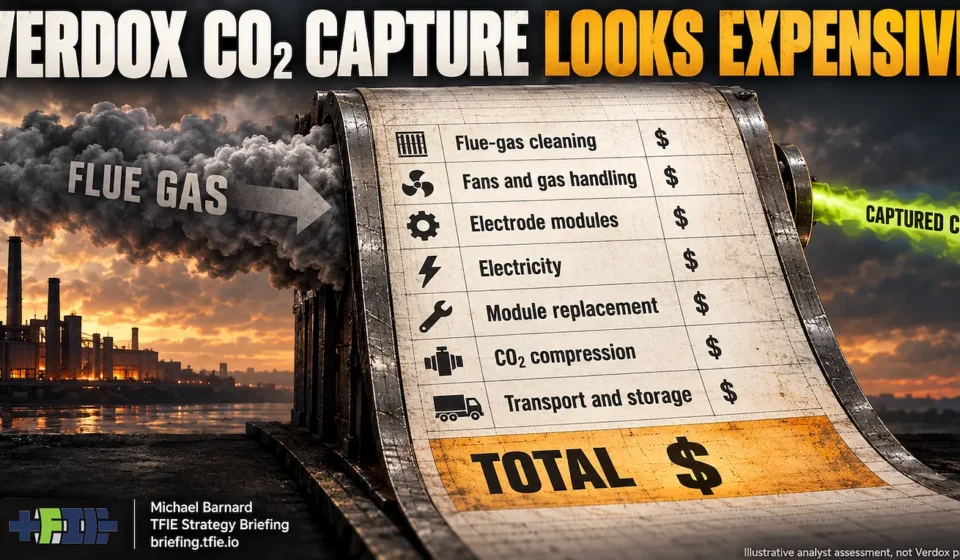
At 1% concentration, the molecule you’re capturing is a rounding error in the stream. Nearly everything the plant handles – fans, ducts, pretreatment, pressure drops – is overhead. The separation is arguably the easy part; the gas handling is the business case. I’ve watched the same pattern in enterprise AI rollouts: teams agonize over model accuracy while data movement, preprocessing, and integration quietly consume the budget. And that headline figure – roughly 417 kWh per tonne of CO₂ – is only as honest as its equipment boundary. Does it include gas cleaning, switching, drying, compression? A number without a boundary isn’t a specification; it’s a marketing asset.
Stateful Chemistry Meets Continuous Industry
Here’s a constraint software people will recognize instantly: the capture material works in one electrical state and releases CO₂ in another. No single surface does both at once, so a smelter’s continuous exhaust demands banks of modules cycling through phases – capture, sweep, release. That’s no longer chemistry; that’s orchestration, capacity planning, and degradation management. Published lab cycling data is evidence about molecules, not a maintenance record for hardware bathed in flue gas for years.
The Innovator’s Dilemma, Smelter Edition
The sharpest strategic point is this: the aluminum industry is racing to eliminate the emissions source altogether. Carbon anodes drive roughly three-quarters of a smelter’s direct CO₂, and ELYSIS (Rio Tinto and Alcoa) fired up a commercial-size 450 kA inert-anode cell in 2025, while Hydro’s HalZero pursues a different chloride-based route. Every rupee or krone invested in capture competes with investment in process conversion. This is the classic “extend the legacy system or re-platform” decision every CTO faces – and it has no universal answer. The right call depends on the asset’s remaining life and when the next capital cycle lands. Evaluate against the alternative, never against zero.
The Chain, Not the Component
Captured CO₂ still needs drying, compression, transport, and a storage operator willing to accept it on commercial terms. A capture unit beside a smelter is a component, not a carbon-management system. Sequencing matters too: concentrated biogenic streams from fermentation or biogas upgrading are the rational first deployments; dilute smelter exhaust sits at the hardest end of the difficulty curve.
What Builders Should Take Away
- Demand the boundary. No performance figure means anything without its system definition.
- Budget the boring parts. Fans, cycling logistics, degradation, and downtime are where economics live or die.
- Compare against the alternative, not against zero. Retrofit-vs-rebuild is an asset-specific decision.
- Sell chains, not components. Buyers purchase outcomes, not elegant mechanisms.
To the young engineers and founders I mentor: Verdox’s real achievement isn’t the chemistry – it’s earning the right to face harder questions. Separating component evidence from system evidence is the most transferable skill in deep tech, whether the domain is climate, AI, or anything else.
Chemistry answers whether we can. Architecture – and patient capital – answer whether we should, at scale, at a price the world will pay.
About the Author: Sanjeev Sarma is the Founder Director and Chief Software Architect at Webx Technologies. With a core focus on Generative AI integration, Cloud-Native Scalability, and Enterprise Software Architecture, he has spent over two decades driving digital transformation across Northeast India and beyond. Beyond his corporate leadership, Sanjeev is deeply invested in shaping the future of the IT industry. He serves as an Industry Expert on the Board of Studies for Assam Don Bosco University’s School of Technology, advises state technology committees, and actively mentors emerging tech startups at STPI. He brings a unique, dual perspective of high-level enterprise execution and future-ready academic curriculum development.