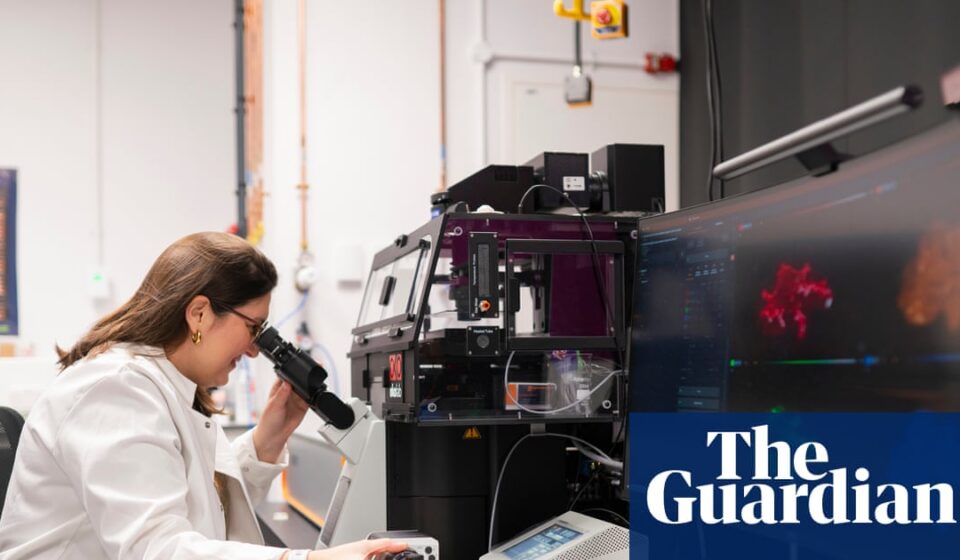

A one-of-a-kind microscope at the Rosalind Franklin Institute in Oxfordshire could help scientists better understand inflammatory bowel disease (IBD) and speed the search for more targeted treatments, researchers say. Unveiled this month and nicknamed “Curie”, the device uses stimulated emission depletion (STED) microscopy to resolve structures down to about 20 nanometres — roughly ten times the resolution of conventional light microscopes — allowing detailed imaging of the cells that line the gut and other organs.
IBD, including Crohn’s disease and ulcerative colitis, affects a growing number of young people worldwide. According to the British Society of Gastroenterology, more than half a million people in the UK live with IBD, and experts say the condition is most often diagnosed between the ages of 15 and 40, a period critical for education, work and relationships.
STED works with two lasers and fluorescent tags. The first laser excites labelled features inside cells so they glow. A second, doughnut-shaped laser overlaps that area and “switches off” fluorescence around the outer ring, leaving a tiny central spot to be detected. That narrowing of the light source produces much higher resolution images than conventional fluorescence microscopy, enabling researchers to tell apart structures that sit very close together.
The Curie system includes additional capabilities that make it unique in the UK. Deformable mirrors correct optical distortions caused by samples, so clear images can be taken from deeper within relatively thick tissues and organoids. A temperature-controlled stage keeps living cells and mini-organs near normal body temperature, permitting experiments that mimic physiological conditions.
“What this microscope technology and what the science we do in the lab can bring is really to understand the mechanism [of IBD] better,” said Dr Karina Pombo-Garcia, a group leader at the institute. PhD student Dimitrios Ioannidis is using the instrument to track how the protein complexes that form protective barriers in the intestine change from fetal development to adulthood. “If the structure changes, so does the function,” he said, noting that comparing healthy and diseased tissue could reveal root causes of conditions such as IBD.
The launch was accompanied by a government funding announcement: £67m for the Rosalind Franklin Institute from April 2027 over five years, and £95m for the Henry Royce Institute for the same period, funded via the Engineering and Physical Sciences Research Council through UK Research and Innovation’s 2025 spending review. The move comes amid wider pressures on UK science: the Science and Technology Facilities Council has said it needs to find £162m in savings by 2030, and several national facilities on the same Harwell campus face projected funding reductions of about 15%, a situation that research leaders say risks services and projects. Researchers say Curie’s imaging power offers fresh hope that deeper insight into disease mechanisms will lead to better, more targeted therapies.
Original Source: https://www.theguardian.com/society/2026/sep/14/new-microscope-discovery-hopes-incurable-inflammatory-bowel-disease-crohns-science-treatment
Category:
Tags:
Publish Date: 2026-09-15 00:51:00