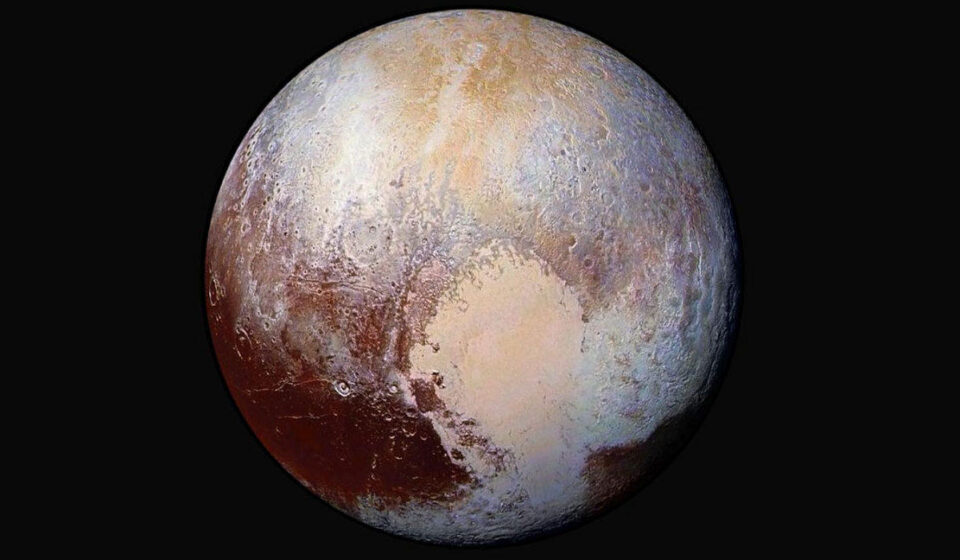

Twenty years after the International Astronomical Union voted in August 2006 to strip Pluto of its planet status, the former ninth planet remains a dwarf planet and a subject of public debate. The IAU’s decision followed new discoveries at the edge of the solar system and established formal criteria for what counts as a planet; the change still draws high-profile voices, with billionaire Jared Isaacman — who the source says now serves as NASA Administrator — urging Pluto’s reinstatement and actor William Shatner objecting to that idea.
The immediate spark for the 2006 debate was the 2005 discovery of a distant, Pluto-sized object nicknamed Xena by its discoverers and officially named Eris by the IAU. Because Eris is roughly Pluto’s size and shares similar traits, its discovery prompted astronomers to clarify what should be called a planet, rather than expanding the list indefinitely.
The IAU set three requirements for a solar system body to be a planet: it must orbit a star (for our system, the Sun); it must be large enough that its gravity makes it roughly spherical; and it must have cleared other objects of similar size from its orbital neighborhood. Bodies that meet the first two conditions but not the third were designated dwarf planets, and everything else orbiting the Sun that is neither a planet nor a dwarf planet was placed in a third category, “small solar system bodies.”
Those definitions reflect how scientific understanding has evolved. “For example, large asteroids like Ceres, Pallas and Vesta that orbit between Mars and Jupiter were originally considered planets when they were discovered in the early 1800s,” astrophysicist David Gerdes told CNET. “As more and more asteroids were discovered in this region, it eventually became clear that these objects were simply the biggest members of a very large population. Today, we know of over a million asteroids — so many that we call that region the ‘asteroid belt’ — and nobody considers them planets.”
Gerdes acknowledged that the labels provoke debate but argued there are limits to how the word “planet” can be defined. “These definitions are somewhat arbitrary, and people still like to debate them,” he said. “But one thing is certain: There’s no way to define a ‘planet’ that includes Pluto without also adding other objects like Eris, Sedna, Makemake and Ceres to the list.”
At the time of the 2006 decision, IAU president Ron Ekers noted that modern observations have revealed many outer-solar-system objects comparable in size to Pluto. “Modern science provides much more knowledge than the simple fact that objects orbiting the sun appear to move with respect to the background of fixed stars,” he wrote in August 2006. “For example, recent new discoveries have been made of objects in the outer regions of our solar system that have sizes comparable to and larger than Pluto. These discoveries have rightfully called into question
Original Source: https://www.cnet.com/science/space/20-years-since-astronomers-decided-pluto-isnt-a-planet/
Category:
Tags:
Publish Date: 2026-08-25 01:27:00